Introduction
The Coombs Site in Utah provides important evidence for the early stages of sedentary life among communities traditionally associated with the Basketmaker period of the American Southwest.
The Basketmaker period represents a crucial stage in Southwestern prehistory.
During this period, communities increasingly combined agriculture with older hunting and gathering traditions.
People began living for longer periods in fixed settlements, cultivating crops, constructing specialized architecture, and developing new technologies.
The pithouses of sites such as Coombs provide an unusually valuable record of this transition.
What Was a Pithouse?
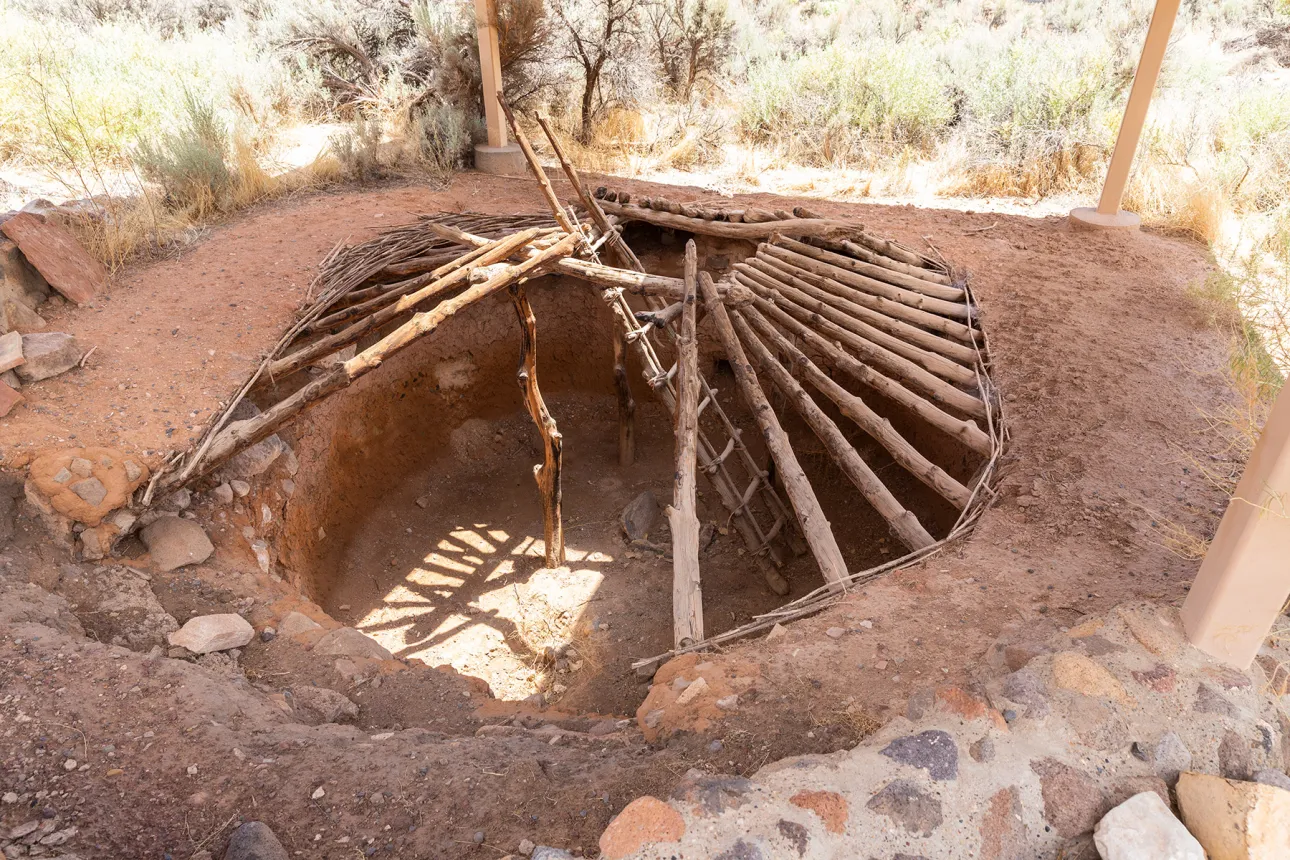
A pithouse is a structure partially dug into the ground.
Instead of constructing an entire building above the surface, builders excavated a shallow depression and constructed walls and a roof above it.
This design had practical advantages.
The surrounding earth helped moderate temperature.
In hot weather, partially underground rooms could remain relatively cool.
During cold periods, the enclosed structure could retain heat more effectively than an exposed surface shelter.
Construction
Building a pithouse required organized labor.
People had to excavate the floor, construct walls, install roof supports, and create an entrance.
Timber was required for structural components.
The roof could then be covered with branches, grasses, earth, or other materials.
Although these structures might appear simple, their design reflects practical architectural knowledge.
Basketmaker Communities
The Basketmaker period takes its name partly from the remarkable basketry produced by Southwestern communities.
Basketry was essential for:
carrying food;
storing materials;
gathering wild plants;
transporting water;
and organizing household activities.
Basket technology could be highly sophisticated.
The ability to produce strong, lightweight containers was especially important for mobile or semi-sedentary communities.
Agriculture
Basketmaker communities increasingly incorporated agriculture into their economies.
Maize became particularly important.
Growing maize changed food production dramatically because it allowed communities to produce predictable food resources under suitable environmental conditions.
However, agriculture did not immediately replace hunting and gathering.
Instead, Basketmaker economies were often mixed.
People continued to hunt animals and collect wild plants.
This flexibility reduced the risks associated with unpredictable harvests.
Hunting
Projectile points and other stone tools provide evidence of hunting.
Animals supplied meat as well as materials.
Bones and hides could be used for tools, clothing, cords, and other purposes.
Hunting therefore remained an important economic activity even as farming expanded.
Food Processing
Agricultural foods required processing.
Stone grinding equipment could be used to process maize and other plant foods.
Grinding transformed hard grains into meal or flour that could be cooked into more digestible foods.
Such tools provide archaeologists with direct evidence of household food preparation.
Social Life Inside Pithouses
The pithouse was more than a shelter.
It could become the center of household life.
Families could cook, sleep, work, socialize, and perform rituals within the same structure.
The architecture therefore offers clues about social organization.
Changes in pithouse design through time can also reveal changing patterns of household life.
Communal Activities
Some pithouses were larger than ordinary residential structures.
These larger spaces may have supported communal gatherings or ceremonial activities.
The distinction between domestic and ritual architecture was not necessarily absolute.
Ancient communities could use the same structure for multiple purposes depending on season, event, or social context.
Basketmaker Technology
Basketmaker communities developed a diverse technological toolkit.
Stone tools were essential.
Bone tools were also used.
Fiber technologies allowed people to manufacture:
sandals;
cords;
baskets;
nets;
mats;
and other objects.
These materials often survive poorly archaeologically.
Consequently, preservation of organic materials at some Southwestern sites provides unusually valuable information.
Settlement and Mobility
The development of pithouses indicates increasing investment in particular places.
Building a substantial structure makes sense when people expect to return repeatedly.
Nevertheless, Basketmaker communities remained more mobile than many later Pueblo societies.
People could move seasonally between agricultural areas and locations offering wild resources.
This combination of mobility and settlement was a defining characteristic of early Southwestern farming societies.
Environmental Knowledge
The success of Basketmaker communities depended upon detailed knowledge of the landscape.
People needed to understand:
rainfall patterns;
planting seasons;
wild plant availability;
animal movements;
water sources;
and soil conditions.
Such knowledge accumulated over generations.
Cultural Transformation
The Basketmaker period represents one stage in a long process of Southwestern cultural development.
Later Pueblo societies would construct larger settlements, develop new architectural forms, produce increasingly specialized pottery, and participate in wider exchange networks.
The early pithouse communities therefore form part of the foundation of later Southwestern traditions.
Conclusion
The Coombs Site is important because it helps illuminate a transformative period in American prehistory.
The pithouses represent more than an architectural innovation.
They reveal changing relationships between people, agriculture, technology, household organization, and landscape.
Basketmaker communities did not abandon their earlier hunting and gathering traditions when they began farming.
Instead, they created flexible economies combining cultivation with long-established environmental knowledge.
The Coombs Site therefore provides a valuable glimpse into the gradual transformation from highly mobile lifeways toward more settled Southwestern communities.