Introduction
The Forestdale Valley of eastern Arizona preserves archaeological evidence associated with the Mogollon tradition, one of the major cultural traditions of the ancient American Southwest.
The Mogollon occupied areas of present-day Arizona, New Mexico, and northern Mexico for many centuries.
Their communities developed distinctive architectural, agricultural, technological, and artistic traditions.
Forestdale Valley is particularly significant for its evidence of pithouse settlements, which provide insight into how ancient Southwestern communities organized households and adapted to highland environments.
The Mogollon Tradition
The term Mogollon refers to a broad archaeological tradition rather than a single unified ethnic group.
Communities associated with the tradition varied through time and region.
Nevertheless, archaeologists recognize recurring characteristics, including:
pithouse architecture;
agriculture;
distinctive pottery traditions;
hunting and gathering;
stone tool production;
and increasingly permanent settlement.
Pithouses as Homes
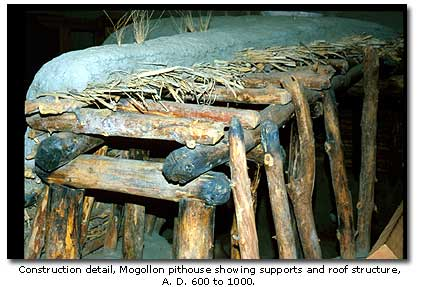
Pithouses were partially underground dwellings.
Their design was highly practical.
Excavating the floor into the earth created natural insulation.
The structure could remain cooler during warm periods and retain heat during colder weather.
A roof supported by wooden beams enclosed the living space.
The entrance often incorporated a ladder or passage.
Household Organization
A pithouse could serve as the center of household life.
Activities included:
food preparation;
sleeping;
tool production;
social interaction;
storage;
and possibly ritual activity.
Archaeological deposits on floors can preserve traces of these activities.
Burned seeds, animal bones, stone flakes, pottery fragments, and hearth remains can reveal what happened inside.
Agriculture
Mogollon communities practiced agriculture while continuing to rely on wild resources.
Maize was fundamental.
Beans and squash could complement the agricultural system.
Agriculture provided calories but also introduced environmental risks.
Drought, frost, pests, and poor harvests could threaten food security.
The combination of farming, hunting, and gathering provided greater resilience.
The Importance of Hunting
Game animals remained an important resource.
Deer and smaller animals provided meat, while bones and hides could be transformed into tools and other materials.
Hunting also required knowledge of seasonal animal movements and local habitats.
This demonstrates that farming did not make communities disconnected from the natural environment.
Pottery
One of the most distinctive features of Mogollon archaeology is pottery.
Mogollon pottery traditions developed over time and eventually became highly sophisticated.
Ceramics could be used for:
cooking;
storage;
transportation;
serving food;
and ceremonial purposes.
Decorative styles also provide evidence for regional interaction and cultural change.
Technological Production
Stone tools were essential for daily life.
People manufactured cutting tools, scraping implements, projectile points, grinding equipment, and other objects.
Manufacturing left behind flakes and broken tools.
These archaeological remains allow researchers to reconstruct technological processes even when finished tools have disappeared.
Community Development
Over time, some Mogollon communities became increasingly sedentary.
The development of substantial houses indicates greater investment in specific locations.
Permanent or semi-permanent settlements also encouraged social relationships.
Households could cooperate in agriculture, construction, exchange, and ceremonial activities.
Landscape Adaptation
Forestdale Valley's environment required careful adaptation.
Elevation influenced temperature and growing seasons.
Water availability determined agricultural possibilities.
Forests and grasslands supplied fuel, timber, game, and wild plants.
People therefore interacted with multiple ecological zones.
Interaction With Other Southwestern Communities
Mogollon communities were not isolated.
Trade and cultural interaction connected them to neighboring regions.
Materials and pottery styles demonstrate relationships extending across considerable distances.
Cultural boundaries were therefore not rigid.
Ideas, technologies, and objects moved between communities.
Archaeological Interpretation
Pithouses are especially valuable because their floors can preserve activity areas.
A concentration of grinding stones might indicate food processing.
Charcoal can provide evidence of burning.
Animal bones can reveal diet.
Stone flakes can identify tool production.
Archaeologists can therefore reconstruct household behavior by examining the spatial distribution of artifacts.
Conclusion
Forestdale Valley provides a valuable perspective on the Mogollon world.
Its pithouses reveal communities that combined agriculture with hunting and gathering while adapting to the environmental conditions of eastern Arizona.
The archaeological record demonstrates that these people possessed sophisticated knowledge of architecture, food production, craft technology, and landscape management.
The pithouse may appear modest when compared with later Southwestern pueblos, but it represents an important stage in the development of settled community life.
Forestdale Valley therefore helps explain how ancient Southwestern societies gradually transformed their relationships with architecture, agriculture, and place.