The ancient Dian Kingdom was a powerful society that developed around the region of Lake Dian in present-day Yunnan Province. Flourishing during the late first millennium BCE and into the early imperial period, Dian became known for its distinctive bronze objects, elaborate burial practices, and artistic depictions of human and animal life.
The archaeological remains of Dian demonstrate that southwestern China possessed complex societies with cultural traditions that differed significantly from those of the Yellow River heartland.
The Land Around Lake Dian
Lake Dian provided an important environmental setting for ancient communities.
The surrounding region offered access to:
freshwater,
agricultural land,
fish,
animal resources,
and transportation routes.
These resources helped support permanent settlements and increasingly complex political structures.
Yunnan's position also connected it with regions to the south and west, making it an important zone of cultural interaction.
The Dian Kingdom in Historical Records
The Dian Kingdom appears in historical sources associated with the expansion of the Han Empire into southwestern China.
Chinese historical accounts describe Dian as an established political entity.
Eventually, the Han government incorporated the region into its expanding imperial system.
Archaeological discoveries provide an independent source of evidence for understanding Dian society.
Bronze Technology
Bronze played a central role in Dian material culture.
Artisans produced:
weapons,
vessels,
ornaments,
animal figures,
and elaborate ceremonial objects.
The quality and complexity of these objects demonstrate highly developed metallurgical knowledge.
Bronze casting required specialized craftsmen and access to valuable raw materials.
Bronze Drums
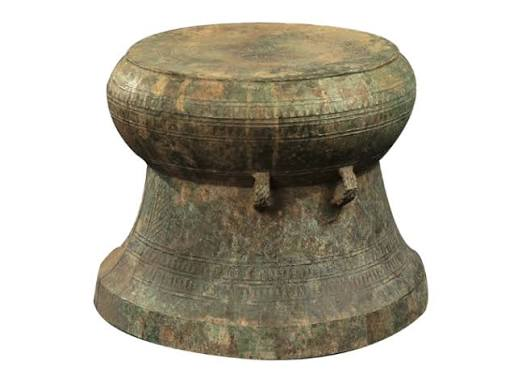
Bronze drums are among the most famous objects associated with ancient Southeast Asia and southwestern China.
These large drums were cast from bronze and often decorated with complex designs.
They could serve multiple purposes, including:
ritual ceremonies,
communication,
displays of authority,
and elite status.
The manufacture of a large bronze drum required advanced technical skill.
A failed casting could waste valuable materials, making successful production a significant achievement.
Images of Daily Life
One of the most valuable aspects of Dian bronze art is its representation of human activities.
Some bronze objects depict scenes involving:
warfare,
hunting,
agriculture,
animals,
ceremonies,
and elite authority.
These images provide rare visual evidence for a society that left relatively limited written records of its own.
Social Hierarchy
The archaeological evidence suggests that Dian society was socially stratified.
Elite tombs contained large quantities of prestige goods.
These included:
bronze objects,
weapons,
ornaments,
and ceremonial artifacts.
The concentration of valuable objects in certain burials suggests differences in wealth and status.
Animals in Dian Art
Animals appear frequently in Dian artifacts.
Bronze artists created detailed representations of:
cattle,
horses,
birds,
tigers,
and other creatures.
These animals may have represented practical aspects of life, religious symbolism, or political power.
The exact meaning of individual images can vary.
Dian and Long-Distance Trade
The location of Yunnan allowed Dian society to participate in networks extending toward:
central China,
Southeast Asia,
the Himalayan region,
and other parts of Inner Asia.
The movement of goods and technologies helped shape the region's cultural development.
Dian was therefore not isolated.
It participated in a broader world of exchange.
The Han Expansion
During the Han Dynasty, Chinese imperial power expanded into southwestern regions.
The relationship between the Han state and Dian involved diplomacy, political incorporation, and administrative change.
Over time, the political independence of the Dian Kingdom declined.
However, local cultural traditions did not simply disappear overnight.
Archaeological evidence demonstrates that cultural interaction and transformation were gradual processes.
Conclusion
The Dian Kingdom was one of the great Bronze Age and early historic societies of southwestern China.
Its bronze drums, artistic depictions, elite tombs, and sophisticated metalwork reveal a complex culture shaped by the geography of Yunnan and its connections with neighboring regions.
The archaeology of Dian demonstrates that ancient Chinese history cannot be understood solely through the civilizations of the Yellow River. Regional societies such as Dian developed their own political traditions, artistic styles, and technological achievements.