The Shizhaishan tomb complex is one of the most important archaeological sites associated with the ancient Dian culture of Yunnan. Located near Lake Dian, the site contains elite burials that produced a remarkable collection of bronze, gold, silver, jade, and other artifacts.
The tombs provide some of the most detailed archaeological evidence for the political hierarchy, artistic traditions, and ritual practices of the Dian Kingdom.
The phrase “Cloud Dream Coffins” evokes the extraordinary richness of these burials, although the archaeological importance of Shizhaishan lies primarily in its evidence for Dian elite society rather than in a single standardized “cloud dream” burial type.
The Discovery of Shizhaishan
Archaeological excavations at Shizhaishan revealed numerous tombs containing valuable objects.
Many of the graves belonged to individuals of high social status.
The richness of the burial goods immediately demonstrated the existence of a powerful elite.
The site became central to the archaeological study of the Dian Kingdom.
Elite Burials
Elite tombs contained objects that were not available equally to every member of society.
These included:
bronze drums,
weapons,
ornaments,
animal sculptures,
gold objects,
and ritual vessels.
The quantity and quality of these materials suggest that social status was expressed through burial.
Funerals may have served not only as ceremonies for the dead but also as public demonstrations of political authority.
Coffins and Burial Construction
The construction of an elite burial required significant labor.
Workers had to prepare the grave, construct or arrange the burial space, and place the deceased alongside selected objects.
Organic materials such as wood often decay, meaning that the surviving archaeological evidence may represent only part of the original burial.
Archaeologists must therefore reconstruct burial practices using traces preserved in the soil.
Bronze Drums as Prestige Objects
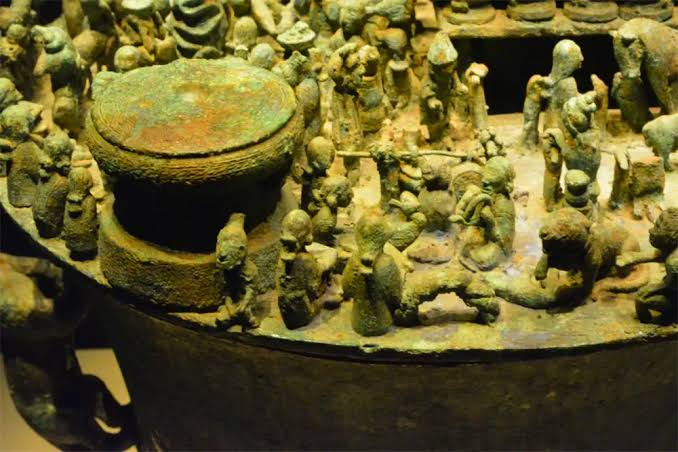
Bronze drums were among the most important objects found in the Dian cultural region.
Because of the technical difficulty involved in their production, they represented considerable wealth and skill.
A drum could function as:
a musical instrument,
a ceremonial object,
a symbol of authority,
or an item of prestige.
Its placement in a tomb could emphasize the status of the deceased.
The Art of Dian Bronze
Shizhaishan produced bronze objects with highly detailed imagery.
Some depict human beings and animals in active scenes.
These artifacts provide evidence about clothing, weapons, transportation, and social activities.
For archaeologists, such imagery is especially valuable because it supplements the information obtained from bones and artifacts.
Horses and Warfare
Horse imagery and equipment indicate the importance of horses in Dian society.
Horses could serve in:
transportation,
elite display,
communication,
and military activity.
Weapons recovered from tombs demonstrate that warfare was also an important aspect of political life.
Control of military resources could help maintain elite authority.
Gold and Silver
The presence of gold and silver objects demonstrates access to valuable materials and skilled craftsmanship.
Precious metals were often associated with elite identity.
The ability to obtain and control such materials suggests participation in wider networks of exchange.
The Dian King's Seal
One of the most famous discoveries associated with Dian archaeology is a gold seal linked with the King of Dian.
The seal provides important evidence because it connects archaeological material with the historical relationship between the Dian Kingdom and the Han Empire.
Objects such as seals were instruments of political authority.
They could authenticate documents and symbolize official recognition.
Death and Political Authority
Elite burials often provide information about how political authority was expressed.
The objects placed with an important individual could communicate:
wealth,
military power,
religious significance,
family identity,
and political status.
The tomb therefore became a permanent statement about the position of the deceased within society.
Why Shizhaishan Matters
Shizhaishan is essential for understanding the Dian Kingdom because it preserves an unusually rich collection of elite material culture.
The site demonstrates:
social hierarchy,
advanced bronze production,
long-distance exchange,
ritual practices,
and political development.
Conclusion
The Shizhaishan tombs preserve the material world of the ancient Dian elite.
Their bronze drums, weapons, precious metals, animal figures, and ceremonial objects reveal a complex society organized around political power and social hierarchy.
The site provides a powerful reminder that Yunnan was home to sophisticated ancient civilizations with their own artistic traditions and political institutions.