Introduction
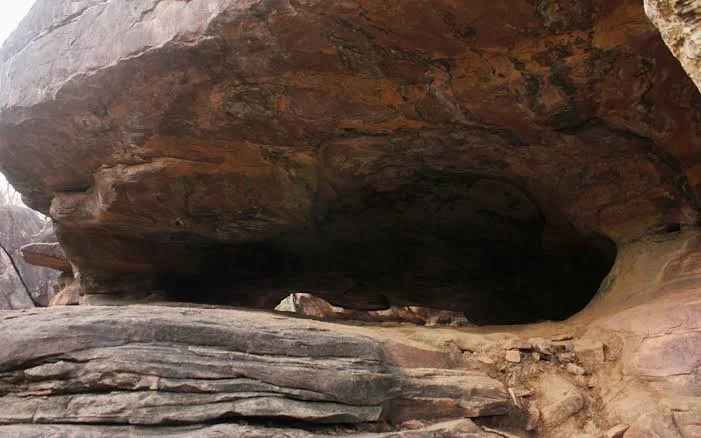
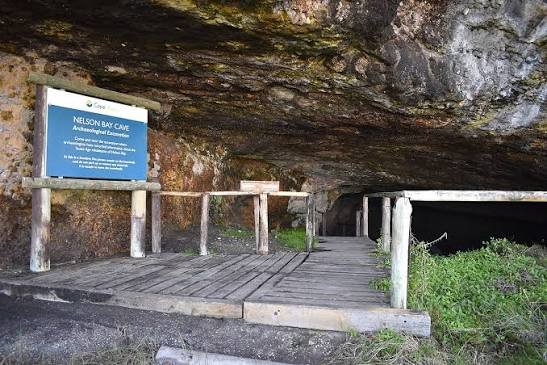
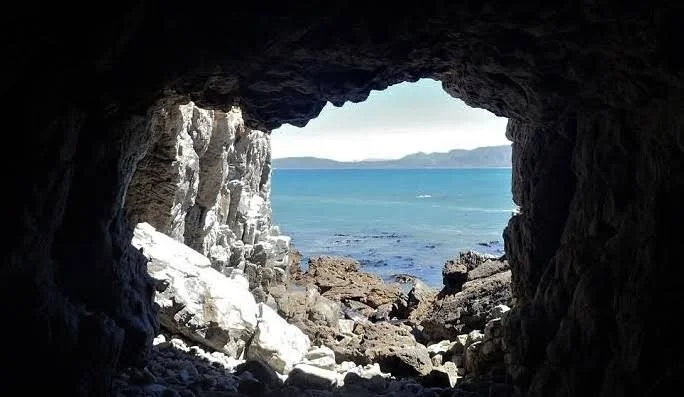
Die Kelders Cave, situated on the coast of Walker Bay in South Africa’s Western Cape, is an important archaeological site for understanding the Middle Stone Age and the behaviour of early modern humans and their predecessors.
The cave is significant because its deposits preserve evidence of ancient human occupation, stone-tool technology, animal remains, and environmental conditions along the southern Cape coast. The site has been investigated through multiple excavations, including research designed to improve understanding of its stratigraphy, fossil assemblages, and chronology.
The Middle Stone Age is a major period in African prehistory, associated with diverse stone-tool technologies and important developments in human behaviour. Sites such as Die Kelders allow researchers to investigate how people used coastal environments, processed resources, and adapted to changing climatic conditions.
The Coastal Environment
Die Kelders overlooks Walker Bay, where rocky shores, marine resources, and inland habitats formed part of the surrounding environment. Coastal settings could offer shellfish and other marine foods, while nearby land provided access to terrestrial animals and plant resources.
The cave’s location also shaped the archaeological record. Sediment could accumulate through natural processes, while people and animals introduced bones, artefacts, and other materials. Changes in sea level and coastal erosion altered the surrounding landscape over time.
Understanding the site requires researchers to distinguish between materials deposited by people and those introduced by natural processes. Animal bones may represent food remains, predator activity, or animals that entered the cave independently. Sediment may have been transported by wind, water, or movement from the cave walls and ceiling.
These processes influence how well archaeological materials are preserved and how confidently they can be interpreted.
The Middle Stone Age
The Middle Stone Age is an archaeological period associated with distinctive stone-tool traditions and a wide range of behaviours among ancient populations in Africa. It includes technologies involving prepared stone cores, flakes, points, and other forms that varied across regions and time.
Stone tools provide evidence of how people selected raw materials and shaped them into implements. Researchers study the sequence of removals on a stone core to reconstruct manufacturing techniques and investigate whether different artefacts were produced for particular tasks.
The Middle Stone Age should not be viewed as a single, uniform cultural period. Its technologies changed over time, and different communities developed different approaches according to local resources, traditions, and needs.
Die Kelders contributes to this broader record by preserving deposits that can be compared with other Middle Stone Age sites in southern Africa. Such comparisons help researchers investigate technological diversity and the timing of changes in behaviour.
Excavations and Stratigraphy
Research at Die Kelders has included renewed excavations designed to improve understanding of the site’s archaeological sequence. A published study of the 1992, 1993, and 1995 field seasons describes work that enlarged the artefact and faunal samples, investigated cave-formation processes, and generated additional chronological information for the Middle Stone Age layers. <Cite refs={["turn487166search2"]} />
Stratigraphy refers to the arrangement and relationships of sediment layers. In an archaeological cave, the order of these layers can provide information about the sequence of deposition and occupation.
However, stratigraphy is not always straightforward. Burrowing animals, water movement, erosion, and the collapse of cave material can disturb deposits. Researchers therefore examine sediment characteristics and the position of artefacts and fossils before deciding whether a layer represents a distinct period.
The preservation of different layers can also vary. Some deposits may retain a rich collection of artefacts, while others contain relatively little evidence of human activity. This difference may reflect occupation patterns, environmental conditions, or preservation processes.
Dating the Middle Stone Age Deposits
Researchers use several dating techniques to establish the age of Die Kelders’ archaeological layers. Depending on the material and context, these can include electron spin resonance, thermoluminescence, and optically stimulated luminescence.
These methods do not all date the same event. Some estimate the time since mineral grains were last exposed to sunlight, while others examine changes in minerals caused by radiation. The interpretation of a result depends on the sample and the conditions under which it was buried.
A reliable chronology requires more than a single numerical estimate. Researchers compare dates from different samples, evaluate the stratigraphic sequence, and consider whether the dated material is directly associated with the archaeological evidence.
The resulting timeline helps establish when people used the cave and how their activities relate to broader changes in the region.
Diet and the Use of Marine Resources
The animal remains at Die Kelders provide evidence for the resources available to ancient communities. Marine animals, shellfish, and terrestrial mammals can reveal how people interacted with coastal and inland environments.
Researchers examine the species represented, the condition of the bones, and the presence of cut marks or burning. These features can help determine whether animals were processed by people and how their remains entered the archaeological deposits.
The presence of marine resources is particularly relevant to discussions of human adaptability. Coastal environments can provide valuable food, but access to these resources depends on local conditions, tides, seasonality, and the availability of suitable gathering or fishing locations.
It would be misleading, however, to assume that all inhabitants relied equally on seafood or that coastal food was always more important than terrestrial resources. Diet must be reconstructed from the full range of available evidence.
Die Kelders and the Evolution of Human Behaviour
Middle Stone Age sites are important for investigating the development of complex human behaviour. Stone-tool manufacture, resource planning, mobility, and the use of different environments all contribute to understanding how ancient populations lived.
Yet no single artefact or food remain can establish the full cognitive capacities of a population. Archaeologists look for recurring patterns across multiple sites and types of evidence.
Die Kelders is particularly valuable because it adds a coastal perspective to the archaeological record. Comparisons with inland sites can help researchers investigate whether communities used different technologies or subsistence strategies in different environments.
These comparisons also highlight the importance of chronology. Two assemblages that appear similar may represent different periods, while differences between assemblages may reflect environmental conditions rather than a fundamental cultural divide.
Conservation and Research
Cave sites are fragile archaeological resources. Excavation permanently changes a deposit, so careful recording and curation are essential. Coastal erosion and uncontrolled access can also threaten the preservation of the site.
Continued research can improve the understanding of existing collections through modern dating, microscopic analysis, and new approaches to studying animal remains and stone tools.
Conclusion
Die Kelders is a significant Middle Stone Age site that contributes to our understanding of ancient human occupation along South Africa’s southern coast. Its archaeological deposits preserve evidence of stone-tool technology, animal use, and environmental change.
The site demonstrates why the Middle Stone Age must be studied through a combination of archaeology, geology, and environmental science. Its evidence helps researchers reconstruct the diverse ways ancient populations used landscapes and adapted to changing conditions.