Introduction
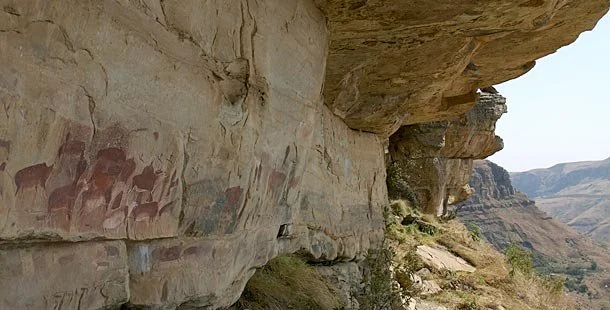
The Drakensberg Mountains of South Africa contain one of the most important concentrations of San rock paintings in southern Africa. Shelters beneath sandstone cliffs preserve images of animals, human figures, and complex scenes that provide evidence of Indigenous artistic traditions and cultural beliefs.
The phrase “4,000-Year Scenes” refers to the possibility of a long chronological history for the region’s rock art. However, it should not be taken to mean that every painting in the Drakensberg is exactly four thousand years old. The art was created over a range of periods, and the age of individual images can be difficult to establish.
The Drakensberg paintings are especially important because they combine detailed observation of the natural world with images that may express spiritual ideas, ritual practices, and relationships between humans and animals. They also demonstrate that the mountain landscape was not simply a physical environment but a place of cultural meaning.
The Drakensberg Landscape
The Drakensberg forms part of the Great Escarpment of southern Africa. Its high cliffs, deep valleys, grasslands, and sandstone shelters create a varied landscape that has supported human activity over long periods.
The shelters offer protection from wind and rain, while the surrounding mountains and valleys provide habitats for wildlife and plant resources. Water sources and routes through the landscape would also have influenced where people travelled and gathered.
The rock surfaces inside sheltered overhangs can preserve pigment better than exposed cliff faces. Nevertheless, moisture, mineral deposits, biological growth, and changes in temperature can gradually damage paintings.
The distribution of rock art across the Drakensberg suggests repeated human engagement with particular locations. However, the presence of paintings does not by itself prove that a shelter was permanently occupied. Some places may have been visited intermittently or used for specific activities.
The San and Their Artistic Traditions
The San are Indigenous peoples with deep historical connections to southern Africa. Their communities have diverse histories, languages, and cultural traditions, and the archaeological record should not be treated as a single, unchanging San culture.
San rock paintings in the Drakensberg often depict eland and other animals, human figures, and scenes that combine people and animals in unusual ways. Some figures appear to be dancing, bending, running, or interacting with animals. Other images are more difficult to interpret.
The artists demonstrated considerable skill in representing animal anatomy and movement. Their paintings can communicate action through body posture, relative size, and the arrangement of figures. Such details provide evidence of close observation and sophisticated artistic practice.
However, the meaning of a painting cannot always be recovered from its visual appearance. Researchers must consider the archaeological context and relevant cultural knowledge before deciding whether a scene represents hunting, ritual activity, or another subject.
Why Eland Appear So Frequently
Eland are among the most recognisable animals in Drakensberg rock art. These large antelope held important roles in several documented San belief systems and appear frequently in southern African paintings.
Eland may be depicted in naturalistic form, with recognisable body proportions, horns, and movement. In some compositions, the animal appears alongside human figures or within scenes interpreted as ritual or symbolic.
Ethnographic research among San communities has helped scholars understand the spiritual significance that eland held in some traditions. In certain accounts, the animal is associated with potency, healing, and ceremonial life.
These interpretations provide important context, but they should not be applied automatically to every image. The significance of an animal could vary by community, period, and setting. Researchers must distinguish evidence from a particular tradition from broader assumptions about all San rock art.
The Relationship Between Art and Spiritual Practice
Some Drakensberg paintings have been interpreted in relation to San spiritual beliefs and healing ceremonies. Human figures may appear in unusual postures, and certain compositions combine human and animal characteristics in ways that do not correspond directly to ordinary observation.
Researchers have connected some of these images with beliefs involving spiritual potency, transformation, and interactions between different aspects of existence. In some documented San traditions, ritual specialists entered altered states of consciousness during healing ceremonies, and rock art has been studied as a possible expression of related experiences.
Nevertheless, not every unusual figure should be labelled a shaman or every scene interpreted as a ceremony. A careful analysis considers the full composition, the location of the art, patterns repeated at other sites, and the limits of the ethnographic evidence.
The original meanings of many paintings may remain uncertain. Recognising that uncertainty does not diminish the art’s significance; it acknowledges that ancient artists worked within cultural systems that cannot always be reconstructed completely.
Dating the Paintings
The age of Drakensberg rock art varies. Some paintings may be several thousand years old, while others were produced more recently. The phrase “4,000-year” therefore describes a broad chronological possibility, not a universal date for all scenes.
Dating rock paintings is challenging because pigments often lack suitable organic material for direct radiocarbon analysis. Researchers may use scientific analyses of pigment or mineral deposits, the relationship between art and archaeological layers, and comparisons with other documented works.
Stylistic differences can help researchers organise paintings into broad traditions, but style alone does not provide an exact date. Similar motifs may persist over long periods, and paintings can be added to the same shelter by different artists.
The result is a chronological record that must be assembled from multiple sources of evidence rather than from the visual appearance of an image alone.
What the Scenes Reveal About Daily Life
Not all rock art is necessarily religious. Some images may reflect hunting, animals, human movement, or other aspects of life. The distinction between practical and symbolic imagery is not always clear, however, because the natural world could also have spiritual significance.
Animal depictions demonstrate knowledge of wildlife, while human figures can reveal how artists represented bodies, groups, and movement. The choice of shelter and the arrangement of paintings may also have influenced how images were viewed by people visiting the site.
Archaeologists compare rock art with stone tools, animal remains, and other evidence of occupation. This approach helps situate paintings within the wider history of the region without assuming that every image has one obvious meaning.
Conservation and Indigenous Perspectives
Drakensberg rock art is vulnerable to weathering, vandalism, uncontrolled visitation, and accidental damage. Pigment can deteriorate when surfaces are touched or exposed to unsuitable cleaning methods.
Conservation includes documenting the paintings, controlling access where necessary, monitoring environmental changes, and educating visitors. The involvement of Indigenous communities and relevant heritage organisations is essential when interpreting and protecting culturally significant places.
San heritage should also be presented as part of a living history. Contemporary San communities should not be portrayed as remnants of a vanished past, and ancient paintings should not be used to make unsupported assumptions about modern identities.
Conclusion
Drakensberg San art is a major part of South Africa’s cultural and archaeological heritage. Its paintings reveal sophisticated artistic techniques, close observation of animals, and cultural traditions that connected people with the surrounding landscape.
The reference to four-thousand-year-old scenes should be understood cautiously because the paintings span different periods and cannot all be assigned the same date. Their interpretation requires a combination of archaeological evidence, scientific analysis, and relevant Indigenous knowledge.
By preserving these works and explaining them responsibly, researchers and heritage organisations can help future generations understand the Drakensberg not only as a mountain landscape but also as a place of enduring cultural significance.