Dun Beag is one of the best-preserved broch towers on the Isle of Skye and provides an excellent example of Scotland's distinctive Iron Age monumental architecture.
Brochs are circular dry-stone towers found exclusively in Scotland, particularly in northern and western regions.
Dun Beag demonstrates that these structures were not simply defensive buildings. Their architecture also communicated status, wealth, engineering ability, and social organization.
What Is a Broch?
A broch is a circular stone tower constructed with two concentric walls.
The space between the walls often contains:
stairs;
chambers;
passageways;
and structural features.
The central interior was generally open to the sky or contained timber structures supporting upper levels.
Construction
Dun Beag has thick stone walls.
Its entrance is reached through a narrow passage.
Door-checks indicate that the entrance could be secured with a wooden door.
The architecture demonstrates careful planning and sophisticated dry-stone construction.
Defensive Features
Dun Beag occupies a rocky hilltop overlooking Loch Bracadale.
Its position provides excellent visibility across the surrounding landscape.
The narrow entrance and substantial walls offered defensive advantages.
However, archaeologists increasingly caution against interpreting every broch primarily as a military fortress.
Symbols of Status
The enormous effort required to build a broch suggests that social status was an important component of its design.
A broch could serve as a residence for an elite household.
Its monumental architecture would have communicated power to people living in the surrounding territory.
Internal Chambers
Dun Beag contains small chambers within the thickness of its walls.
One ground-level chamber may have functioned as a guardroom or storage space.
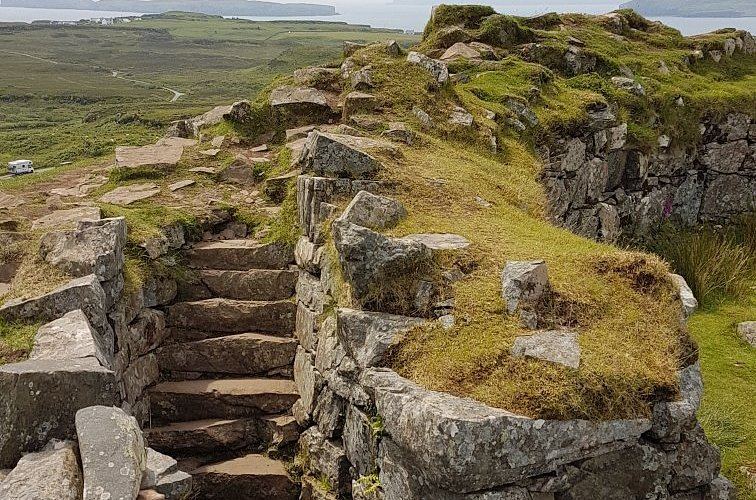
A surviving stone staircase provides access within the wall structure.
Approximately twenty steps survive from one section of the staircase.
Height
The original height of Dun Beag is unknown.
Comparisons with better-preserved brochs suggest that it may once have reached approximately ten meters.
The surviving structure is considerably lower.
Long-Term Occupation
Evidence suggests that Dun Beag may have remained significant after its original Iron Age construction.
Medieval and later coins were reportedly recovered during excavations in the early twentieth century.
These finds do not necessarily prove continuous occupation, but they indicate that people returned to the site at later periods.
Brochs and Iron Age Society
More than 500 broch sites are known in Scotland.
Their distribution is particularly dense in:
Orkney;
Shetland;
Caithness;
Sutherland;
the Hebrides;
and western Scotland.
Their construction reflects distinctive regional traditions in prehistoric architecture.
Why Were Brochs Built?
Several explanations have been proposed.
They may have served as:
elite residences;
defensive settlements;
community gathering places;
symbols of authority;
storage centers;
or combinations of these functions.
The answer may have differed from one broch to another.
Conclusion
Dun Beag: Skye's Broch Tower provides an exceptional example of Iron Age Scottish architecture.
Its thick dry-stone walls, internal chambers, staircase, narrow entrance, and commanding position reveal sophisticated construction.
More importantly, Dun Beag demonstrates that prehistoric monumental buildings could communicate both security and social prestige.
Rather than viewing the broch simply as a fortress, it is better understood as a complex social building whose architecture reflected the organization and ambitions of Iron Age communities.