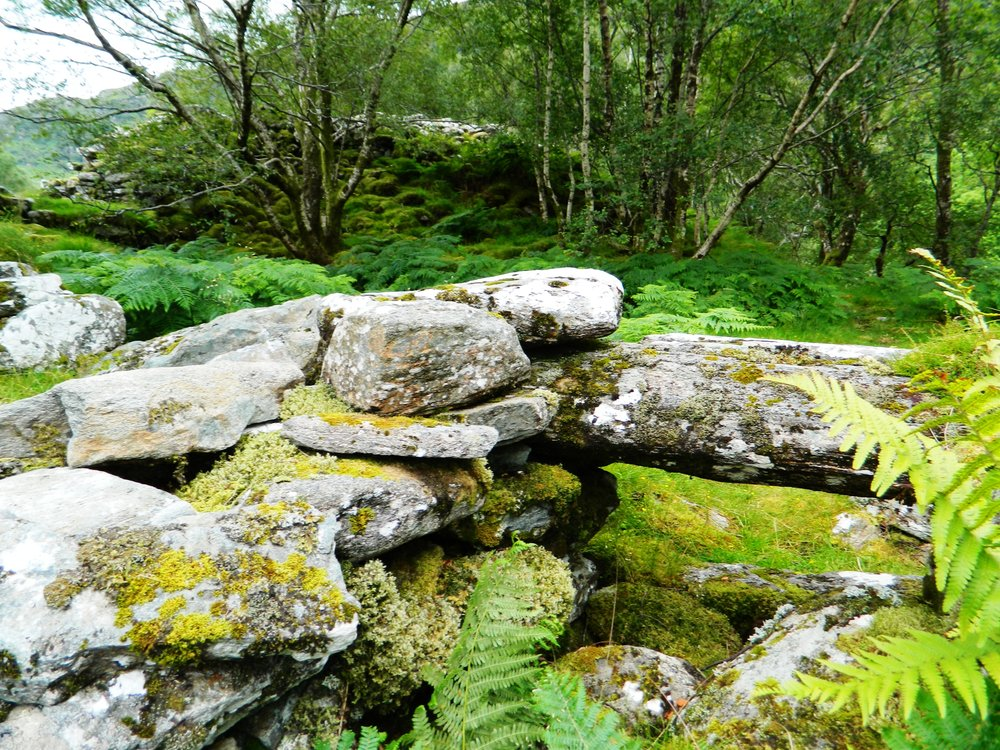
Dun Grugaig is associated with the distinctive Iron Age architecture of western Scotland and is particularly interesting because of its relationship to the wheelhouse tradition.
Wheelhouses are circular stone structures in which internal radial walls or piers create a plan resembling the spokes of a wheel.
They are particularly characteristic of the Iron Age Atlantic zone.
The Wheelhouse Tradition
Wheelhouses are concentrated especially in:
the Western Isles;
parts of Skye;
the northern Highlands;
and other areas of Atlantic Scotland.
Their construction reflects regional architectural traditions.
Circular Design
The basic principle of a wheelhouse is straightforward but ingenious.
A circular outer wall surrounds a central area.
Inside, stone piers project inward.
These create compartments or bays around the central space.
The arrangement resembles the spokes of a wheel.
Engineering Advantages
The internal piers may have helped support a roof.
Stone architecture presents a major challenge because large spans are difficult to cover without timber.
By using internal supports, builders could create more manageable structural spans.
Social Function
Wheelhouses were not necessarily purely defensive.
Archaeological evidence from comparable sites suggests that some were occupied as residences.
Activities could include:
cooking;
craft production;
storage;
animal management;
and domestic life.
Brochs and Wheelhouses
The relationship between brochs and wheelhouses is complex.
Both belong to the broader Iron Age architectural tradition of Atlantic Scotland, but they are not identical structures.
Some sites combine characteristics of both forms.
This demonstrates that prehistoric architecture was flexible.
Builders could adapt established designs to local needs.
The Highland Environment
Glenelg's mountainous and coastal environment provided access to:
stone;
marine resources;
grazing land;
woodland resources;
and maritime routes.
The location of prehistoric settlements must therefore be understood in relation to the surrounding landscape.
The Importance of Architecture
Architecture provides information about prehistoric society even when written records are absent.
The size and complexity of a structure can reveal:
labor organization;
technical knowledge;
social hierarchy;
and settlement patterns.
Archaeological Caution
The exact chronology and function of individual structures in the Glenelg region can be difficult to reconstruct because many sites have been disturbed by later activity.
Therefore, interpretations should distinguish established architectural features from hypotheses about their use.
Conclusion
Dun Grugaig: Glenelg's Wheelhouse Broch represents the remarkable architectural diversity of Iron Age western Scotland.
Its wheelhouse tradition illustrates how prehistoric builders combined circular planning, dry-stone engineering, and internal supports to create sophisticated buildings.
The site contributes to a broader understanding of how Iron Age communities adapted architecture to local environmental and social conditions.