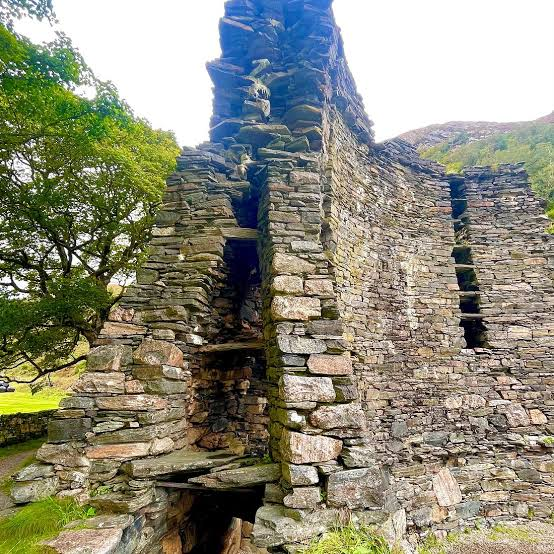
Dun Troddan is one of Scotland's most remarkable surviving Iron Age brochs.
Located near Glenelg and close to Dun Telve, the structure forms part of a distinctive prehistoric landscape where two monumental circular towers were constructed within the same general area.
The survival of Dun Troddan provides archaeologists with valuable evidence for prehistoric architecture, construction techniques, and social organization.
A Twin to Dun Telve
Dun Troddan is often described alongside Dun Telve because of their geographical proximity and similar architectural traditions.
Both demonstrate the characteristic double-wall construction associated with brochs.
Their closeness has made Glenelg an important destination for studying Scottish Iron Age architecture.
Circular Architecture
The central feature of Dun Troddan is its circular plan.
The builders constructed:
an outer wall;
an inner wall;
internal galleries;
stairways;
and chambers.
This created a highly specialized architectural form.
The Entrance
The entrance was deliberately narrow and controlled.
Broch entrances commonly contained architectural features that allowed occupants to regulate access.
These could include:
doorways;
guard chambers;
door-checks;
and stone-built passageways.
Such features demonstrate that movement through the building was carefully controlled.
The Internal Staircase
One of the most impressive features of Dun Troddan is its surviving internal staircase.
The staircase was incorporated into the thickness of the wall.
This is a characteristic feature of many brochs.
It demonstrates that the wall itself functioned as usable architectural space.
A Tall Tower
Dun Troddan is unusually well preserved.
Its surviving walls allow archaeologists to visualize how a complete broch may have appeared.
The original upper levels are not completely preserved, so the precise height remains uncertain.
However, comparisons with other brochs suggest that some structures could have risen many meters above ground level.
Defense or Residence?
The traditional interpretation of brochs emphasized defense.
Their thick walls and restricted entrances certainly provided defensive advantages.
However, a purely military interpretation does not explain all broch features.
The internal spaces may have supported residential activity and social gatherings.
The broch could therefore have functioned as a fortified residence belonging to an influential household.
Social Power
Building Dun Troddan would have required substantial resources.
Large quantities of stone had to be:
quarried or collected;
transported;
shaped;
positioned;
and carefully stacked.
The ability to coordinate this work indicates a degree of social organization.
The Two Brochs of Glenelg
The existence of Dun Troddan and Dun Telve together makes Glenelg particularly valuable.
The monuments demonstrate that broch construction was not an isolated phenomenon.
Rather, it formed part of a regional tradition.
Conclusion
Dun Troddan: Glenelg's Twin Broch represents one of Scotland's finest surviving examples of Iron Age dry-stone architecture.
Its internal staircase, massive walls, and carefully controlled entrance provide insight into both engineering and social organization.
Together with Dun Telve, it makes Glenelg an exceptional archaeological landscape for studying Scotland's prehistoric monumental.