Introduction
The Engis Caves, located near Liège, Belgium, occupy a unique place in the history of paleoanthropology. In 1829, nearly three decades before the famous Neander Valley discovery in Germany, Dutch physician Philippe-Charles Schmerling excavated human fossils from the caves, including the skull of a prehistoric child that was later recognized as one of the earliest known Neanderthal specimens. Although its significance was not fully understood at the time, the Engis discovery eventually became one of the foundational pieces of evidence for the existence of an extinct human species.
Early Excavations
Schmerling carefully excavated several cave chambers, recovering fossilized human bones alongside stone tools and the remains of extinct Ice Age animals such as cave bears, mammoths, woolly rhinoceroses, and reindeer. His systematic approach was unusual for the early nineteenth century, when archaeology was still in its infancy.
Initially, many scholars assumed that the unusual skull belonged to an anatomically modern human because the concept of extinct human species had not yet gained scientific acceptance.
The Engis Child
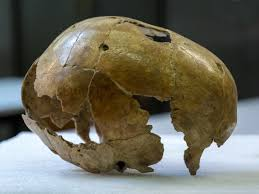
The most famous fossil from the cave is the partial skull of a young child, now known as Engis 2. Modern analyses have identified the specimen as belonging to a Neanderthal child approximately 2 to 4 years old.
The fossil exhibits several Neanderthal characteristics, including a long, low cranial shape and distinctive facial proportions. Because children's skulls are less robust than those of adults, the Neanderthal features are subtler than in later discoveries, explaining why its significance remained unrecognized for many years.
Archaeological Context
Stone tools recovered from the cave belong primarily to the Mousterian tradition, characterized by prepared-core flake technology associated with Neanderthal populations. Animal bones bearing cut marks indicate systematic hunting and butchering activities, while hearth remains demonstrate regular use of fire.
The cave's archaeological sequence provides evidence for repeated occupation during different climatic phases of the Pleistocene.
Historical Importance
Although the Neanderthal fossils discovered in Germany's Neander Valley became internationally famous in 1856, historians now recognize that the Engis child represents the first scientifically recovered Neanderthal fossil. The site therefore occupies a central place in the history of human evolutionary research.
Conclusion
The Engis Caves are among the most historically significant archaeological sites in Europe. Their early fossil discoveries, Mousterian artifacts, and Ice Age faunal remains have made the caves a cornerstone in the scientific study of Neanderthals and human evolution.