• MAIN PAGE
  • LATEST NEWS
    • Lost Cities
    • Archaeology's Greatest Finds
    • Underwater Discoveries
    • Greatest Inventions
    • Studies
    • Blog
  • PHILOSOPHY
  • HISTORY
  • RELIGIONS
    • Africa
    • Anatolia
    • Arabian Peninsula
    • Balkan Region
    • China - East Asia
    • Europe
    • Eurasian Steppe
    • Levant
    • Mesopotamia
    • Oceania - SE Asia
    • Pre-Columbian Civilizations of America
    • Iranian Plateau - Central Asia
    • Indus Valley - South Asia
    • Japan
    • The Archaeologist Editor Group
    • Scientific Studies
    • Aegean Prehistory
    • Historical Period
    • Byzantine Middle Ages
    • Predynastic Period
    • Dynastic Period
    • Greco-Roman Egypt
  • Rome
  • PALEONTOLOGY
  • About us
Menu

The Archaeologist

  • MAIN PAGE
  • LATEST NEWS
  • DISCOVERIES
    • Lost Cities
    • Archaeology's Greatest Finds
    • Underwater Discoveries
    • Greatest Inventions
    • Studies
    • Blog
  • PHILOSOPHY
  • HISTORY
  • RELIGIONS
  • World Civilizations
    • Africa
    • Anatolia
    • Arabian Peninsula
    • Balkan Region
    • China - East Asia
    • Europe
    • Eurasian Steppe
    • Levant
    • Mesopotamia
    • Oceania - SE Asia
    • Pre-Columbian Civilizations of America
    • Iranian Plateau - Central Asia
    • Indus Valley - South Asia
    • Japan
    • The Archaeologist Editor Group
    • Scientific Studies
  • GREECE
    • Aegean Prehistory
    • Historical Period
    • Byzantine Middle Ages
  • Egypt
    • Predynastic Period
    • Dynastic Period
    • Greco-Roman Egypt
  • Rome
  • PALEONTOLOGY
  • About us

Excavating the British tin trade that shaped the Bronze Age

January 20, 2026

In 2025, we published a study in Antiquity showing, through chemical and isotopic analysis, that around 1300 BC tin ingots produced from ores in southwest Britain were transported as far as the coast of Israel, where they were recovered from shipwrecks some 4,000 km away.

We also demonstrated that tin from the Rochelongue shipwreck, discovered off southern France and dated to around 600 BC, likewise originated in southwest Britain. We concluded by stressing the importance of surveying and excavating potential coastal sites linked to tin trade—and soon acted on that recommendation.

Just one week after publication, we travelled to St Michael’s Mount in Cornwall to begin fieldwork in partnership with the Cornwall Archaeological Unit and the National Trust. This well-known tidal island has long been associated with Ictis, the tin trading island described by the Greek writer Pytheas around 320 BC in the earliest written account of Britain.

The most recent archaeological work on St Michael’s Mount involved a series of narrow construction trenches monitored between 1995 and 1998, which produced pottery evidence of Late Bronze Age and Early Iron Age activity (c. 1100–400 BC). The site’s potential was further underscored in 2009 by the accidental discovery of a large and remarkable Late Bronze Age bronze hoard dating to c. 1100–800 BC, containing objects commonly found across southern Britain, northern France, and beyond.
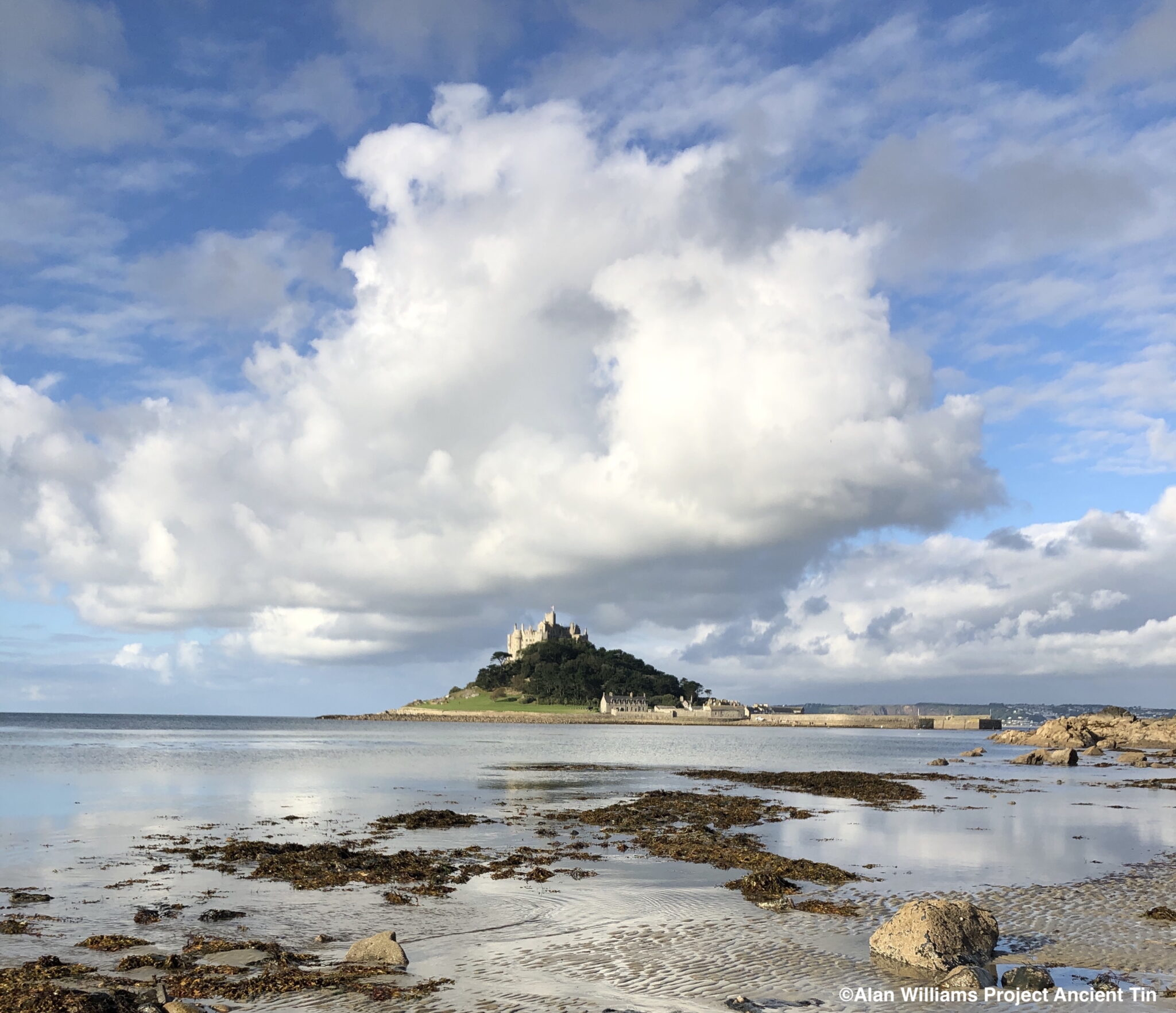
St Michael’s Mount near Penzance in Cornwall. Thought by many to be the island of Ictis, first described around 320 BC, and mentioned in later classical texts as a tin trading centre from where tin was shipped to France and reached the Mediterranean in 30 days.

Our excavations uncovered a substantial circular stone structure containing large amounts of Late Bronze Age and Early Iron Age pottery, along with flint flakes and stone tools. Analysis of the tools’ surfaces—first using portable XRF and then scanning electron microscopy (SEM)—showed that they had been used to crush tin ore. Further post-excavation work is now underway, including detailed analyses and an extensive programme of radiocarbon dating for the structure and its associated features. If confirmed, this would represent the first direct evidence of prehistoric tin production and trade on St Michael’s Mount.

We plan to publish the full results in due course. In the meantime, those interested in our fieldwork can see more in the new series of Digging for Britain, for which our team was filmed.
← One of Europe’s Most Mysterious Languages May Share Ancient Roots with IberianIce Age engraving discovered in Moravian Karst cave →
Featured
image_2026-01-20_105118178.png
Jan 20, 2026
Hiker stumbles across ancient rock paintings in Kayseri
Jan 20, 2026
Read More →
Jan 20, 2026
image_2026-01-20_104501751.png
Jan 20, 2026
Italy Uncovers Basilica Designed by Vitruvius, the 'Father of Architecture'
Jan 20, 2026
Read More →
Jan 20, 2026
image_2026-01-20_104230286.png
Jan 20, 2026
The project is being undertaken by the Calton Hill Conservation Trust in partnership with Headland Archaeology, a firm with headquarters in Leith.
Jan 20, 2026
Read More →
Jan 20, 2026
image_2026-01-20_103506416.png
Jan 20, 2026
One of Europe’s Most Mysterious Languages May Share Ancient Roots with Iberian
Jan 20, 2026
Read More →
Jan 20, 2026
image_2026-01-20_103157808.png
Jan 20, 2026
Excavating the British tin trade that shaped the Bronze Age
Jan 20, 2026
Read More →
Jan 20, 2026
image_2026-01-20_103119172.png
Jan 20, 2026
Ice Age engraving discovered in Moravian Karst cave
Jan 20, 2026
Read More →
Jan 20, 2026
read more

Powered by The archaeologist