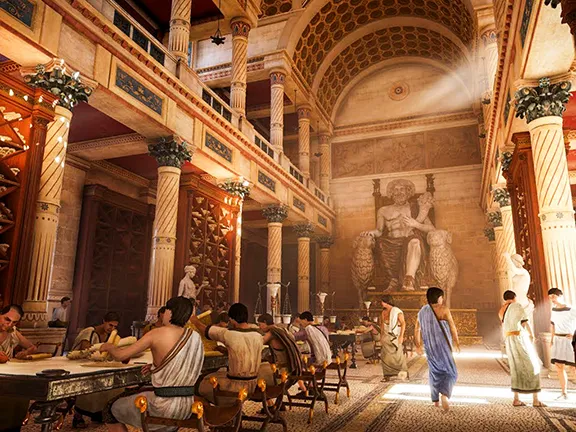
Deserts are often imagined as empty and lifeless. Yet beneath their shifting sands lie some of the most remarkable archives in human history. In remote oases, ruined cities, and abandoned cave complexes, ancient script depositories once preserved knowledge that might otherwise have vanished forever.
These were the forgotten libraries of antiquity—hidden not behind palace walls, but beneath dunes and inside cliffside chambers.
Why the Desert Preserves the Past
Dry climates are surprisingly protective. In regions where moisture is scarce, organic materials such as papyrus, parchment, and cloth can survive for centuries. What rots in humid environments can endure in arid ones.
This is why sites like Oxyrhynchus have yielded thousands of papyrus fragments. Discarded texts buried in rubbish mounds were preserved by Egypt’s dry sands. These fragments include literary works, administrative records, private letters, and religious writings—offering insight into daily life and intellectual traditions.
Monasteries and Hidden Script Repositories
Some desert libraries were intentionally protected. In the cliffs near the Nile, early Christian communities stored texts in jars and sealed chambers. The discovery of manuscripts near Nag Hammadi in 1945 revealed a cache of early Christian and Gnostic writings hidden for over 1,500 years.
These texts survived precisely because they were placed in isolation, away from political and religious turmoil.
Knowledge Along Desert Trade Routes
Deserts were not barriers—they were highways. Caravans moved across North Africa and Central Asia, linking civilizations. Along these trade routes, scribes recorded contracts, religious texts, scientific treatises, and poetry.
In the Sahara, the manuscript tradition of cities like Timbuktu flourished. Though later in date, these libraries demonstrate how desert scholarship thrived in remote settings. Thousands of handwritten manuscripts on law, astronomy, medicine, and theology were carefully preserved in family collections.
Libraries Lost to Sandstorms and Time
Not all desert libraries survived intact. Many were buried by advancing dunes or destroyed by conflict. In Central Asia, ancient Buddhist cave complexes once housed scriptural scrolls, some rediscovered in the early 20th century after centuries of concealment.
Each rediscovered archive reshapes our understanding of vanished cultures. These texts reveal languages, philosophies, and scientific knowledge that might otherwise have disappeared from history.
Silent Shelves Beneath the Sand
The forgotten desert libraries remind us that knowledge is fragile. It can be lost through war, neglect, or natural forces. Yet sometimes, the very environment that seems hostile becomes a guardian of memory.
Beneath layers of sand lie voices waiting to be heard again.