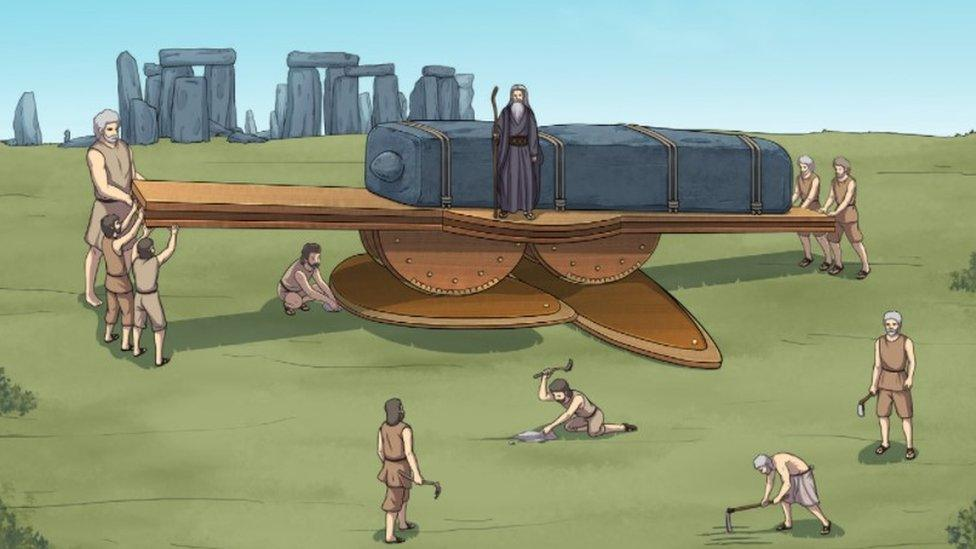
Scattered across the globe stand massive stones weighing dozens—or even hundreds—of tons. These megaliths were quarried, transported, and raised long before cranes or steel cables existed. Their sheer size raises a simple but powerful question: how were they moved?
The answer is still debated.
Monumental Stones Across Continents
In southern England, the towering blocks of Stonehenge were transported from distant quarries. Some of the smaller “bluestones” traveled over 200 kilometers before being arranged in a carefully aligned circle.
In the Andes, the precisely cut stones of Sacsayhuamán fit together so tightly that a blade cannot slip between them. Some blocks weigh more than 100 tons.
On Easter Island, the giant moai statues of Rapa Nui were carved from volcanic rock and transported across rugged terrain.
Theories of Transportation
Archaeologists propose several methods:
Rolling logs and sledges: Stones may have been placed on wooden rollers or dragged on sledges over lubricated paths.
Earthen ramps: Gradual slopes made from packed earth could have allowed builders to raise stones incrementally.
Human coordination: Large groups working in synchronized teams could shift enormous weight with ropes and leverage.
Recent experiments have demonstrated that coordinated human labor, combined with simple mechanical principles, can indeed move massive stones.
Engineering Without Modern Tools
Early builders understood balance, leverage, and counterweight systems. They may not have written formulas, but they applied physics effectively.
The precision of placement also suggests careful planning. Alignments with solstices and celestial events indicate that these stones were not only heavy—they were meaningful.
Why Build on Such a Scale?
Megalithic monuments likely served religious, social, or political purposes. Their scale communicated power and unity. Building them required cooperation, reinforcing community identity.
The Enduring Mystery
While practical explanations exist, not every detail is fully understood. How did builders quarry stones so precisely? How were routes chosen and maintained?
The stone giants stand as reminders of ancient ambition. They prove that early societies were capable of extraordinary engineering feats—without modern machinery.