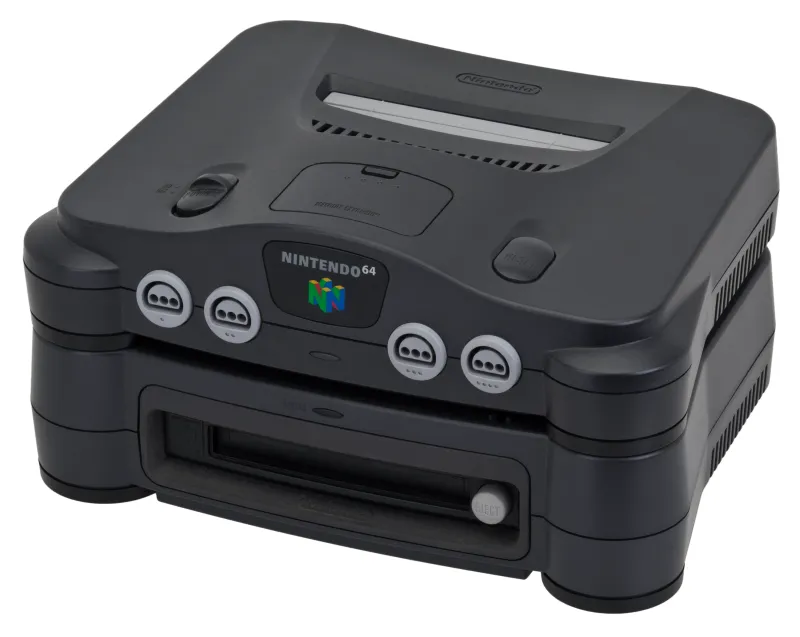
What if a Nintendo 64 cartridge-based game could also use a large-capacity magnetic disc format? That was the idea behind the Nintendo 64DD, explored in a recent video by [Skawo], which performs a kind of archaeological dive into the game’s code to uncover remnants of the abandoned peripheral.
The 64DD plugged into the bottom of the console via its peripheral connector, allowing the Nintendo 64 to read and write 64DD magnetic discs. At 64 MB, the discs matched the storage capacity of cartridges but had the added advantage of being writable — something cartridges and CDs could not offer. The concept followed in the footsteps of earlier expansions like the Famicom Disk System.
One notable project was a 64DD expansion for 1998’s The Legend of Zelda: Ocarina of Time, a Game of the Year title. Although both the expansion and the 64DD were ultimately cancelled, the recently decompiled Zelda source code still contains extensive traces of 64DD-related features, which [Skawo] examines in the video.
Like many CD- or magnetic-based formats, the 64DD suffered from slow access times and poor transfer speeds compared with a cartridge’s mask ROM. This clearly forced developers to rethink how to make the 64DD a meaningful enhancement. Since the 64DD was never released outside Japan and had a very short lifespan, it became evident that disc-based formats were a poor fit for the console’s design.
Looking at the game code, the intended interface with the 64DD mostly revolved around swapping on-cartridge resources — for example, using different dungeon maps. While this content eventually appeared commercially as the Master Quest option on the GameCube re-release, it shows what might have been.
Although features like tracking the player’s full route or permanently updating maps in-game never materialized, the surviving code offers a fascinating glimpse into the expansion possibilities the 64DD could have brought to Ocarina of Time.