Introduction
Flagghaugen is associated with the rich archaeological tradition of Viking Age burial monuments in Norway. Its popular interpretation as the grave of a "shield maiden" reflects the enduring fascination with female warriors in Scandinavian history and legend.
However, archaeological interpretation requires care. Terms such as "shield maiden" are modern descriptions influenced by literary traditions and popular culture. The presence of weapons or military equipment in a woman's grave does not automatically prove that she fought as a professional warrior.
Nevertheless, elite female burials containing weapons and other high-status objects provide important evidence that women could possess military symbolism, authority, wealth, or roles that extended beyond conventional domestic activities.
Women in Viking Age Society
Viking Age society was strongly hierarchical and gendered.
Men frequently occupied roles associated with warfare, political leadership, and long-distance raiding.
Women were commonly associated with household management, textile production, family organization, and agricultural responsibilities.
Yet archaeological evidence demonstrates that these categories were not absolute.
Women could own property, inherit wealth, manage estates, and occupy positions of considerable social influence.
Burial as Social Evidence
A grave is not necessarily a simple record of the person's occupation.
Burial rituals are constructed by the living.
Objects placed in a grave may represent the identity of the deceased, their family, their social position, or ideals that the community wished to associate with them.
A weapon might therefore indicate actual military participation, elite status, symbolic authority, or some combination.
The "Shield Maiden" Debate
The term shield maiden comes largely from medieval literary traditions.
Sagas and heroic narratives contain women portrayed as warriors.
However, many of these texts were written down centuries after the Viking Age.
Their descriptions cannot automatically be treated as direct historical records.
Archaeology provides a different kind of evidence.
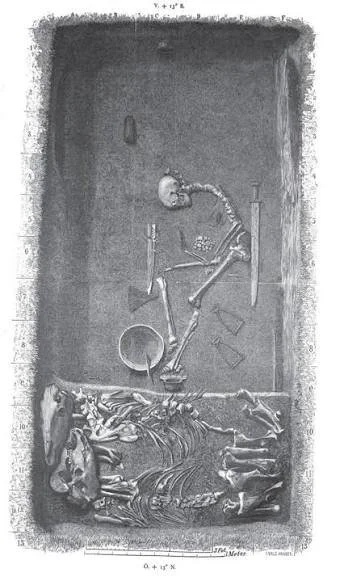
When weapons appear in women's graves, they establish that weapons could be part of female funerary symbolism.
They do not, by themselves, settle questions about battlefield participation.
Weapons and Identity
Weapons were powerful status symbols.
Swords, shields, spears, axes, and other military equipment represented considerable value.
A grave containing such objects therefore indicates access to wealth.
The symbolic importance of weapons could also extend beyond actual combat.
They could communicate authority, ancestry, social position, or membership in an elite group.
The Broader Viking Burial Tradition
Viking burials varied enormously.
Some individuals received elaborate ship burials.
Others were buried with minimal grave goods.
The differences likely reflect variations in wealth, social status, regional custom, and personal identity.
Flagghaugen belongs to this broader funerary landscape.
Women and Political Authority
Elite women could play important roles in political networks.
Marriage connected families.
Women could manage estates while men were absent.
They could oversee household resources and maintain relationships with neighboring communities.
A high-status burial may therefore reflect social power that cannot be reduced to a single occupational label.
Archaeological Caution
One of the most important lessons from sites such as Flagghaugen is the importance of evidence-based interpretation.
Archaeologists must distinguish:
what the excavation directly demonstrates;
what can reasonably be inferred;
what remains uncertain.
This distinction is especially important when interpreting gender and warfare.
Viking Age Gender Complexity
The Viking Age was not a society in which every individual fit neatly into modern categories.
Identity could involve ancestry, wealth, household position, religious role, political relationships, age, and personal reputation.
Burial objects formed part of the way these identities were communicated.
Conclusion
Flagghaugen's significance extends beyond the popular image of a female Viking warrior.
The site contributes to a much larger discussion about gender, identity, wealth, and power in Viking Age Scandinavia.
Whether the individual associated with the grave actually fought in battle may remain uncertain. What is clearer is that weapons and elite symbols could be incorporated into female funerary contexts, challenging simplistic assumptions about women's roles.
The archaeological record therefore presents a more complicated Viking world—one in which women could possess wealth, authority, and powerful symbols of status, while the precise meaning of those symbols must be interpreted carefully.
Flagghaugen reminds us that the Viking past is most fascinating when archaeological evidence is allowed to reveal complexity rather than being forced into simple heroic categories.