
Archaeologists are now three years into a five-year excavation at a Roman fort.
Earlier this year, the dig made headlines when eight unusually large shoes, each at least 30 cm (11.8 in) long—roughly a UK size 13–14—were uncovered at Magna Roman Fort in Northumberland. By comparison, only four or five shoes of this size have been found among the 5,000 discovered over 55 years at the nearby Vindolanda settlement in Hexham, according to Roman archaeology specialist Dr. Elizabeth Greene.
These oversized shoes were not the only significant finds of the year. One of the standout discoveries, according to archaeologist Rachel Frame, was a silver ring featuring a hare engraved on its gem.
“Archaeology isn’t always about the flashy finds,” she explained, “but then you have moments where you think, ‘wow, this is not something you see every day in your career.’
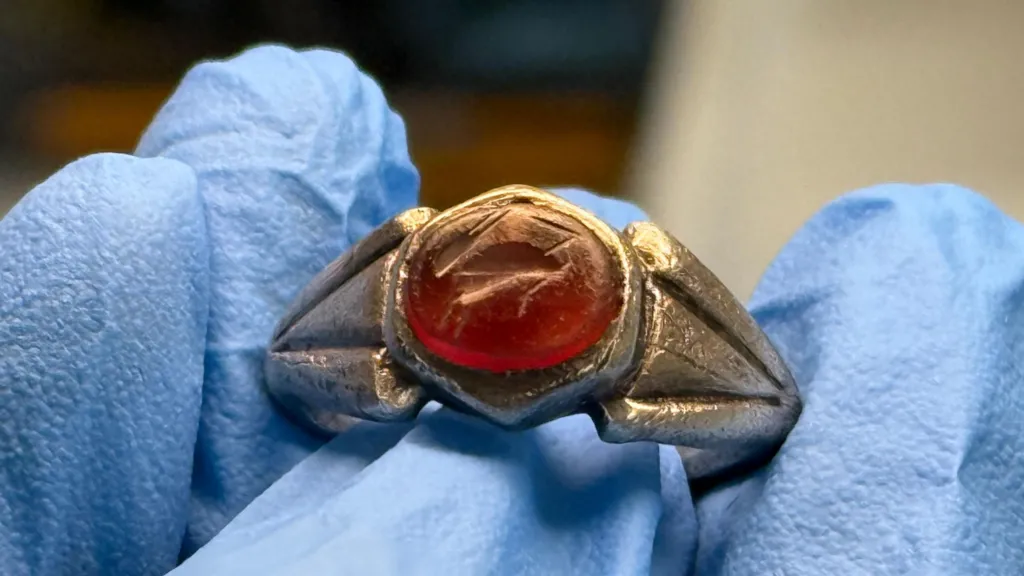
The team still do not know how old the inscribed ring is
Ms. Frame noted that after cleaning, the ring looked like something you could purchase in a jewelry store today and wear right away.
However, she added that it is still too soon to determine the ring’s precise history, as the team has yet to date the specific layers of soil where it was found.
“It’s one of the major research questions we’re looking to answer,” she said.

Hairpins are evidence that women spent time at the forts as well
Another discovery at the site included several hairpins crafted from animal bone.
Ms. Frame explained that these pins provide additional evidence that women and children also lived at Roman forts.
“Roman soldiers typically didn’t have long hair to style in elaborate ways,” she said.
“You can picture someone using a pin to secure their hair while working… it’s lovely to get these small insights into daily life.”
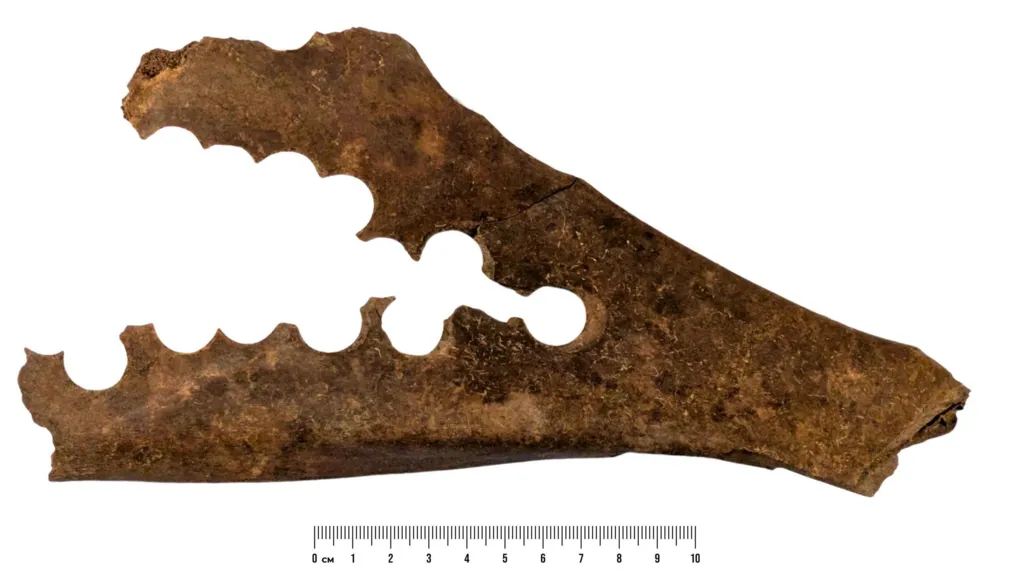
Roman soldiers may have used counters to gamble,
“I can tell this was a shoulder blade, but I don’t know why it’s full of holes,” she explained.
The team later determined that the bone had likely been used to make game counters.
“Romans used counters like this for different games and gambling,” she said.
Ms. Frame added that the person who made them was probably crafting them for themselves and their friends.
“It’s a small but fascinating glimpse into everyday life, rather than the usual image people have of Hadrian’s Wall,” she said.