Women in the Annual of the British School at Athens, 1895–1930
The first volume of the Annual of the British School at Athens (ABSA) was published in 1895, nearly a decade after the British School in Athens (BSA) was founded in 1886. The Annual was designed to report on archaeological work in Greece and to provide “more popular accounts of travel and research” alongside the Journal of Hellenic Studies. In the early volumes, almost all articles were written by directors and students of the School; producing an article was considered a standard outcome of a session in Greece.
During the late nineteenth and early twentieth centuries, the BSA was largely male-dominated, so most early articles were authored by men. Women, however, were admitted as early as 1890, and by the 1900s, a steady stream of women archaeologists came to Greece to conduct research at local sites and museums. This online collection highlights their contributions, gathering all articles written or co-written by women in the ABSA between 1895 and 1930. Together, these works provide a microhistory of women’s early contributions to archaeology in Greece.
Early Contributors
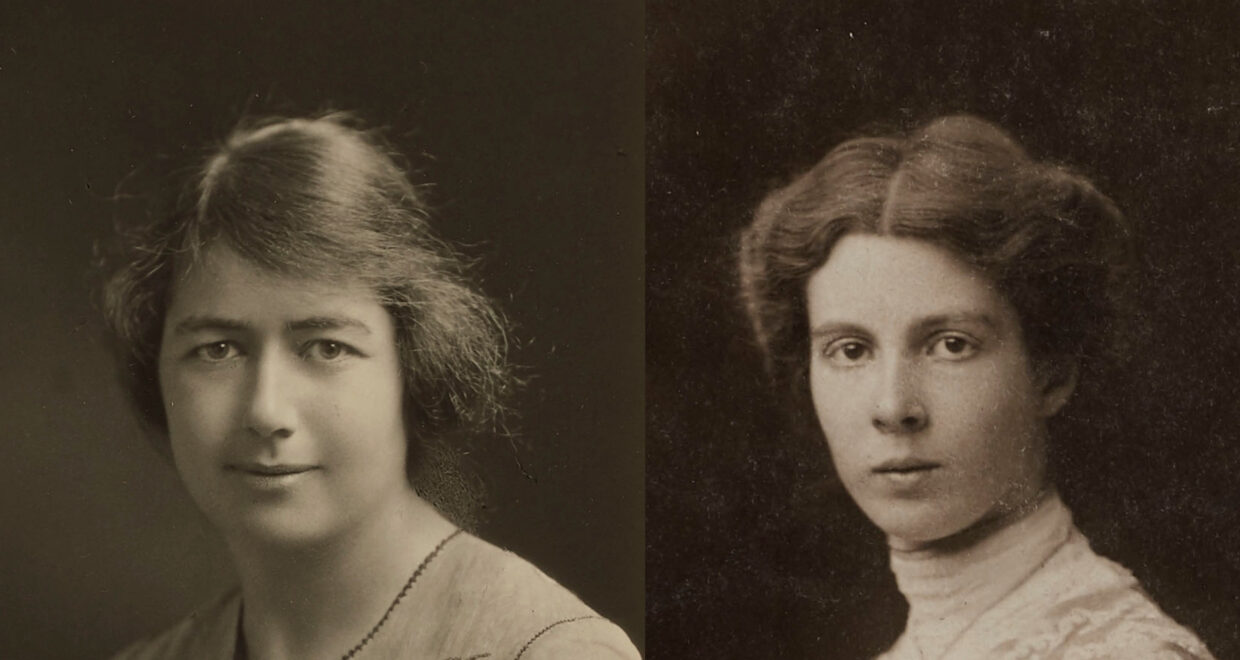
The earliest article in the collection was by Caroline Amy Hutton, who joined the BSA in 1896 to study Greek terracottas and later served as ABSA co-editor from 1906 to 1926. Her 1897 article argued for the importance of bronze statuettes in reconstructing Classical Greek marble sculpture. In 1916, Hutton also published articles on Greek inscriptions from Petworth House in England and Suvla Bay in Gallipoli, the latter in her capacity as editor.
In the same 1897 volume, Helène Triantaphyllides, an English-speaking Greek woman and BSA associate since 1896, published a study of modern Greek folklore and customs. Her research drew praise from Cecil Harcourt Smith, then Director of the School, who emphasized its value and the need for further work.
Jane Ellen Harrison, a scholar of ancient Greek religion at Newnham College, Cambridge, published in the ABSA in the early 1900s. Described by Mary Beard as “the first woman in England to become an academic,” Harrison was a member of the BSA Managing Committee from 1888 to 1919 and mentored women visiting Athens for research. Her ABSA articles cover Hellenistic relief sculpture and the identity of the Kouretes, and she also published extensively in the Journal of Hellenic Studies.
Women Students in the Early 1900s
The early twentieth century saw more women admitted as students. Notable contributors include:
Margery Welsh (later Daniel), Newnham College, Cambridge, admitted in 1903 to study Greek sculpture.
Gisela Richter, Girton College, Cambridge, admitted in 1904, later curator at the Metropolitan Museum of Art, New York.
Mary Hamilton (later Dickins), University of St Andrews, admitted in 1905, studying ancient and modern incubatio practices.
Dorothy Lamb, Newnham College, admitted in 1910, who worked on the Acropolis Museum catalogue in Athens.
Their ABSA articles, based on research conducted in Athens, covered topics from honorary statues and ancient ceramics to Christian saint names.
Funded Positions and Excavations
In 1911, Margaret Hardie (later Hasluck) became the first woman granted a funded position at the BSA, following advocacy from Jane Harrison. Her ABSA article explored the cult of Dionysus at Smyrna; she later conducted extensive work on Albanian society and folklore.
The 1920s brought more women into funded positions and allowed them to reside in the BSA hostel alongside male students. Women increasingly participated in excavations, reflected in ABSA publications. For example, Margaret Hobling reported on excavations at Sparta, while Winifred Lamb published on work at Sparta, Mycenae, and Thermi in Lesbos. Lamb went on to direct excavations in Greece and Turkey, serve as curator of Greek antiquities at the Fitzwilliam Museum (1920–1958), and co-found the British Institute at Ankara.
Collaborative Work
Some women co-authored articles with their husbands. Jacobus Johannes Ewoud Hondius and Magdalena Agathe Hondius-Van Haeften co-wrote on Laconian topography after their joint studies at the BSA. Hilda and John Pendlebury, who met at the BSA in 1927, published together on the 1930 excavations of two Protopalatial houses at Knossos.
Legacy of Early Women Archaeologists
This collection documents women’s research across the first decades of the BSA and ABSA, covering diverse periods and topics, from Mycenaean frescoes to Hellenistic sculpture to Spartan bronzes. It highlights the research achievements of these women and encourages interest in their travels, roles within British universities, and lives beyond academia. Some pursued celebrated archaeological careers, while others married and left the field—but in both cases, their work laid important foundations for archaeological research in Greece throughout the twentieth century.