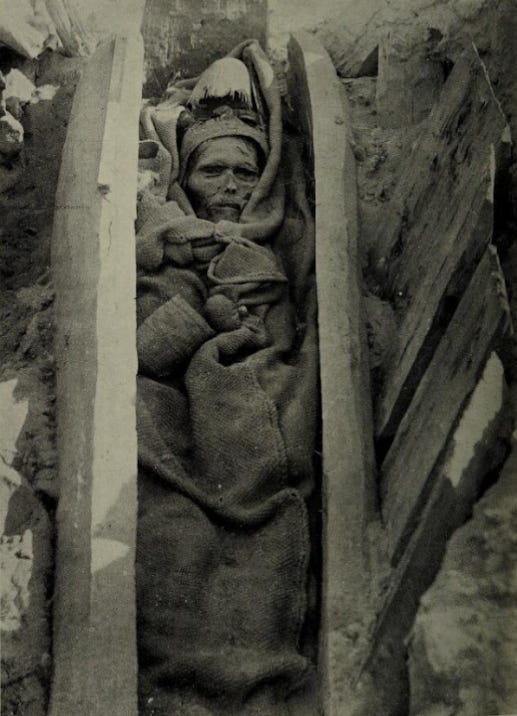
Gumugou Cemetery is an important Bronze Age burial site in the Tarim Basin of Xinjiang. The cemetery forms part of the broader archaeological record that has contributed to debates about the early populations of Central Asia and the later emergence of Indo-European-speaking communities in the region.
The term “Proto-Tocharian” is often used cautiously in discussions of ancient populations connected with the broader cultural and linguistic background of the Tarim Basin. However, archaeological remains alone cannot prove that a particular prehistoric population spoke a specific language.
This distinction is essential.
Burial customs, genetics, and material culture can provide evidence about ancient populations, but language must usually be reconstructed through later written records and linguistic analysis.
The Archaeological Context of Gumugou
Gumugou lies within the broader Tarim Basin cultural landscape.
The region contains numerous ancient cemeteries whose exceptional preservation has provided evidence for Bronze Age communities.
The dry environment allowed the survival of:
human remains,
wooden structures,
textiles,
and other organic materials.
These discoveries have allowed archaeologists to reconstruct aspects of prehistoric life with unusual detail.
Burial Practices
The graves at Gumugou reflect organized mortuary traditions.
The treatment of the dead involved deliberate placement within a cemetery landscape.
Burial practices can provide evidence about:
social organization,
cultural identity,
attitudes toward death,
and relationships between communities.
However, the exact beliefs behind these practices cannot be directly recovered.
A burial pattern may reflect tradition without revealing the specific stories or religious ideas associated with it.
The Question of the Tocharians
The Tocharians are historically known from manuscripts written in an Indo-European branch of languages discovered in the Tarim Basin.
These texts date to much later periods than the earliest Bronze Age cemeteries.
Because of this chronological gap, archaeologists cannot automatically identify early Bronze Age populations such as those associated with Gumugou as direct speakers of Tocharian languages.
The relationship between ancient populations, genetics, material culture, and language remains complex.
Genetics and Cultural Identity
Ancient DNA has demonstrated that the population history of the Tarim Basin was highly distinctive.
Early communities were not simply straightforward migrants from western Eurasia, despite older interpretations based partly on physical appearance and cultural similarities.
This has important implications for discussions of Proto-Tocharian identity.
A language can spread through:
migration,
trade,
intermarriage,
political influence,
or cultural interaction.
Therefore, genetic ancestry and language do not always correspond.
Textiles and Material Culture
The preservation of textiles in Tarim Basin cemeteries has provided important evidence about ancient craftsmanship.
Producing clothing required knowledge of:
fiber collection,
spinning,
weaving,
sewing,
and garment construction.
Textiles could also express cultural traditions through patterns and styles.
The people buried in these cemeteries were part of societies that possessed substantial technical knowledge.
Agriculture and Herding
Bronze Age populations in Xinjiang made use of both agricultural and pastoral resources.
Communities could cultivate crops while also raising animals.
This flexible economic strategy was particularly useful in the challenging environments surrounding the Tarim Basin.
Herding provided:
meat,
milk,
hides,
wool,
and transportation.
Agriculture added additional sources of food.
Why the Site Matters
Gumugou is important because it contributes to a larger picture of prehistoric Central Asia.
The Tarim Basin was not culturally isolated.
Communities interacted with neighboring populations and participated in the movement of technologies and agricultural practices across Eurasia.
At the same time, ancient-DNA research demonstrates that these communities retained distinctive population histories.
The Limits of Archaeological Labels
Terms such as “Proto-Tocharian” can be useful for organizing historical questions, but they should not be treated as proven identities when direct evidence is unavailable.
Archaeologists must distinguish between:
what a burial reveals,
what genetics reveals,
what language evidence reveals,
and what remains hypothetical.
This careful approach is particularly important in prehistoric studies.
Conclusion
Gumugou Cemetery provides valuable evidence for the Bronze Age communities of the Tarim Basin. Its burials, preserved materials, and broader archaeological context contribute to ongoing debates about population history, cultural interaction, and the possible origins of later societies in Xinjiang.
The connection between early Bronze Age populations and the later Tocharian-speaking world remains a complex historical question rather than a simple identification.
Gumugou is therefore important not only because of its archaeological remains but because it demonstrates how carefully archaeologists must separate evidence from interpretation.