Xiaohe Cemetery is one of the most distinctive Bronze Age burial sites ever discovered in the Tarim Basin. Located in the Xinjiang region of northwestern China, the cemetery became famous for its unusual wooden coffins, many of which have been described as boat-shaped.
The dry desert environment preserved not only human remains but also wood, textiles, plant materials, and other organic objects that would normally disappear from the archaeological record.
Xiaohe offers an exceptional opportunity to study a prehistoric community in remarkable detail.
The Discovery and Rediscovery of Xiaohe
The site became known to modern archaeology during the early twentieth century, although its remote location made systematic research difficult.
Later expeditions and archaeological investigations revealed the scale and complexity of the cemetery.
Xiaohe contained numerous burials arranged within a distinctive mortuary landscape.
The preservation of wooden structures was especially remarkable because wood rarely survives for thousands of years in most environments.
In the Taklamakan region, however, extreme dryness acted as a natural preservative.
The Famous Boat Coffins
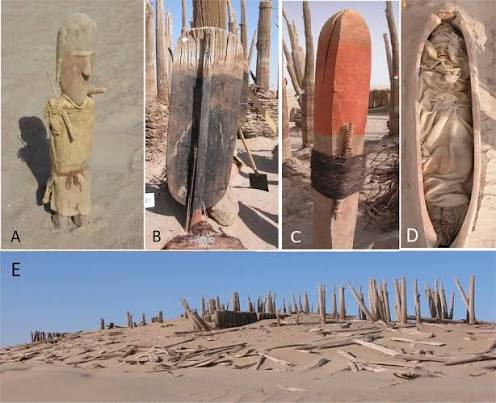
The most recognizable feature of Xiaohe Cemetery is its use of wooden coffins shaped in a form often compared to overturned boats.
The bodies were placed within these structures and covered or enclosed using additional materials.
The boat-like form has generated considerable discussion.
Researchers must be careful, however, not to assume that the coffins necessarily represented literal boats.
Their shape may have had practical, traditional, or symbolic significance.
Without written explanations, the beliefs behind the burial design remain uncertain.
Wooden Posts and the Cemetery Landscape
Many Xiaohe burials were associated with upright wooden markers.
These posts created a striking visual landscape.
The use of such structures demonstrates that the cemetery was deliberately organized and repeatedly used.
The placement of markers may have helped identify particular graves or contributed to broader ceremonial practices.
Because the site was located in an extremely dry environment, these wooden elements survived far longer than would normally be possible.
Wheat and the Archaeology of Food
One of the important discoveries associated with prehistoric Xinjiang is evidence for the movement of agricultural crops across Eurasia.
Wheat was originally domesticated in Southwest Asia and eventually spread eastward through networks of migration, exchange, and cultural contact.
The presence of wheat-related evidence in Bronze Age contexts demonstrates that prehistoric communities were already participating in long-distance processes of agricultural transmission.
This occurred thousands of years before the formal Silk Road became famous.
A Crossroads Before the Silk Road
The Tarim Basin is often associated with the Silk Road, the historical network that linked East Asia with Central Asia, South Asia, the Middle East, and Europe.
However, archaeological evidence shows that long-distance contact existed in Eurasia long before the Silk Road of later historical periods.
The movement of:
crops,
livestock,
technologies,
textiles,
and cultural practices
demonstrates that prehistoric communities were already connected through wide networks of exchange.
Xiaohe is therefore important for understanding the deeper history of Eurasian interaction.
Human Remains and Ancient DNA
The preservation of human remains at Xiaohe has allowed scientists to investigate the ancestry of the population using ancient DNA.
Research indicates that the people of the early Tarim Basin formed a distinctive population with deep ancestry in northern Eurasia.
This challenged earlier explanations that interpreted the community simply as recent migrants from western Eurasia.
The results demonstrate that cultural exchange and genetic ancestry do not always follow the same pattern.
A community can adopt wheat, animal husbandry, or textile technologies through interaction without being genetically identical to the populations from which those practices originated.
Burial Objects and Symbolism
The burials at Xiaohe contained a range of associated materials.
These could include:
baskets,
textiles,
wooden objects,
animal materials,
plant remains,
and other carefully placed items.
The deliberate inclusion of these materials suggests that burial was an organized cultural activity.
However, the precise symbolic meaning of individual objects cannot always be determined.
Archaeology can identify patterns of behavior, but reconstructing beliefs requires caution.
Life in the Tarim Basin
Living near the Taklamakan Desert required detailed environmental knowledge.
Communities depended on access to water and needed strategies for obtaining food and raw materials.
Agriculture and herding could be combined with the collection of local resources.
The inhabitants of the region were therefore not simply isolated desert dwellers.
They participated in technological and cultural networks extending across prehistoric Eurasia.
Why Xiaohe Cemetery Is So Important
Xiaohe is important because of the extraordinary preservation of organic material.
At many prehistoric cemeteries, archaeologists recover only stone, pottery, and skeletal remains.
At Xiaohe, the desert environment preserved much more.
This allows researchers to investigate:
clothing,
woodworking,
food,
burial practices,
plant use,
and human genetics.
The site provides one of the most detailed archaeological records of Bronze Age life in Central Asia.
Conclusion
Xiaohe Cemetery is an extraordinary archaeological monument preserved by the harsh environment of the Tarim Basin. Its boat-shaped coffins, wooden markers, naturally preserved bodies, and evidence of agricultural connections reveal a complex prehistoric community.
The presence of crops such as wheat demonstrates that long-distance cultural exchange was occurring across Eurasia thousands of years before the historical Silk Road.
Xiaohe reminds us that ancient connections between distant societies did not begin with famous empires or commercial caravans. Long before those developments, prehistoric communities were already exchanging knowledge, technologies, and resources across enormous distances.