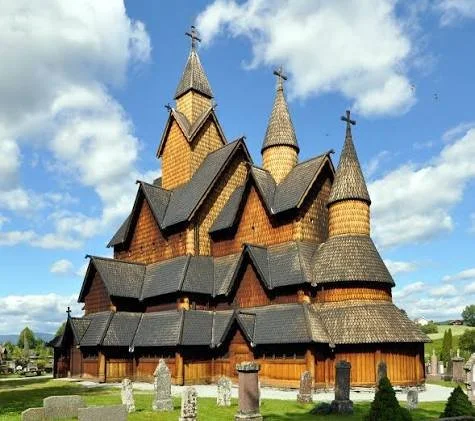
Heddal Stave Church is widely regarded as the largest surviving stave church in Norway and is one of the most impressive examples of medieval Scandinavian timber architecture. Its monumental scale, complex structure, and survival through centuries of change make it an especially important source for understanding medieval construction, Christianization, and Norwegian heritage.
The Scale of Heddal
Unlike a small rural timber chapel, Heddal was built on a substantial scale.
Its multiple roof levels create a dramatic vertical silhouette, while the internal structural system demonstrates the sophistication of stave construction.
The church was designed to accommodate a community and to project a strong visual presence within the landscape.
How Stave Construction Worked
The word "stave" refers to the large vertical structural posts forming the building's framework.
These posts support horizontal beams and connect to other structural elements.
Walls are inserted between the framework, while the roof structure transfers loads through a carefully organized system.
This allowed medieval builders to create relatively tall timber structures.
Medieval Craftsmanship
Constructing Heddal required highly skilled craftsmen.
Trees had to be selected carefully, particularly for structural components. Timber needed to be shaped with axes, adzes, chisels, and other woodworking tools.
Joints had to be accurately fitted.
The resulting structure demonstrates that medieval carpentry was a sophisticated engineering discipline rather than merely rough timber construction.
Christianity and Local Society
Heddal belonged to the Christian landscape of medieval Norway.
Churches were central to religious life, providing locations for Mass, baptism, marriage, burial, confession, and major festivals.
The church also reinforced community organization.
Its size indicates that the building served a substantial local population or had an important regional role.
Decorative Traditions
Stave churches often incorporate carved wooden details.
These can include geometric ornament, vegetal forms, interlaced designs, and animal motifs.
Such decoration reflects the interaction of Christian symbolism with Scandinavian artistic traditions.
The result is a distinctive architectural language that differs from both continental Romanesque stone churches and later Gothic architecture.
Preservation and Restoration
Heddal has undergone significant restoration and conservation.
This is important because surviving medieval buildings rarely remain completely unchanged.
Timber deteriorates, roofs require replacement, structural components weaken, and later generations modify buildings to meet changing needs.
Restoration therefore involves a difficult balance between preserving genuine historical fabric and ensuring structural stability.
Why Heddal Matters
Heddal is significant because it demonstrates what medieval Norwegian timber architecture could achieve at its largest scale.
It represents engineering knowledge, woodworking expertise, religious devotion, community organization, and cultural continuity.
The church also helps correct the common misconception that medieval monumental architecture was synonymous with stone.
In Norway, forests supplied the raw material for a remarkable architectural tradition. Builders transformed timber into churches that could rise several stories into the landscape and survive for centuries.
Heddal therefore stands not merely as a religious building but as a monument to medieval Norwegian craftsmanship and the enduring cultural importance of wood.