Introduction
Hedeby was one of the most important trading centers of the Viking Age and one of the greatest archaeological sites associated with early medieval northern Europe.
Located near the southern edge of the Jutland Peninsula, close to the modern German-Danish border, Hedeby occupied an exceptionally strategic position.
Its location connected the North Sea with the Baltic Sea through the narrow land and water corridors of Schleswig.
This geography transformed Hedeby into a commercial gateway between Scandinavia, continental Europe, the North Atlantic, and the eastern Baltic.
A Strategic Location
Hedeby's success was fundamentally geographical.
The settlement stood near the Schlei inlet, which provided access to the Baltic.
At the same time, travelers could cross relatively short distances overland to reach waterways leading toward the North Sea.
This meant merchants could avoid dangerous open-sea voyages around Jutland.
The settlement consequently became a natural transfer point between different maritime systems.
Foundation and Growth
Hedeby emerged during the eighth century and expanded significantly during the following centuries.
Its development corresponded with the growing importance of long-distance trade.
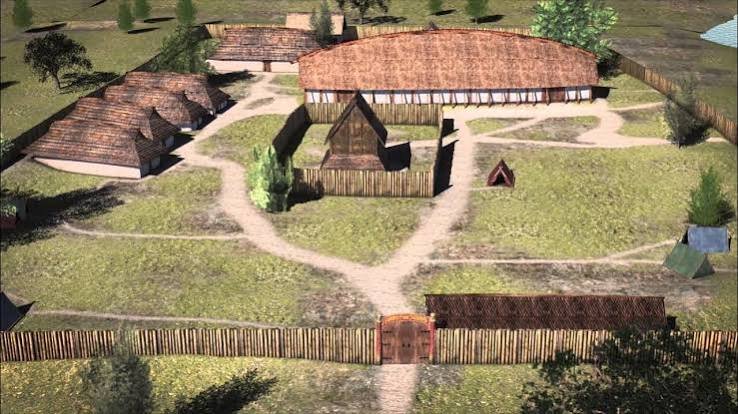
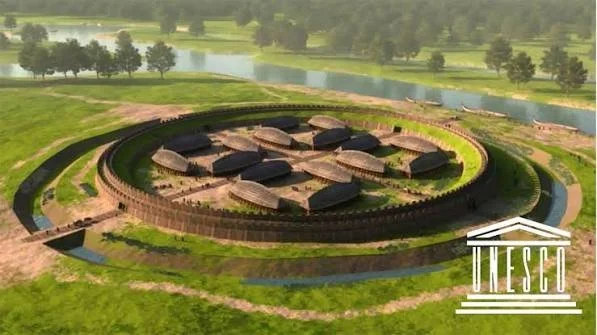
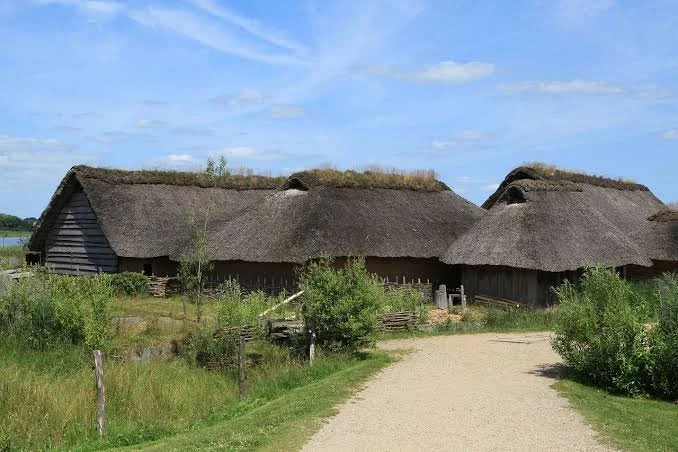
The settlement eventually contained houses, workshops, streets, landing facilities, and defensive structures.
Thousands of people may have participated in its economic life over the course of its occupation.
International Commerce
Hedeby's archaeological record demonstrates an enormous geographic range of connections.
Goods came from:
Scandinavia;
the Frankish world;
the British Isles;
the Baltic;
eastern Europe;
the North Atlantic;
regions farther south.
Merchants could exchange furs, amber, textiles, metals, weapons, food products, ceramics, glass, and luxury goods.
The settlement functioned as an international marketplace.
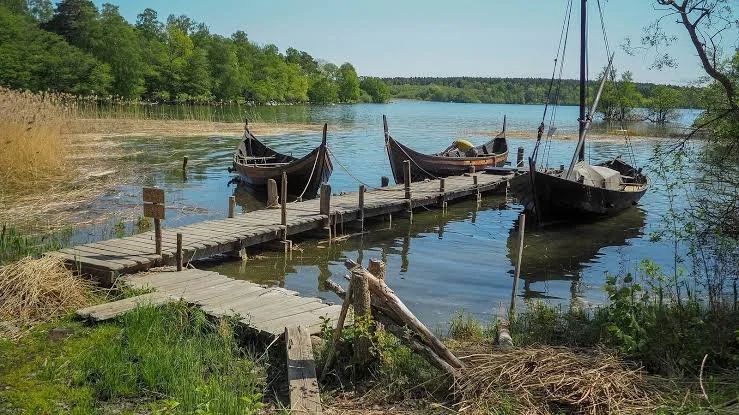
The Port
Water transportation was central to Hedeby.
Ships could bring cargo directly to the settlement.
Archaeological evidence indicates extensive maritime activity.
The harbor would have been filled with vessels during periods of commercial activity, bringing merchants and sailors from different regions.
The port was therefore not merely an economic facility but a point of cultural contact.
Craftspeople
Hedeby supported many specialized crafts.
Archaeologists have discovered evidence of:
metalworking;
bone carving;
antler working;
glass production;
beadmaking;
textile production;
leatherworking;
woodworking.
Craft specialization demonstrates that the settlement possessed a complex economy.
Houses and Urban Structure
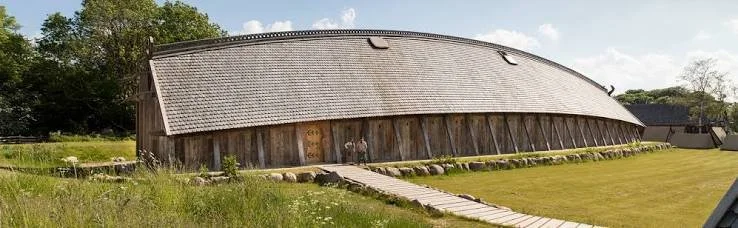
Hedeby's houses were typically constructed from timber and other organic materials.
Because wood, leather, textiles, and food waste were preserved in certain archaeological layers, excavations provide remarkable information about everyday life.
The settlement included organized streets and densely occupied areas.
This degree of spatial organization demonstrates that Hedeby was substantially more urban than ordinary Viking Age rural settlements.
Defensive Earthworks
Hedeby was protected by substantial defensive structures.
The settlement became connected with the Danevirke defensive system, which controlled movement across southern Jutland.
These fortifications demonstrate the political significance of the region.
Trade and defense were closely connected.
A ruler who controlled Hedeby could potentially influence the movement of wealth across northern Europe.
Religious Change
Hedeby existed during the transition from traditional Norse religion to Christianity.
Pagan beliefs remained important for much of its history.
Later, Christianity became increasingly prominent.
The archaeological record reflects this transformation through burial practices, religious objects, and the eventual establishment of Christian institutions.
Hedeby therefore provides an unusually valuable setting for studying religious change.
Coinage
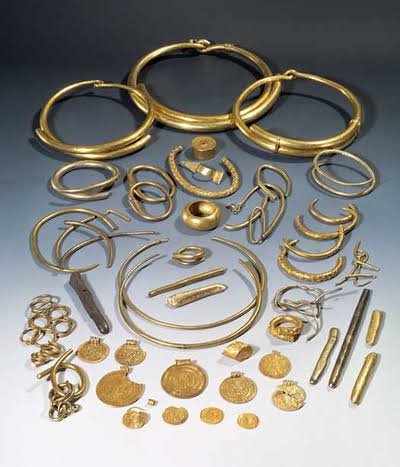
Coins were essential to Hedeby's commercial system.
Both local and foreign coins have been discovered.
Arabic dirhams and coins from western Europe demonstrate the enormous geographic range of trade networks.
Silver could also circulate as bullion.
Weights and scales allowed merchants to conduct transactions based on precious-metal weight.
Everyday Life
Despite its international significance, Hedeby was also a place where ordinary people lived.
Archaeologists can study diet, housing, clothing, tools, household activities, and crafts.
Animal bones reveal aspects of food consumption.
Objects such as combs, needles, knives, beads, and household implements provide insight into personal and domestic life.
Political Importance
Control of Hedeby meant control over a major economic resource.
Danish rulers and regional political powers therefore had strong incentives to protect and influence the settlement.
Hedeby's importance illustrates a central principle of Viking Age politics: economic power and political power were closely connected.
Decline
Hedeby eventually declined during the eleventh century.
Changes in political geography, commercial routes, and competing settlements contributed to its loss of importance.
Nearby Schleswig eventually developed as a successor urban center.
The abandonment of Hedeby, however, preserved archaeological layers that later became extraordinarily valuable to researchers.
Archaeological Significance
Hedeby is important because it captures a critical period in European history.
It demonstrates how Scandinavian societies became integrated into international trade networks.
It also reveals the diversity of Viking Age communities.
The archaeological record contains evidence for people, objects, technologies, and ideas moving across enormous distances.
Conclusion
Hedeby was much more than a Viking marketplace.
It was an international port, craft center, political asset, cultural meeting point, and gateway between northern and continental Europe.
Its strategic geography allowed merchants to connect the Baltic and North Sea worlds, while its defensive structures demonstrate the political importance of controlling commerce.
Today, Hedeby remains one of the most important archaeological windows into Viking Age urban life.
Its remains reveal a world that was remarkably mobile, commercially sophisticated, culturally diverse, and deeply connected to the wider medieval world.