Introduction
Kaupang occupies a special place in the archaeology of the Viking Age because it represents one of Scandinavia's earliest urban trading settlements. Located in present-day Vestfold in southeastern Norway, the site developed during the late eighth century and became an important center for commerce, craft production, maritime activity, and cultural exchange.
The name Kaupang is itself revealing. It is related to Old Norse terms associated with buying, selling, and marketplaces, reflecting the settlement's commercial character. Rather than being simply a farming village, Kaupang was part of a wider network connecting Scandinavia with the North Sea, the Baltic, and regions farther east.
Its importance becomes particularly clear when Kaupang is compared with other Viking Age commercial centers such as Ribe, Hedeby, Birka, and later trading towns. Archaeological excavations have uncovered evidence of imported objects, manufacturing, coinage, weights, metalworking, glassworking, textiles, and maritime commerce.
Kaupang therefore provides an extraordinary opportunity to study how Scandinavian society began developing more complex economic centers during the transition into the Viking Age.
Geographic Setting
Kaupang was situated near the western side of the Oslo Fjord system.
Its location was strategically valuable because waterways were the principal transportation routes of Viking Age Scandinavia. Ships could move people and goods considerably more efficiently than overland transportation.
The surrounding landscape also provided agricultural resources, timber, pasture, and access to maritime resources.
Most importantly, Kaupang's position allowed it to participate in regional and international maritime networks.
The Founding of Kaupang
Archaeological evidence indicates that Kaupang was established around the late eighth century, approximately contemporary with the beginning of the Viking Age.
Its emergence was not an isolated event.
Across Scandinavia and the wider North Sea world, new commercial settlements were developing. These locations brought together merchants, craftspeople, sailors, farmers, political authorities, and travelers.
Kaupang appears to have been established as part of this broader transformation.
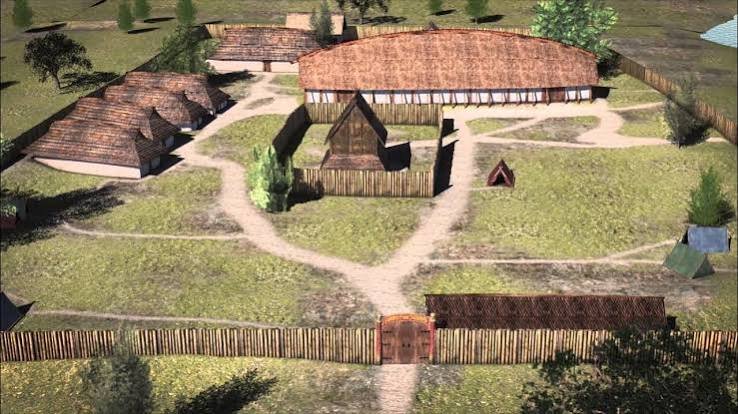
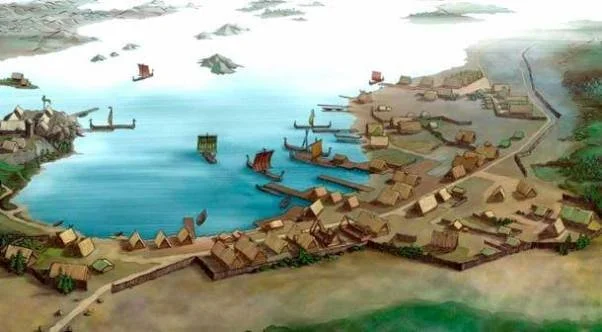
The settlement did not necessarily resemble a modern city. Instead, it consisted of workshops, houses, activity areas, storage spaces, paths, landing places, and commercial zones.
Archaeological Excavation
Modern archaeological investigation at Kaupang has revealed an exceptionally rich collection of evidence.
Excavators have recovered:
glass beads;
imported ceramics;
coins;
weights;
iron objects;
bronze ornaments;
textile equipment;
animal bones;
metalworking debris;
evidence of craft production;
fragments of imported materials.
The distribution of these discoveries allows archaeologists to reconstruct different activities within the settlement.
Some areas appear to have been associated with craft production, while others were residential or commercial.
Craft Production
Kaupang was not merely a place where imported goods were exchanged.
Craftsmanship was one of its defining characteristics.
Evidence indicates production of objects including jewelry, tools, textiles, and other manufactured goods.
Metalworkers transformed raw materials into finished objects, while beadmakers and other craftspeople produced decorative items.
Textile production was also important.
Spinning and weaving were essential Scandinavian industries, and archaeological discoveries of spindle whorls and other textile equipment demonstrate that domestic and specialized production occurred within the settlement.
International Trade
Perhaps the most significant aspect of Kaupang is the evidence for international commerce.
Objects originating from distant regions demonstrate that people living or trading at Kaupang were connected to networks extending far beyond Norway.
The Viking Age was characterized by extensive movement of goods through maritime routes.
Products could travel from the British Isles and continental Europe into Scandinavia and onward toward the Baltic and eastern European river systems.
Luxury goods, raw materials, ornaments, coins, and everyday commodities all participated in these networks.
Kaupang therefore functioned as a meeting point between different economic and cultural systems.
Coinage and Weights
Trade required mechanisms for measuring value.
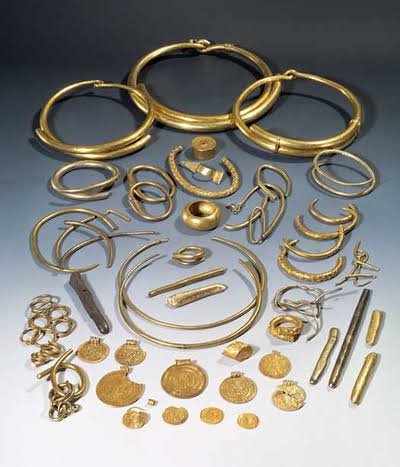
Archaeological discoveries of weights and scales demonstrate that merchants at Kaupang engaged in transactions involving measured quantities of precious metals and commodities.
Unlike modern economies, Viking Age commerce did not rely exclusively on standardized coinage.
Silver could be weighed and exchanged according to its mass.
Coins could be used as bullion rather than simply as currency.
This system required specialized weights and careful measurement.
The presence of such equipment provides evidence of sophisticated commercial practices.
Ships and Maritime Activity
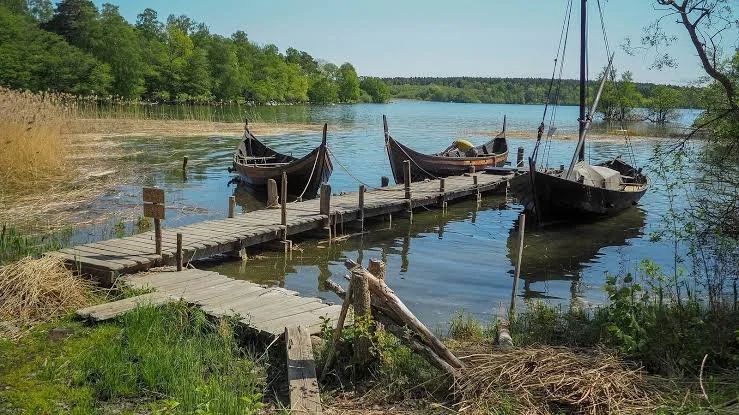
Kaupang's economic success depended heavily on ships.
Viking Age vessels served simultaneously as transportation systems, trading platforms, military machines, and symbols of political power.
Merchants could transport cargoes across enormous distances.
The settlement's location near navigable waterways made maritime access fundamental to its existence.
Ships also brought people.
Foreign merchants, travelers, craftspeople, and settlers contributed to the cultural diversity of Viking Age commercial centers.
Cultural Diversity
The archaeological evidence from Kaupang suggests that the settlement was more cosmopolitan than a typical rural Scandinavian community.
Imported objects reveal contact with different cultural regions.
Such contact could involve trade, migration, marriage, political alliances, warfare, or religious exchange.
The Viking world was therefore not culturally isolated.
Kaupang demonstrates that Scandinavian communities were integrated into international networks centuries before the development of modern nation-states.
Religion and Belief
Although Kaupang was fundamentally commercial, religion remained embedded in Viking society.
Merchants and craftspeople operated within a world shaped by Norse religious beliefs.
Amulets, symbolic objects, burial practices, and artistic motifs can provide evidence for religious traditions.
At the same time, contact with Christian Europe meant that Christian objects could also reach Scandinavian trading centers.
Kaupang thus existed during a period when Scandinavian religious culture was beginning to encounter increasingly strong Christian influence.
Social Organization
A trading settlement required cooperation between people with different occupations.
Farmers provided food.
Craftspeople manufactured objects.
Merchants organized trade.
Sailors transported goods.
Political authorities provided protection and controlled access to resources.
This created a complex social environment.
Kaupang demonstrates that Viking Age society cannot be understood solely through rural farms or warrior elites. Commercial communities were becoming increasingly important.
Kaupang and Urbanization
Kaupang is sometimes described as an early town, but Viking Age urbanization was different from modern urban development.
The settlement was relatively small by modern standards.
Its importance came from the concentration of people, economic activity, craft production, and long-distance trade.
This represented a major transformation in Scandinavian economic organization.
Instead of every community producing nearly everything it needed, specialized centers could facilitate exchange.
Decline
Kaupang did not remain permanently dominant.
By the tenth century, its importance had declined.
The reasons were probably complex.
Changes in trade routes, political organization, economic centers, and regional power structures could all influence the fortunes of a settlement.
The rise of other Scandinavian centers eventually reduced Kaupang's commercial importance.
Yet its decline does not diminish its historical significance.
Archaeological Importance
Kaupang provides direct evidence for the emergence of early Scandinavian commercial society.
It demonstrates:
long-distance trade;
specialized craftsmanship;
maritime transportation;
monetized exchange;
cultural interaction;
social specialization;
early urban development.
The site is particularly valuable because archaeological evidence preserves aspects of Viking life that written sources rarely describe.
Conclusion
Kaupang was one of the earliest major trading settlements in Norway and an important participant in the international networks of the Viking Age.
Its workshops, imported objects, weights, coins, and maritime connections reveal a society undergoing profound economic transformation.
The settlement shows that Viking Age Scandinavia was not merely a world of isolated farms and raiding warriors.
It was also a world of merchants, artisans, sailors, marketplaces, international exchange, and increasingly complex communities.
Kaupang therefore represents an essential stage in the development of Scandinavian urbanism and commerce—a place where the emerging Viking economy connected Norway to the wider medieval world.