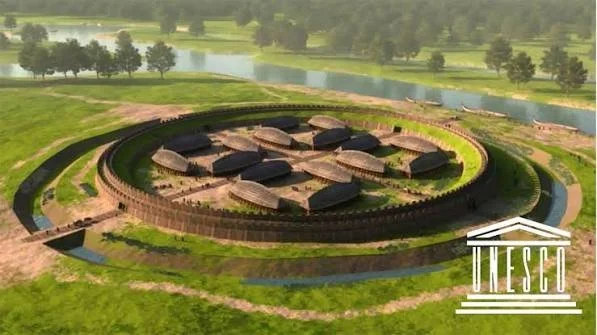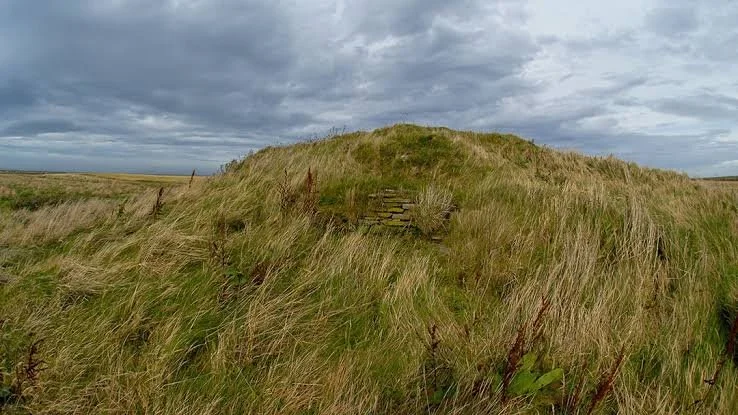
The Hillock of Bay broch on Stronsay belongs to the remarkable tradition of Iron Age monumental stone architecture found throughout Orkney and northern Scotland. Brochs are among the most distinctive prehistoric structures in Britain, characterized by circular towers constructed with massive dry-stone walls.
Their function remains one of the enduring questions of Scottish archaeology. Once interpreted primarily as defensive structures, brochs are now understood as complex buildings whose roles may have included residence, status display, communal gathering, storage, protection, and political authority.
The Architecture of Brochs
Brochs were constructed using a sophisticated form of dry-stone masonry.
Two concentric walls created a thick structural envelope. Within this wall thickness, builders could incorporate stairways, galleries, and small chambers.
The circular design distributed structural loads effectively and allowed builders to create tall structures without mortar.
The Hillock of Bay structure therefore reflects considerable architectural knowledge.
Engineering Without Modern Equipment
Iron Age builders did not possess cranes, trucks, or powered machinery.
Instead, they relied upon human labor, stone-working techniques, levers, sledges, ropes, and carefully planned construction.
Large stones could be moved using coordinated teams. Smaller stones could be carried individually or transported using simple devices.
The successful construction of a broch demonstrates that prehistoric communities possessed both practical engineering knowledge and organizational capacity.
The Broch as a Social Monument
A broch would have been highly visible within its surrounding landscape.
Its monumental architecture may have communicated the wealth and authority of its occupants.
Building such a structure required resources. Food had to support workers, stone had to be obtained and transported, and construction had to be coordinated.
The ability to mobilize labor may itself have been a source of political power.
Domestic Life Inside the Broch
Despite their monumental appearance, brochs were not necessarily empty fortresses.
Evidence from other Scottish brochs demonstrates that people lived, cooked, worked, and stored materials inside them.
Central hearths provided warmth and supported cooking. Stone furniture, storage spaces, and internal cells allowed a range of domestic activities.
The structure could therefore function as both residence and social center.
Agriculture and Livestock
The inhabitants of the Hillock of Bay community would have depended heavily on agriculture.
Cattle, sheep, and pigs were important domestic animals. Cereal cultivation provided carbohydrates, while livestock supplied meat and other products.
Agricultural communities also required storage systems to survive through winter.
Brochs may sometimes have provided secure storage environments, although their precise economic roles varied.
Maritime Resources
Stronsay's island position meant that the sea was central to daily life.
Fishing could provide protein, while shellfish and seabirds offered additional food.
Boats also enabled communication with neighboring communities.
The inhabitants of the broch therefore operated within a maritime landscape rather than an isolated terrestrial one.
Warfare and Protection
Defensive functions cannot be dismissed.
Thick stone walls could provide substantial protection against attacks. Controlled entrances and elevated positions may have improved security.
However, not every broch shows evidence of violent conflict.
The safest interpretation is that protection may have been one component of a broader social function.
Archaeological Interpretation
Archaeologists increasingly study brochs through landscape analysis rather than examining them individually.
The location of the Hillock of Bay structure can be compared with nearby farms, other monumental buildings, agricultural land, and coastal routes.
This approach can reveal whether the broch occupied a strategic location, controlled access to resources, or served as a local community center.
Later Reuse
Like many prehistoric monuments, the broch may have continued to influence the landscape after its original period of use.
Later communities encountered the ruins as prominent landmarks. Stone may have been reused, while the site itself could acquire new meanings.
Archaeological sites are therefore often palimpsests containing multiple periods of activity.
Conclusion
The Hillock of Bay broch represents the technological skill, social organization, and architectural ambition of Iron Age Stronsay.
Its thick stone construction reflects advanced dry-stone engineering, while its location demonstrates the integration of architecture with agriculture, maritime activity, and community organization.
Rather than viewing it simply as a fortress, it is more useful to understand the broch as a multifunctional monument embedded within a complex society.
Its surviving remains provide a valuable opportunity to study how Iron Age communities expressed identity, organized resources, and transformed the Orkney landscape.