Introduction
Few archaeological sites demonstrate the sophistication of ancient desert engineering as clearly as Hohokam Snaketown in central Arizona.
Located in the lower Gila River valley, Snaketown was one of the most important settlements associated with the Hohokam tradition.
Its archaeological remains reveal an extraordinary combination of:
irrigation agriculture;
large-scale canal construction;
ceremonial architecture;
ballcourts;
craft production;
long-distance exchange;
and complex community organization.
Snaketown demonstrates that ancient people could transform an arid environment into a productive agricultural landscape through coordinated engineering and environmental knowledge.
The Hohokam Tradition
The Hohokam tradition developed in the Sonoran Desert of present-day Arizona.
Hohokam communities flourished for centuries and developed extensive irrigation systems.
The term "Hohokam" is an archaeological designation, and modern Indigenous communities have complex relationships with the archaeological legacy of these societies.
Researchers increasingly recognize that the Hohokam world should not be viewed as a vanished civilization but as part of the long Indigenous history of the Southwest.
Snaketown's Location
Snaketown was located near the Gila River.
The river was essential to the settlement's development.
Although the surrounding Sonoran Desert is extremely arid, river water could be diverted toward agricultural fields.
This created the foundation for intensive agriculture.
The Canal System
The Hohokam canal network is among the most impressive achievements of ancient North American engineering.
Canals were constructed to move water from rivers toward fields.
Building a canal required:
surveying terrain;
determining appropriate gradients;
excavating soil;
constructing embankments;
maintaining channels;
and coordinating labor.
The canals could extend considerable distances.
Engineering Knowledge
Canal construction required an understanding of elevation and water flow.
A channel that was too steep could erode rapidly.
A channel that was too shallow might fail to transport water effectively.
This meant that Hohokam engineers had to understand the landscape through observation and experience.
Their achievements demonstrate practical hydraulic engineering long before modern surveying instruments.
Agriculture
Irrigation transformed the agricultural possibilities of the Sonoran Desert.
Farmers cultivated maize, beans, squash, and other crops.
Agricultural surpluses could support larger populations.
Farming also encouraged people to remain near irrigation systems.
This helped create permanent settlements.
Community Labor
Large irrigation canals could not have been constructed by isolated households.
Their construction and maintenance required organized labor.
People needed to:
excavate channels;
repair damaged sections;
clear sediment;
maintain banks;
and coordinate water distribution.
This suggests sophisticated community organization.
Ballcourts
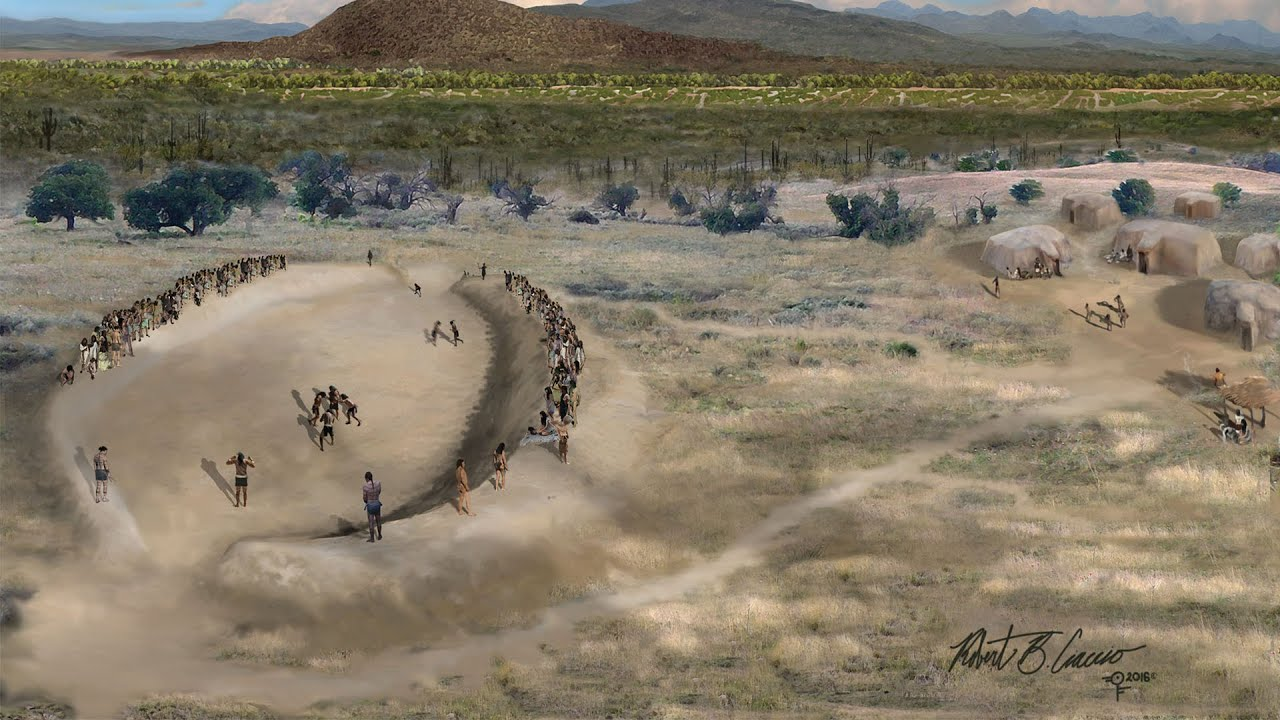
Snaketown is particularly famous for its ballcourts.
Ballcourts were large, deliberately constructed spaces associated with a game played in parts of the ancient Southwest.
The game appears to have had social and ceremonial significance.
Ballcourts provide evidence that Hohokam communities participated in shared cultural practices across broad regions.
The Ballgame
Although the exact rules of the ancient game remain uncertain, archaeological evidence indicates that the activity involved teams and a ball.
The game may have served multiple purposes.
It could have been:
recreational;
ceremonial;
political;
social;
or connected to regional gatherings.
The construction of large ballcourts suggests that such activities could involve substantial audiences.
Social Interaction
Ballcourts may have provided opportunities for communities to meet.
Visitors could travel from neighboring settlements to participate in ceremonies, exchange goods, establish relationships, or attend games.
This means that ballcourts may have functioned as social infrastructure.
They brought people together.
Trade
Snaketown participated in extensive exchange networks.
Materials from distant regions have been found in Hohokam contexts.
Shell from the Gulf of California is particularly significant.
Marine shells traveled considerable distances inland, demonstrating connections between desert communities and coastal environments.
Other traded materials included minerals, stone, and finished objects.
Craft Production
Hohokam artisans produced distinctive ceramics, ornaments, tools, and other objects.
Shell working was especially important.
Artisans could cut, polish, drill, and shape shells into:
beads;
pendants;
bracelets;
and decorative objects.
These items could have served both aesthetic and social purposes.
Social Complexity
Snaketown's irrigation systems, ballcourts, craft production, and extensive exchange networks indicate a complex society.
However, complexity does not necessarily mean centralized kingship.
Hohokam communities may have been organized through local leaders, ritual institutions, cooperative labor systems, and community networks.
Archaeologists continue to debate the exact political organization of Hohokam society.
Environmental Challenges
Irrigation created tremendous agricultural opportunities but also required continuous maintenance.
Canals could become clogged.
Floods could damage infrastructure.
Sediment could accumulate.
Water distribution could also create social tensions.
Successful irrigation therefore depended upon both engineering and social cooperation.
Transformation of Snaketown
Snaketown's history extended over many centuries.
The settlement changed substantially through time.
Population levels fluctuated.
Architectural forms evolved.
Exchange networks changed.
Eventually, the settlement was abandoned.
As with many Southwestern archaeological sites, abandonment should not be understood as the disappearance of its people.
Communities reorganized and moved elsewhere.
Modern Archaeological Importance
Snaketown is important not only because of what survives but also because of how archaeological research has changed over time.
Excavations have revealed architecture, canals, ballcourts, artifacts, food remains, and craft production.
Together, these materials allow archaeologists to reconstruct an interconnected society.
The site's preservation also demonstrates the importance of protecting archaeological landscapes.
Conclusion
Hohokam Snaketown represents one of the most impressive examples of ancient desert adaptation in North America.
Its irrigation canals transformed the Sonoran Desert into productive agricultural land.
Its ballcourts connected communities through shared cultural practices.
Its craft production and trade networks linked inland settlements with distant regions.
And its large-scale infrastructure demonstrates that ancient communities could coordinate complex engineering projects without modern machinery.
Snaketown ultimately challenges simplistic ideas about ancient desert societies.
Its inhabitants were farmers, engineers, artisans, traders, athletes, and community organizers.
Their achievements demonstrate that technological sophistication does not depend upon modern machines.
Sometimes it begins with something much more fundamental: careful observation of a landscape, generations of accumulated knowledge, and the ability of a community to work together.