The rock art of Hordaland forms part of Norway's remarkable Bronze Age visual tradition. Across Scandinavia, prehistoric communities carved images into exposed rock surfaces, producing scenes of ships, humans, animals, weapons, footprints, and geometric symbols.
These images provide one of the most important sources of evidence for understanding Scandinavian Bronze Age beliefs and society.
Unlike written documents, rock carvings do not tell us directly what their creators intended. Yet their repeated motifs and locations reveal patterns that archaeologists can analyze.
Bronze Age Scandinavia
The Scandinavian Bronze Age broadly spans the second millennium and early first millennium BCE, although chronology differs by region.
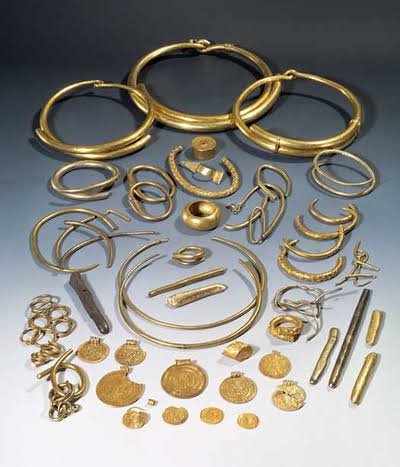
This was a period of increasing long-distance interaction. Metal objects, amber, livestock, and other commodities circulated across northern Europe.
Bronze itself required copper and tin, materials that were not equally available throughout Scandinavia. The presence of bronze objects therefore indicates participation in extensive exchange networks.
Rock art emerged within this interconnected world.
Ships as a Dominant Motif
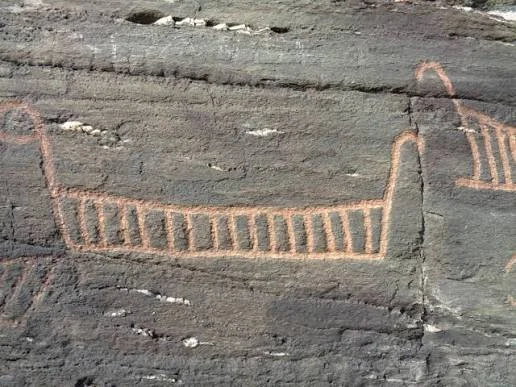
One of the most recognizable features of Scandinavian rock art is the ship.
These vessels are often represented with curved hulls and distinctive prows. Some contain rows of vertical lines interpreted as crew members, while others include symbols that may represent equipment or ritual elements.
Ships may have represented actual transportation, maritime power, trade, warfare, or symbolic journeys.
The importance of ships in rock art is especially significant because maritime travel was essential to communication throughout coastal Norway.
Human Figures
Human figures appear in a variety of forms. Some carry weapons such as axes, spears, or bows. Others appear to participate in ceremonies or dances.
Certain figures have exaggerated proportions or distinctive postures, suggesting that the images may not represent ordinary daily activities.
They may instead depict ritual specialists, warriors, deities, ancestors, or mythological narratives.
Animals and Symbolic Images
Animals also appear in Scandinavian rock art. Deer, horses, and other creatures may have had economic and symbolic significance.
Some motifs remain difficult to identify. Circular shapes, cup marks, spirals, and other geometric designs may have carried meanings that are now inaccessible.
Archaeologists therefore avoid assuming that every symbol has an obvious interpretation.
Landscape and Sacred Space
The location of rock art is as important as the images themselves.
Many carvings occur on exposed rock surfaces overlooking valleys, waterways, or routes through the landscape. The physical experience of approaching the artwork may have been part of its meaning.
The process of carving itself may also have been significant. Producing an image by striking stone against stone required repeated physical action. The sound, labor, and transformation of the rock could have been incorporated into ritual experiences.
Hordaland's Importance
Hordaland's archaeological landscapes demonstrate how Bronze Age communities combined maritime mobility, agriculture, metalworking, ritual activity, and visual symbolism.
Rock art is therefore not simply prehistoric decoration. It is evidence for a sophisticated symbolic culture.
The carvings provide rare insight into how people represented themselves and the world around them at a time before written records were established in Scandinavia.