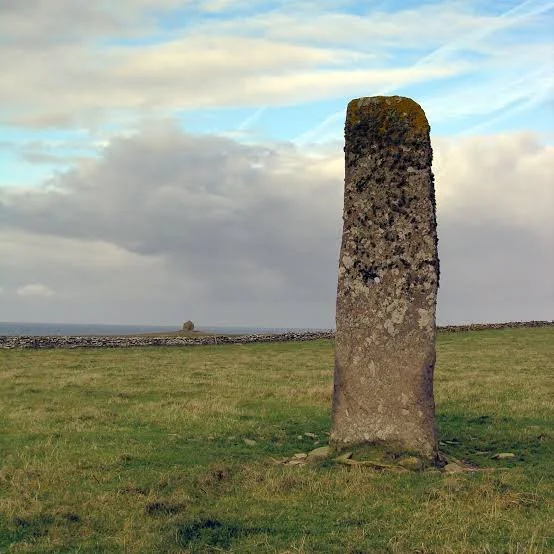
Standing stones are among the most recognizable monuments of prehistoric Britain. Their apparent simplicity—one large stone placed upright in the landscape—can obscure the considerable effort and symbolic meaning involved in their creation. Lairsh, associated with Rousay's prehistoric landscape, belongs to this broader tradition of monumental stones that helped shape the visual and social geography of prehistoric Orkney.
Standing stones are difficult archaeological monuments because they often lack inscriptions or artifacts that provide direct explanations for their purpose. Nevertheless, their locations, orientation, geological characteristics, and relationships to other monuments provide important evidence.
Why Stand a Stone Upright?
The most fundamental question is also the most difficult: why did prehistoric people erect standing stones?
There was probably no single answer.
Standing stones may have marked ceremonial locations, territorial boundaries, routes, burial landscapes, astronomical alignments, or places associated with ancestral traditions. Some may have had meanings that modern archaeology cannot reconstruct.
Their durability was undoubtedly important. Unlike wooden structures or temporary installations, a large stone could remain visible for generations.
The Physical Challenge
Moving a large stone without modern machinery required considerable organization.
Prehistoric communities could use wooden rollers, sledges, ropes, levers, manpower, and carefully prepared tracks. The exact methods varied according to the size and shape of the stone.
Once transported, the stone had to be positioned upright. A deep socket or prepared foundation could help stabilize it.
The engineering was relatively simple in principle but demanded practical knowledge.
Standing Stones and Landscape
Orkney's standing stones frequently occur within landscapes containing other monuments. This is important because prehistoric communities may have understood monuments as components of larger sacred or social spaces.
A standing stone could serve as a visual marker from considerable distances. In a landscape of fields, hills, coastlines, and water, it would have provided a permanent reference point.
The stone could therefore participate in people's daily understanding of geography.
Astronomical Interpretations
Modern observers often interpret standing stones as astronomical instruments. Some monuments genuinely display orientations toward significant solar or lunar positions.
However, archaeologists are cautious about assigning astronomical purposes without evidence. A monument's orientation may result from landscape, practical, ceremonial, or astronomical considerations—or a combination of them.
It is therefore better to describe astronomical alignments as possible interpretations rather than assume every standing stone functioned as an observatory.
Lairsh and Rousay
Rousay's rich archaeological record makes the context of Lairsh especially significant. The island contains Neolithic tombs, settlements, later prehistoric structures, and Viking-period remains.
A standing stone within such an environment could have participated in a landscape whose meanings changed repeatedly.
Later communities may have recognized ancient stones without knowing their original purpose. Such monuments could become incorporated into local traditions and folklore.
The Enduring Monument
Standing stones survive because of their material simplicity. A structure can collapse, a wooden building can decay, and a settlement can disappear beneath soil, but a single massive stone can remain upright for thousands of years.
That survival gives the modern observer a rare physical connection to prehistoric communities.
Lairsh therefore represents more than an isolated stone. It belongs to a tradition of monumental construction in which prehistoric people deliberately altered the landscape to create enduring points of memory, identity, and possibly ritual significance.