Introduction
Izborsk is one of the most historically significant fortified settlements in the northwestern Russian lands. Its origins reach back to the early medieval period, when fortified hilltop settlements served as centers of political authority, defense, trade, and community organization.
Located west of Pskov, near the modern Estonian border, Izborsk occupied an important position between the eastern Baltic and the emerging political centers of medieval Rus'.
Its history provides valuable insight into the development of fortified communities before the rise of the great medieval Russian principalities.
Early Origins
Izborsk is traditionally associated with the early medieval period and appears in historical traditions connected with the early rulers of Rus'.
Its elevated location offered natural defensive advantages.
A settlement built on a hill could observe surrounding territory while making direct assault more difficult.
Fortified Settlement
Early hillforts were not simply military bases.
They were communities.
Residents could include:
farmers;
craftsmen;
merchants;
warriors;
political leaders;
religious figures.
The fortification protected both people and valuable resources.
Strategic Location
Izborsk's location placed it near important routes connecting the Baltic region with the interior of eastern Europe.
This made it strategically important to rulers seeking control over regional trade and transportation.
The settlement could serve as a defensive outpost as well as a commercial center.
The Development of Stone Fortifications
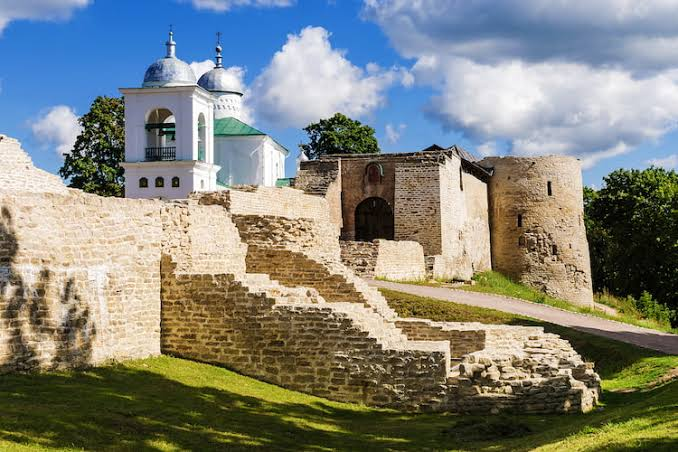
Over time, the earlier settlement was transformed into a much stronger stone fortress.
The later medieval walls demonstrate sophisticated defensive engineering.
Towers projected from the walls, allowing defenders to attack enemies approaching from different directions.
Medieval Warfare
The western frontier of medieval Rus' was politically contested.
Izborsk experienced military pressure from neighboring powers, particularly from forces associated with the German and Livonian spheres.
Repeated attacks encouraged continued investment in the fortress.
Its survival depended on the ability of its defenders and rulers to adapt to changing forms of warfare.
Community Life
Even though the fortress had military functions, ordinary life continued within its walls.
Residents needed food, water, tools, clothing, and housing.
Craft production would have supported the settlement.
Agricultural communities in the surrounding landscape supplied food and raw materials.
Religious History
Christianity gradually became a major component of the region's cultural landscape.
Churches and religious institutions developed alongside fortified settlements.
Izborsk's later religious monuments reflect this transformation.
Archaeological Importance
Archaeology is particularly important for understanding Izborsk because written sources provide only partial information.
Excavations can reveal:
settlement layers;
pottery;
metal objects;
weapons;
agricultural tools;
building remains;
food remains.
These discoveries allow researchers to reconstruct daily life as well as political history.
Conclusion
Izborsk represents the evolution of a fortified community from an early medieval hillfort into a substantial stone fortress.
Its strategic position connected the Baltic frontier with the political world of Rus'.
The site demonstrates that medieval fortifications were not isolated military structures. They were living communities whose survival depended upon agriculture, craftsmanship, trade, political organization, and military defense.
Izborsk therefore provides an important archaeological window into the formative centuries of northwestern Rus'.