Narva Fortress stands beside the Narva River at one of the most strategically important points in northeastern Estonia. For centuries, the river formed a major political and military boundary, and control of the crossing was crucial for states competing for influence in the eastern Baltic.
The fortress therefore represents much more than medieval military architecture.
It is a physical expression of centuries of competition between Scandinavian, Baltic, German, and Russian political powers.
The Narva River
Geography determined Narva's importance.
The Narva River connects Lake Peipus with the Baltic Sea.
This created a natural transportation corridor between inland territories and maritime routes.
A fortified crossing could therefore control movement through a large region.
Medieval Origins
Fortifications developed at Narva during the medieval period as external powers expanded their influence across northeastern Europe.
The Danish rulers of northern Estonia played an important role in establishing a fortified presence.
The site subsequently underwent repeated reconstruction.
Hermann Castle
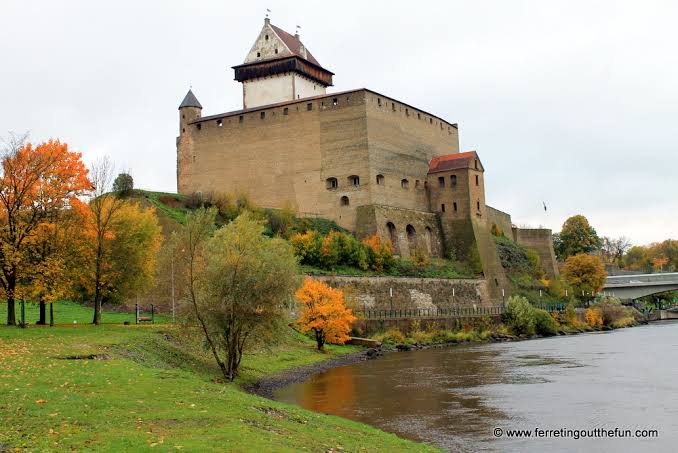
The most famous surviving fortress structure is Hermann Castle.
Its massive stone walls and tower dominate the riverbank.
Across the river stands the fortress of Ivangorod, creating one of Europe's most dramatic fortified landscapes.
The two castles face each other across the water, reflecting centuries of political competition.
A Frontier Fortress
Narva's importance came from its frontier position.
Border regions were often unstable because political authority could change rapidly.
Fortresses helped rulers:
control roads;
supervise river crossings;
collect customs;
protect settlements;
project military power;
deter hostile forces.
Narva performed many of these functions.
Trade and Customs
Military power was not the only reason to control Narva.
Merchants traveling between the Baltic and inland regions could pass through the area.
Authorities could regulate commercial movement and collect taxes.
The fortress therefore had an economic function as well as a military one.
Russian Expansion
During the late medieval and early modern periods, Russian political power expanded toward the Baltic.
Narva became increasingly important in conflicts involving Muscovite Russia, Sweden, Denmark, and other powers.
The fortress was repeatedly attacked, captured, modified, and incorporated into different defensive systems.
Gunpowder Warfare
The development of firearms transformed fortress design.
Traditional medieval walls were increasingly vulnerable to artillery.
Narva's defenses therefore evolved in response to changing military technology.
This illustrates a broader transformation in European warfare from medieval siege methods toward artillery-dominated warfare.
The Great Northern War
Narva became particularly famous during the Great Northern War.
The Battle of Narva in 1700 resulted in a major Swedish victory over Russian forces.
Although the battle itself occurred outside the immediate medieval period, it demonstrates how the strategic importance of the fortress continued long after its original construction.
Archaeological Research
Archaeologists can examine layers of construction, destruction, and rebuilding to reconstruct Narva's complicated history.
Artifacts from different periods reveal changing military technologies, commercial relationships, and patterns of everyday life.
The fortress therefore serves as a historical archive constructed from stone, soil, and material culture.
Conclusion
Narva Fortress represents the long history of the eastern Baltic frontier.
Its position beside the Narva River made it strategically important for medieval rulers and later European states.
From its medieval origins through centuries of warfare, Narva remained a critical military and commercial gateway.
Its surviving architecture provides a powerful reminder that geography, trade, and warfare were inseparable in the political history of the baltic.