Introduction
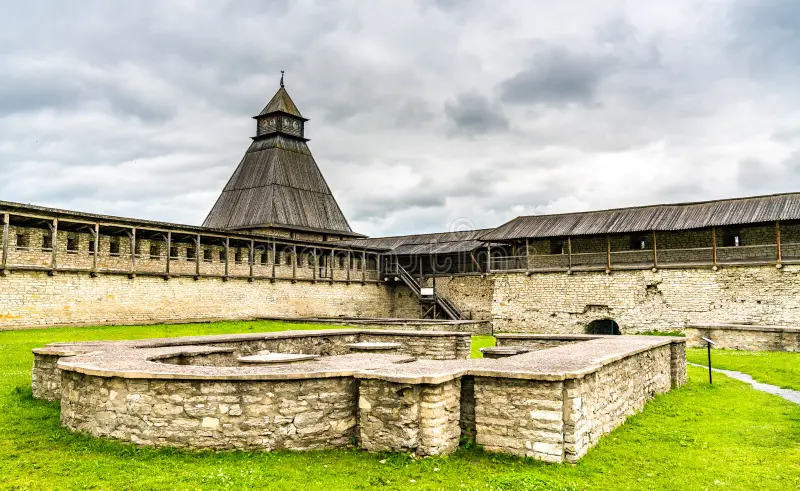
The Pskov Krom, commonly known as the Pskov Kremlin, is the historic fortified heart of Pskov. Rising above the confluence of the Velikaya and Pskova Rivers, the citadel became the center of political, religious, and military life in one of medieval Russia's most important frontier cities.
Its walls and towers reflect centuries of warfare, political development, religious authority, and commercial expansion.
Geography and Defense
Pskov's location was strategically exceptional.
The city developed around major waterways that connected inland territories with the Baltic region.
The Krom occupied a naturally defensible position.
Rivers provided additional protection, while fortified walls controlled access to the central settlement.
Early Fortifications
The earliest defenses were likely constructed from timber and earth.
Such fortifications were common in early medieval eastern Europe.
As political power and military threats increased, stone construction became increasingly important.
The later stone walls transformed the Krom into a formidable citadel.
Religious Center
The Krom was also the spiritual center of Pskov.
The Trinity Cathedral became one of the most important religious buildings in the city.
The close association between fortress and cathedral reflects the medieval belief that political and religious communities were interconnected.
Political Authority
Pskov developed a distinctive political tradition.
The city enjoyed considerable autonomy during parts of the medieval period and developed institutions of collective government.
The Krom therefore represented civic authority as well as military defense.
Warfare on the Western Frontier
Pskov was repeatedly involved in conflicts with neighboring powers.
The city faced military pressure from German crusading orders, Swedish forces, and other rivals.
The Krom's walls provided essential protection.
Its defensive importance increased as siege warfare became more sophisticated.
Towers and Walls
The fortress incorporated multiple towers and defensive lines.
Towers allowed defenders to observe attackers and launch attacks from protected positions.
Walls created controlled zones that could slow or repel invading armies.
The architectural complexity of Pskov's defenses demonstrates the importance of accumulated military experience.
Economic Importance
Pskov's strategic location also made it commercially significant.
Merchants traveled along routes linking Russia with the Baltic.
The city's economy depended on agriculture, craft production, fishing, trade, and taxation.
The Krom protected the political center that regulated this economic system.
Archaeological Research
Archaeological excavations in Pskov have produced enormous quantities of information.
Organic materials survive unusually well in some layers, allowing researchers to study wooden structures and everyday objects.
Artifacts can reveal details about food, clothing, trade, literacy, craft production, and domestic life.
Cultural Significance
Pskov developed distinctive architectural and artistic traditions.
Its churches became famous for their characteristic forms.
The Krom therefore belongs not only to military history but also to the history of Russian architecture and religious culture.
Conclusion
Pskov Krom is one of the most important medieval fortified complexes in Russia.
Its strategic location, political role, religious significance, and military architecture demonstrate the complexity of medieval urban life.
The fortress protected more than a city.
It protected a political community, a religious center, and a major regional economy.
For this reason, the Pskov Krom remains one of the clearest physical expressions of medieval Pskov's independence and strategic importance.