Introduction
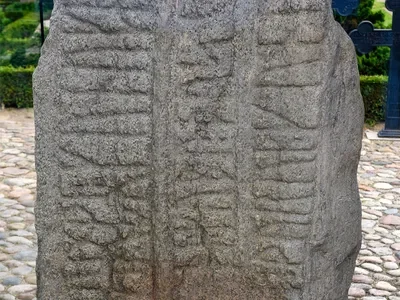
The Jelling Stones are among the most important monuments in Danish history.
Standing at Jelling in central Jutland, the two famous runestones are closely associated with King Gorm and King Harald Bluetooth.
The larger stone erected by Harald is particularly significant because its inscription refers to Harald's rule over Denmark and Norway and his conversion of the Danes to Christianity.
The monument therefore combines political authority, dynastic memory, religion, writing, and monumental art.
King Gorm's Stone
The older stone is associated with King Gorm.
Its inscription commemorates his wife, Thyra.
This demonstrates that runestones served as monuments to individuals and families.
They could preserve memory in a public and highly visible form.
Harald Bluetooth's Stone
The larger Jelling Stone was erected by Harald Bluetooth.
Its inscription presents Harald as a powerful ruler and emphasizes his achievements.
Among these was his claim to have unified Denmark and made the Danes Christian.
This is one of the clearest statements of royal ideology from Viking Age Scandinavia.
Christianity and Political Power
Harald's Christian conversion was not simply a religious event.
Christianity offered rulers new political and ideological tools.
Kings could present themselves as divinely sanctioned authorities.
Church institutions could strengthen royal administration.
Christianity also connected Denmark more closely to the wider European Christian world.
The Images
The larger Jelling Stone contains both runic writing and elaborate imagery.
One famous figure is interpreted as Christ.
The monument therefore represents the merging of Scandinavian artistic traditions with Christian symbolism.
Runic Writing
Runes were more than decorative symbols.
They were a practical writing system used for names, memorial inscriptions, ownership statements, magical formulas, and other purposes.
At Jelling, writing became a tool of royal propaganda.
The king's achievements were publicly displayed in durable stone.
The Jelling Monument Complex
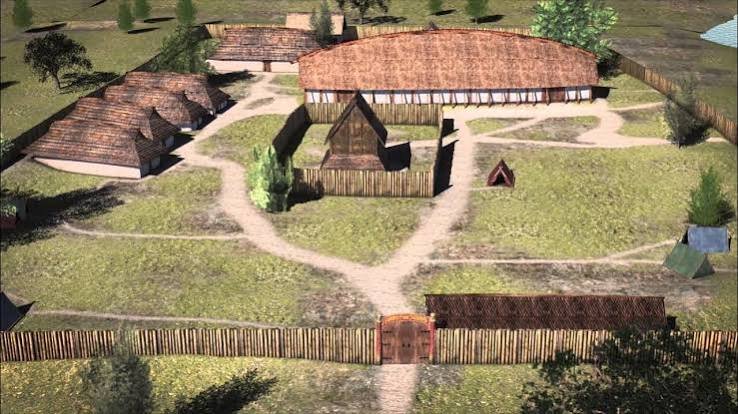
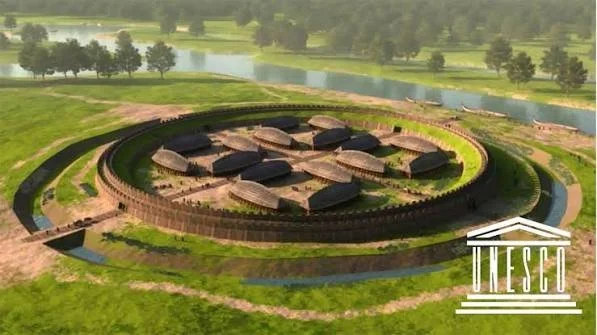
The stones were part of a much larger monumental landscape.
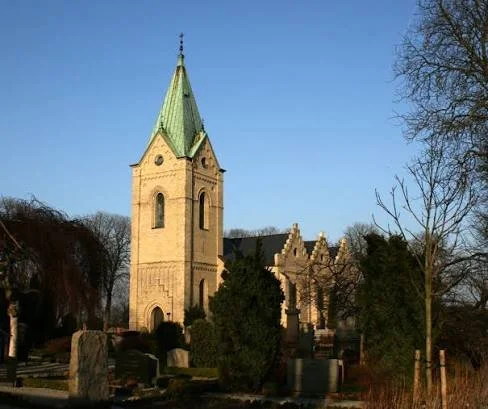
The site included burial mounds, a church, and other structures.
Together they formed a carefully organized royal complex.
The arrangement demonstrates that architecture and landscape were used to communicate political authority.
Dynastic Memory
The Jelling monuments linked Harald to his parents and royal ancestors.
This strengthened dynastic legitimacy.
A ruler did not simply govern because he possessed military power.
He also needed to establish a convincing historical connection with earlier rulers.
Historical Significance
The Jelling Stones are frequently described as a kind of national monument because of their connection with the formation of Denmark.
However, historians must be careful not to project modern nationalism backward.
The tenth-century political world was structured around kingship, dynasties, alliances, territories, and personal loyalties rather than modern nation-states.
Conclusion
The Jelling Stones represent one of the most important surviving expressions of Viking Age royal ideology.
Through their inscriptions, imagery, and monumental setting, they communicate ideas about family, kingship, conquest, Christianity, and political legitimacy.
They demonstrate how Viking rulers used both traditional Scandinavian forms and new Christian symbolism to construct powerful statements about their authority.
Jelling is therefore not simply a collection of ancient stones.
It is a carefully constructed political landscape that captures Denmark during one of the most transformative periods in its history.