Introduction
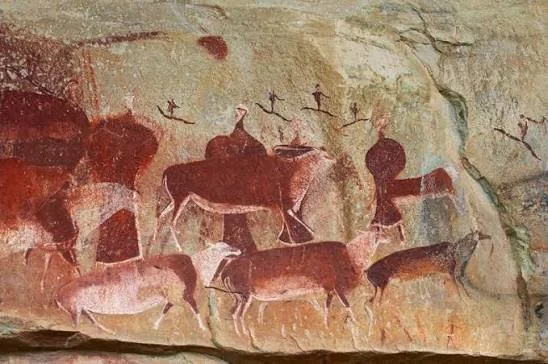
Kamberg, in the KwaZulu-Natal Drakensberg, is internationally recognised for its San rock art and the opportunity it provides to investigate the artistic and spiritual traditions of southern Africa’s Indigenous hunter-gatherer communities.
Some Drakensberg paintings have been interpreted as depictions of ritual specialists engaged in healing ceremonies or spiritual experiences. These interpretations have led to the frequent use of the term “shaman scenes” when discussing particular compositions.
The term requires care. It is an analytical label used by researchers and does not necessarily reflect the terminology or categories used by the original artists. Moreover, not every unusual human figure in San rock art represents a shaman or a ritual specialist. The interpretation of a scene depends on its visual features, archaeological context, and relevant cultural evidence.
The Kamberg Landscape
Kamberg lies among the grasslands, sandstone cliffs, and sheltered valleys of the Drakensberg. The landscape contains rock shelters that provided protection and places for human activity.
The location of a shelter may have influenced its use. Access to water, views across the surrounding landscape, and the availability of nearby resources could all have been important. A painted shelter might also have carried cultural significance beyond its practical function.
Rock art survives unevenly because of differences in the rock surface and local conditions. Sheltered paintings may be protected from direct rainfall, while dampness, mineral deposits, and changes in temperature can cause deterioration.
What Are Shamanic Interpretations?
In anthropology, the term shamanism is often used to describe traditions in which ritual specialists enter altered states of consciousness or interact with spiritual forces as part of healing or other ceremonies. The term has been applied to several Indigenous traditions around the world, but it should not be used as though all societies share the same beliefs.
Research on San rock art has connected some Drakensberg images with accounts of healing dances and spiritual potency. In certain documented San traditions, ritual specialists were believed to engage with forces associated with animals, illness, and the spiritual world.
Some paintings contain figures in unusual postures, with bent bodies, outstretched arms, or features that appear partly human and partly animal. These characteristics have been interpreted by some researchers as possible expressions of ritual transformation or altered states of consciousness.
Such interpretations can be informative, but they remain interpretations. An unusual figure could have more than one possible meaning, and not every image can be connected securely to a known ritual practice.
Reading the Images Carefully
Rock-art interpretation begins with careful observation. Researchers record the shape of figures, the direction in which they face, the relationship between figures, and the presence of animals or other motifs.
The placement of a painting within a shelter can also matter. Images may be grouped into compositions, overlap earlier paintings, or occupy surfaces that are difficult to see from certain positions.
Researchers then compare the artwork with other images and relevant ethnographic information. The comparison must account for differences between communities and historical periods. A belief recorded in one San community cannot automatically be assumed to explain every painting across the Drakensberg.
A responsible interpretation distinguishes direct observations from explanations that depend on cultural comparison.
Ritual, Healing, and the Eland
Eland appear frequently in Drakensberg rock art and are associated with significant symbolic meanings in several documented San traditions. Researchers have investigated whether eland imagery in particular compositions relates to ritual potency, healing, and the spiritual experiences of ritual specialists.
Some paintings appear to combine human figures and animal characteristics. These have sometimes been interpreted as visual representations of transformation or relationships between different forms of existence.
However, the presence of an eland alongside a human figure does not by itself establish that a healing ceremony is being depicted. The interpretation becomes more persuasive only when multiple features of the composition and relevant cultural evidence support it.
The Importance of Ethnographic Evidence
Ethnographic research has played an important role in understanding San rock art. Accounts from San people can explain the meanings of animals, ceremonies, and spiritual concepts that might otherwise be difficult for archaeologists to interpret.
Nevertheless, ethnographic evidence has limitations. Communities change over time, and the beliefs recorded by researchers may not represent every group or historical period. Some accounts were also collected under unequal social conditions, requiring scholars to consider the circumstances in which the information was recorded.
Indigenous knowledge should be treated as an important source of understanding, not as a simple code that reveals the meaning of every ancient image.
Conservation and Respect
Kamberg’s paintings are fragile cultural records. Touching the rock surface, applying substances, tracing outlines, or creating new marks can cause irreversible damage.
Conservation involves monitoring the condition of the paintings, managing access, and explaining the importance of the site to visitors. Interpretive material should also acknowledge the living heritage of San communities and avoid portraying them as people who exist only in the distant past.
Conclusion
Kamberg rock art provides a valuable opportunity to investigate the relationship between artistic expression and spiritual traditions in southern Africa. Some paintings have been interpreted as scenes involving ritual specialists, healing, and spiritual transformation, but these meanings must be supported by careful analysis.
The term “shaman scenes” is best understood as an interpretive category rather than a definitive description of every unusual figure. Through responsible research, conservation, and engagement with Indigenous perspectives, Kamberg can continue to contribute to a deeper understanding of San artistic and cultural heritage.