The Karuo archaeological site is one of the most important prehistoric settlements discovered on the Tibetan Plateau. Located near modern Chamdo in eastern Tibet, Karuo provides valuable evidence for human communities living at high altitude thousands of years ago.
The site is especially significant because it demonstrates that prehistoric populations had established substantial settlements in the Tibetan highlands rather than merely passing through them seasonally.
Its archaeological remains include evidence of:
houses;
hearths;
stone tools;
pottery;
bone tools;
and subsistence activities.
Together, these discoveries help archaeologists understand how human communities adapted to one of the world's most demanding environments.
Life on the Tibetan Plateau
The Tibetan Plateau presents major environmental challenges.
High-altitude communities must cope with:
lower oxygen levels;
cold temperatures;
shorter growing seasons;
strong seasonal variation;
and difficult terrain.
Human settlement in such environments required more than physical endurance.
Communities needed effective strategies for:
obtaining food;
constructing shelter;
managing fuel;
making clothing;
and organizing seasonal activities.
Karuo provides evidence for how prehistoric populations developed these strategies.
The Age of Karuo
The site dates to approximately five thousand years ago, placing it within the broad Neolithic period of the Tibetan Plateau.
This chronology is important because it demonstrates that substantial human communities existed in the region long before the rise of historical Tibetan kingdoms.
The history of Tibet therefore extends far beyond written records and medieval political history.
Houses and Settlement Organization
Excavations at Karuo revealed evidence for numerous structures.
Many prehistoric houses were constructed using locally available materials.
Depending on the environment, these could include:
wood;
earth;
stone;
reeds;
and other plant materials.
The archaeological traces of houses allow researchers to estimate settlement organization and population density.
A substantial number of domestic structures suggests that Karuo was more than a temporary campsite.
Hearths and Domestic Life
Hearths were essential to life in a cold highland environment.
Fire provided:
warmth;
light;
a means of cooking food;
and a center for domestic activity.
The location of hearths within archaeological structures can reveal how ancient houses were organized.
Ash, charcoal, burned bones, and heat-altered stones can preserve evidence of fire even after the original building has disappeared.
Stone Tools
Stone tools formed an essential part of prehistoric technology.
At Karuo, different tools could be used for:
cutting;
scraping;
hunting;
processing plants;
woodworking;
and preparing animal hides.
The study of stone tools involves examining their shape, manufacturing methods, and microscopic traces of wear.
A blade used to cut plants may develop different patterns from a scraper used to process hides.
Pottery and Food Preparation
The presence of pottery indicates that Karuo's inhabitants used ceramic technology for domestic purposes.
Pottery could assist with:
boiling food;
storing supplies;
processing plants;
and preparing meals.
The development of ceramics was particularly important because containers allowed people to use water-based cooking methods that were difficult with open fires alone.
Farming and Food Resources
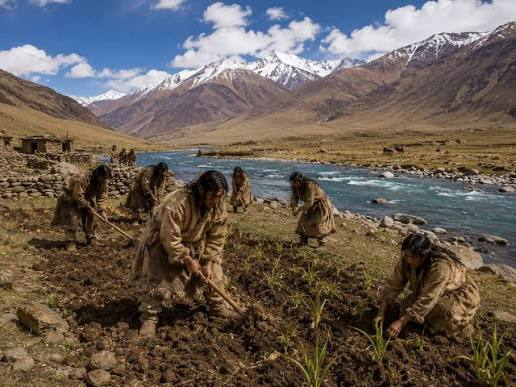
Prehistoric communities on the Tibetan Plateau used flexible subsistence strategies.
The exact balance between farming, hunting, gathering, and animal use could change according to local conditions.
In suitable areas, cultivated crops could supplement other food sources.
Wild animals and plants also remained important.
This mixed economic strategy reduced dependence on a single resource.
Animal Resources
Animals were essential to highland life.
They could provide:
meat;
hides;
bone for tools;
and other useful materials.
Over time, domesticated animals became increasingly important to many highland societies.
The archaeological study of animal bones can reveal information about hunting practices, livestock management, and dietary preferences.
Karuo and Highland Adaptation
One of the major questions in Tibetan archaeology concerns how humans successfully adapted to high altitude.
Long-term occupation required cultural adaptation as well as biological adaptation.
People developed technologies and economic strategies appropriate to their environment.
These could include:
insulated housing;
specialized clothing;
flexible food production;
animal management;
and seasonal movement.
Karuo provides important evidence for the early development of such highland lifeways.
Connections Beyond Tibet
The Karuo community was not necessarily isolated from the surrounding world.
Eastern Tibet occupies a geographical position linking the plateau with regions of Sichuan, Yunnan, and the Himalayas.
Material similarities between archaeological traditions can provide evidence for long-term interaction.
Objects, technologies, crops, and people could move across mountain corridors despite the challenges of the terrain.
Why Karuo Is Important
Karuo challenges outdated ideas that the Tibetan Plateau was an empty or inaccessible wilderness until relatively recent historical periods.
The archaeological evidence demonstrates that prehistoric people established organized settlements and developed practical solutions to highland living.
The site is important for understanding:
early settlement on the Tibetan Plateau;
Neolithic technology;
high-altitude adaptation;
prehistoric housing;
and the development of regional cultural traditions.
Conclusion
The Karuo site preserves evidence of a prehistoric community that successfully lived in the demanding environment of the Tibetan highlands around five thousand years ago.
Its houses, hearths, stone tools, pottery, and food remains reveal a population that had developed practical systems for surviving and organizing life at high altitude.
Karuo remains one of the most important archaeological sites for understanding the deep human history of Tibet and the remarkable ability of prehistoric communities to adapt to extreme environments.