Introduction
Kathu Pan, located in South Africa's Northern Cape, is one of the most important archaeological sites for understanding early hunting technology.
The site has produced evidence of stone points dating to roughly half a million years ago that have been interpreted as possible components of hafted spears.
The significance of Kathu Pan lies in the possibility that humans were producing complex hunting weapons far earlier than once assumed.
The Kathu Pan Landscape
Kathu Pan is part of a landscape containing archaeological deposits associated with ancient water and wetland environments.
These environments attracted animals.
Where animals gathered, human hunters also had opportunities.
The site therefore provides evidence for the interaction between water, animals, and human settlement.
Stone Points
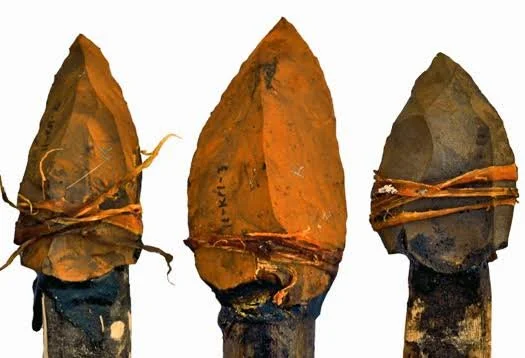
Archaeologists recovered large numbers of stone points.
Their shapes suggest intentional production for particular functions.
The points were carefully flaked.
Some show characteristics consistent with use as weapon tips.
Spears
A stone point by itself does not automatically prove a spear.
A spear is a composite object.
It may consist of:
wooden shaft;
stone point;
adhesive;
binding material.
Most of these components decay.
Archaeologists therefore rely on indirect evidence such as point morphology, impact damage, residue, experimental comparisons, and spatial context.
The Age of the Evidence
Kathu Pan is important because the relevant archaeological material dates to approximately 500,000 years ago.
This pushes complex projectile technology deep into the Middle Pleistocene.
The evidence therefore predates the widespread appearance of many later projectile traditions.
Hunting Technology
A hafted spear dramatically changes hunting possibilities.
Instead of approaching an animal with a simple wooden club, a hunter can use a pointed weapon capable of penetrating tissue.
A spear can be thrust at close range or potentially thrown, depending on its design.
Cooperative Hunting
Complex projectile weapons may also have implications for social organization.
Large-animal hunting often requires cooperation.
Hunters must coordinate movement.
They need knowledge of animal behavior.
They may have to anticipate escape routes.
Although direct evidence for specific hunting strategies is difficult to recover, weapon technology provides clues about these capabilities.
Fire and Hafting
Composite tools often require adhesives.
Adhesive production may involve heating plant resins or other substances.
If early populations were capable of producing effective adhesives, this would demonstrate chemical and technological knowledge.
Raw Materials
Toolmakers selected stone according to its properties.
A good spear point requires stone capable of producing strong sharp edges.
Raw-material procurement therefore reflects knowledge of geology.
Human Evolution
Who made the Kathu Pan points?
This is an important question.
The archaeological layers do not necessarily contain a fossil directly identifying the toolmakers.
Several Middle Pleistocene hominin populations occupied Africa.
Therefore, the safest interpretation is that the tools were made by hominins rather than assigning them automatically to one named species.
Broader Significance
Kathu Pan contributes to a broader pattern of evidence for early complex technology.
It complements discoveries from other African sites demonstrating that hominins were capable of planning multi-component tools long before the Late Pleistocene.
Conclusion
Kathu Pan is important because its approximately half-million-year-old stone points provide evidence relevant to the early history of hafted hunting weapons.
Whether every point functioned specifically as a spear tip cannot be demonstrated with certainty.
Nevertheless, the site strongly supports the conclusion that Middle Pleistocene hominins possessed sophisticated stone-working and hunting technologies.