Introduction
Florisbad, located in South Africa's Free State Province, is famous for a remarkably important human fossil discovered in association with a Middle Pleistocene archaeological and environmental record.
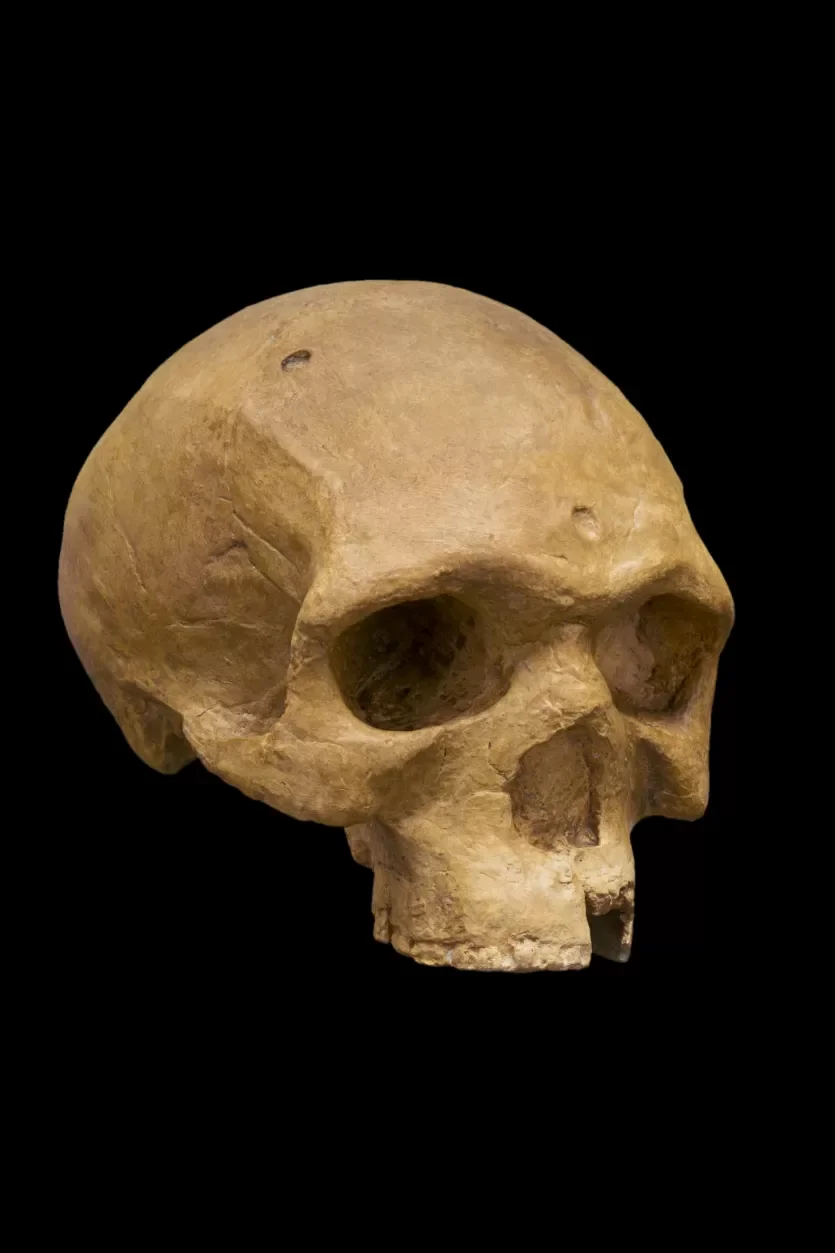
The Florisbad skull is generally dated to roughly 259,000 years ago and has played a major role in discussions about the evolution of Homo sapiens.
Its significance comes from its unusual anatomy.
The specimen appears neither completely archaic nor identical to later anatomically modern humans.
Instead, it represents a population during a period of major evolutionary change.
The Florisbad Site
Florisbad is associated with an ancient spring and lake environment.
Water attracted animals and provided opportunities for human occupation.
Over time, sediments accumulated around the ancient wetland.
These sediments preserved animal remains and archaeological material.
The Skull
The human fossil was discovered in the twentieth century.
It consists primarily of a partial skull.
Its anatomy displays a mixture of characteristics.
Some features resemble earlier Middle Pleistocene humans.
Others are compatible with populations approaching anatomically modern Homo sapiens.
Evolutionary Mosaic
Florisbad is important precisely because it does not fit neatly into one category.
Evolution often produces transitional populations whose anatomy combines multiple characteristics.
This does not mean that Florisbad represents a single "missing link."
The concept of a missing link is misleading because human evolution involved branching populations rather than one straight chain.
Dating
The fossil is commonly associated with an age around 259,000 years.
This places it within the Middle Pleistocene, a period when African populations were undergoing major evolutionary changes.
The date is particularly important because it falls relatively close to the period when early forms of Homo sapiens appear in the African fossil record.
Archaeological Evidence
Florisbad also contains stone tools and animal remains.
These materials provide environmental context.
The human fossil is therefore not an isolated anatomical specimen.
It belongs to a broader archaeological landscape.
Climate
The ancient spring environment changed with climate.
Wet and dry periods altered the lake and surrounding vegetation.
Animals responded to these changes.
Humans exploited the landscape according to available resources.
Human Evolution in Africa
Florisbad supports the broader view that modern human evolution was geographically complex.
Populations in different regions may have exchanged genes.
Anatomical characteristics could spread gradually.
Different populations could maintain distinctive traits while contributing to later Homo sapiens populations.
Relationship to Modern Humans
Researchers have debated exactly how Florisbad relates to later Homo sapiens.
Some classifications have placed the specimen within or near the evolutionary history of early Homo sapiens.
Others emphasize its distinct morphology.
The uncertainty is scientifically valuable.
It demonstrates that the evolutionary history of our species remains an active field of research.
Archaeological Context
The association between fossil, stone tools, fauna, and ancient environmental deposits allows researchers to study both biology and behavior.
The site demonstrates that human evolution cannot be separated from environmental history.
Conclusion
Florisbad provides one of the most important human fossils from Middle Pleistocene Africa.
Its approximately 259,000-year-old skull preserves a mosaic of anatomical features relevant to the emergence of Homo sapiens.
Rather than providing a simple missing link, Florisbad reveals a complex stage in a branching evolutionary history.