Introduction
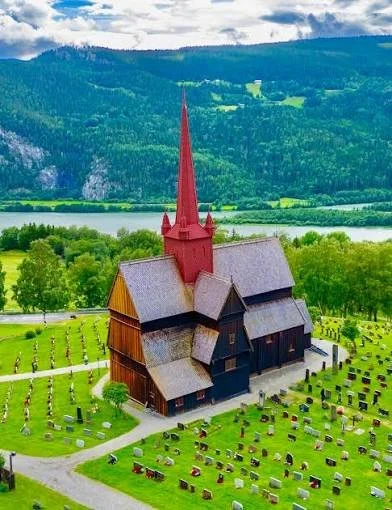
Ringebu Stave Church stands in the historic Gudbrandsdal valley of central Norway and is one of the country's best-known surviving medieval wooden churches. Its location is significant because Gudbrandsdal was an important inland communication corridor, linking communities, agricultural settlements, and routes across the Norwegian interior.
The church represents the remarkable stave-building tradition that flourished in medieval Norway. Constructed primarily from timber, it demonstrates how Scandinavian builders developed structural techniques capable of producing tall and durable religious buildings from a material that was abundant in the Norwegian landscape.
Although the present church incorporates modifications made during later centuries, its medieval core provides valuable evidence for the development of Norwegian Christian architecture.
The Medieval Timber Tradition
Stave churches developed from Norway's extensive woodworking tradition.
Long before Christian churches were constructed, Scandinavian societies had mastered timber architecture. Houses, halls, boats, storage buildings, bridges, and defensive structures were commonly built from wood.
Christianity introduced a new architectural requirement: permanent buildings dedicated to communal worship.
The stave church provided an effective solution. Rather than copying stone churches directly, Norwegian builders adapted Christian architectural concepts to their own construction traditions.
Structural Design
The defining feature of a stave church is its internal timber framework.
Vertical posts known as staves provide the primary structural support. These are connected with beams and reinforced with additional timber members.
The walls are not simply piles of horizontal logs. Instead, the building resembles a carefully engineered wooden skeleton.
This construction method allowed builders to create substantial vertical structures while keeping the weight manageable.
The structural system also made extensive use of carefully designed joints. Medieval carpenters relied on wooden connections, pegs, braces, and interlocking components rather than modern metal hardware.
Such construction required extensive practical knowledge.
Ringebu's Distinctive Form
Ringebu Stave Church is particularly interesting because of its architectural development.
Unlike some smaller stave churches, Ringebu possesses a substantial appearance and has undergone changes reflecting later requirements.
The church demonstrates that stave architecture was not a single rigid design. Builders could modify the basic system according to local conditions, available resources, congregation size, and changing liturgical needs.
The result is an architectural form that combines medieval foundations with later historical layers.
Christianity in Gudbrandsdal
Gudbrandsdal played an important role in the Christianization of inland Norway.
The valley contained agricultural communities that were connected through local and regional networks. As Christianity became established, churches became permanent centers of religious life.
The construction of a church represented a major investment.
Large quantities of timber had to be obtained and transported. Skilled craftsmen were required to shape structural elements. Communities had to support the building economically and maintain it over generations.
The church therefore represented not merely religious belief but also collective organization.
The Church and Medieval Society
A medieval church was a central institution.
People came to church for worship, but the building was also associated with baptisms, marriages, funerals, seasonal festivals, and community gatherings.
The Christian calendar influenced agricultural and social rhythms.
Major feast days created recurring occasions when religious and social life intersected.
The church also represented authority. Its presence demonstrated that Christianity was not simply a personal belief but a social institution embedded in the landscape.
Architecture as Cultural Evidence
Ringebu provides evidence for the cultural adaptation of Christianity.
The basic purpose of the building was Christian, yet its construction belonged to a distinctly Scandinavian tradition.
This distinction is important.
Medieval Europe is often imagined as being dominated by standardized stone churches. In reality, architecture varied enormously according to geography, climate, resources, and local craftsmanship.
Norway's stave churches demonstrate that Christian architecture could take radically different forms while serving similar religious purposes.
Timber and Environmental Knowledge
The construction of Ringebu also reveals medieval knowledge of natural resources.
Timber quality mattered enormously.
Builders had to select trees that were sufficiently strong and suitable for large structural components. They also needed to understand how wood behaved when exposed to moisture, temperature changes, and prolonged loading.
The survival of medieval timber buildings indicates that these craftsmen possessed sophisticated empirical knowledge even without modern structural engineering.
Later Modifications
Ringebu Stave Church, like many surviving medieval churches, should not be treated as a completely untouched monument.
Buildings that remain in use must adapt.
Doors may be replaced. Windows may be enlarged. Interior arrangements may change. Structural elements may be repaired. New architectural components may be added.
These changes are historically significant because they reveal how later generations interacted with medieval heritage.
The church is therefore both a medieval monument and a record of centuries of continued use.
Preservation
Preserving a timber church presents challenges that differ from those encountered with stone architecture.
Wood can be damaged by moisture, fungi, insects, temperature fluctuations, and structural stress.
Conservation therefore requires careful monitoring.
Modern preservation seeks to protect historical material while avoiding unnecessary replacement. Where original timber survives, it represents irreplaceable archaeological evidence.
Historical Significance
Ringebu Stave Church contributes to our understanding of:
medieval Norwegian Christianity;
timber engineering;
Scandinavian craftsmanship;
rural community organization;
medieval landscape settlement;
architectural adaptation;
long-term heritage preservation.
Its value lies not in a single feature but in the combination of these elements.
Conclusion
Ringebu Stave Church is one of the enduring monuments of Norway's medieval landscape.
Its timber framework reflects the ingenuity of Scandinavian carpenters, while its position in Gudbrandsdal connects it to the agricultural and communication networks of inland Norway.
Most importantly, the church illustrates how architecture can preserve evidence of cultural change. Christianity transformed Norway's religious world, but it did not erase local traditions of woodworking and artistic expression. Instead, those traditions became part of the country's Christian architectural heritage.
Ringebu therefore stands as both a religious building and a historical document—one whose timbers preserve nearly a millennium of Norwegian architectural and social history.