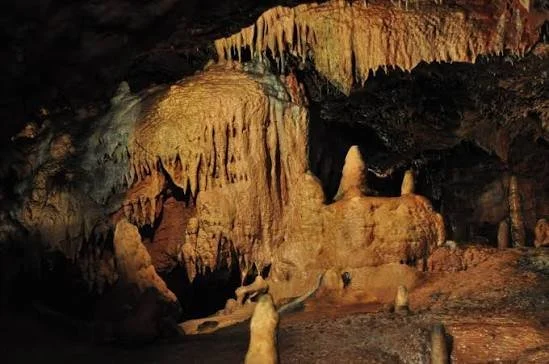
Kents Cavern in Devon is one of Britain's most important prehistoric sites.
Its significance comes from the extraordinary range of evidence preserved within and around the cave system.
Archaeological investigations have revealed traces associated with ancient stone-tool makers, Neanderthal populations, Ice Age animals, and early modern humans.
The story stretches across hundreds of thousands of years.
However, there is an important clarification.
Kents Cavern was not continuously occupied for 400,000 years.
Instead, different populations visited and used the cave and surrounding landscape at different times.
The archaeological deposits represent repeated episodes separated by immense periods of environmental change.
Britain During the Pleistocene
To understand Kents Cavern, modern Britain must be forgotten.
The country we know today did not exist in the same geographical form during much of the Pleistocene.
Sea levels repeatedly changed.
During some periods, Britain was connected to continental Europe.
Animals and human populations could move into the region.
During severe cold phases, large areas became inhospitable.
Human occupation was therefore intermittent.
Kents Cavern preserves evidence from several of these ancient worlds.
The Oldest Toolmakers
The site contains stone tools associated with very ancient periods of human activity.
Handaxes and other implements demonstrate that human populations were present in the region hundreds of thousands of years ago.
These early toolmakers belonged to populations that existed long before modern humans entered Europe.
Their technology demonstrates planning and skill.
A handaxe was created by repeatedly striking stone to produce a symmetrical, sharp-edged object.
The maker had to understand the structure of the stone and anticipate the effects of each blow.
The Neanderthal Chapter
Later archaeological material is associated with Middle Paleolithic populations, including Neanderthals.
Neanderthals repeatedly occupied parts of Britain during favorable climatic periods.
They were capable hunters and skilled toolmakers.
They adapted to changing environments and used sophisticated stone technologies.
At Kents Cavern, their archaeological presence demonstrates that the cave remained part of a human landscape long after the earliest handaxe makers disappeared.
The Arrival of Modern Humans
One of the site's most important discoveries is the fragmentary human upper jaw known as Kents Cavern 4.
The fossil has been identified as belonging to Homo sapiens.
Its chronology has been the subject of significant scientific discussion because directly dating the fossil was not straightforward.
Researchers therefore examined associated materials and the archaeological context.
The result is a continuing debate about exactly when early modern humans reached the region.
What remains clear is that Kents Cavern is central to discussions about the earliest Homo sapiens in Britain and northwestern Europe.
Humans and Carnivores Shared the Cave
Kents Cavern was not exclusively used by humans.
Carnivores also occupied or visited cave systems.
Animal remains can reveal evidence of:
Hyenas
Bears
Deer
Horses
Woolly rhinoceroses
Other Ice Age species
Archaeologists must determine how these bones entered the cave.
A bone may have been brought by a human.
It may have been dragged in by a predator.
It may have been deposited naturally.
Cut marks and tooth marks provide crucial clues.
Why Caves Are Archaeological Time Capsules
A cave can preserve material that would disappear in an open landscape.
Sediment can cover bones and tools.
The stable environment may slow some destructive processes.
However, caves are also complicated.
Water can move deposits.
Animals can disturb sediments.
Later human activity can mix layers.
The interpretation of Kents Cavern therefore depends on detailed geological and archaeological study.
More Than a Prehistoric Home
The people who used Kents Cavern did not simply “live in a cave” in the popular sense.
The cave was one location within a wider landscape.
Humans hunted outside.
They gathered raw materials.
They followed animals.
They moved according to season and climate.
The cave could serve as shelter, a temporary camp, or another specialized location.
The Long Archaeological Record
The true importance of Kents Cavern lies in its chronological range.
Few sites connect so many chapters of Britain's prehistoric past.
Its evidence links:
Early Pleistocene or Middle Pleistocene toolmakers
Neanderthal-associated populations
Early modern humans
Later prehistoric communities
The cave therefore demonstrates that Britain's human history is far older than written records.
Long before Roman roads, medieval castles, or even agriculture, humans were already entering the limestone landscape of Devon.
Kents Cavern remains one of the places where that immense history can still be traced.