Some archaeological sites become famous because they contain a spectacular object.
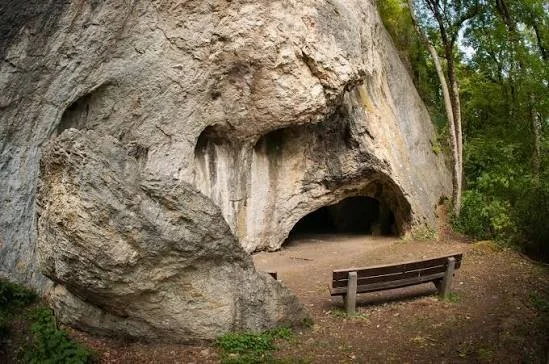
Sirgenstein Cave is important for a different reason.
Its greatest treasure is time.
Within its sediments, archaeologists identified evidence representing multiple chapters of European prehistory. The cave's layers preserve a sequence associated with different technological traditions and human populations, including Middle Paleolithic occupations connected with Neanderthals and Upper Paleolithic phases associated with modern humans.
Sirgenstein is therefore a prehistoric archive.
Its floor became a record book written in sediment, stone, bone, ash, and abandoned tools.
The Importance of Archaeological Layers
The study of Sirgenstein begins with stratigraphy.
Stratigraphy is the analysis of layers.
Over time, sediments accumulate.
A human group may occupy a cave and leave behind stone tools and animal bones.
Later, windblown sediment covers those remains.
Thousands of years pass.
Another group enters the cave and leaves its own material.
Gradually, a sequence develops.
When archaeologists excavate carefully, they can reconstruct that sequence.
In ideal conditions, lower layers are older than higher ones.
However, archaeology is rarely perfectly simple.
Animals can disturb sediments.
Water can move objects.
Human activity can mix layers.
Later excavations may damage earlier deposits.
For this reason, stratigraphic interpretation requires careful analysis.
Sirgenstein became important because it offered an opportunity to study cultural change through a long sequence rather than a single occupation.
The Middle Paleolithic World
The older portions of Sirgenstein's archaeological sequence are associated with the Middle Paleolithic.
Across much of Europe, this period is strongly associated with Neanderthal populations.
Neanderthals were not primitive failures of evolution.
They were successful humans who survived for hundreds of thousands of years across diverse environments.
They hunted.
They controlled fire.
They manufactured sophisticated stone tools.
They adapted to climatic fluctuations.
The tools associated with Middle Paleolithic occupations often demonstrate deliberate preparation and controlled flaking.
A stone was not simply broken randomly.
Craftspeople understood how to select raw material and strike it in ways that produced useful cutting edges.
Neanderthals and the Cave
The Neanderthal-associated inhabitants of Sirgenstein would not have lived entirely inside the cave.
The surrounding landscape was essential.
They moved through valleys.
They located stone resources.
They hunted animals.
They collected fuel.
They may have returned to familiar locations repeatedly.
The cave was one part of a larger territory.
Yet the protected environment of the cave preserved traces of those activities.
Broken tools became archaeological evidence.
Discarded animal bones became evidence of diet and environment.
Hearth-related materials preserved traces of fire.
The Transition to the Upper Paleolithic
One of the greatest questions in European archaeology concerns what happened when Homo sapiens populations entered territories already inhabited by Neanderthals.
The transition was complex.
Different regions experienced it differently.
Some archaeological traditions may represent periods of technological experimentation or population interaction.
Eventually, Neanderthals disappeared as a distinct human population.
Modern humans became the only surviving human species in Europe.
Sirgenstein is important because its sequence contributes to the archaeological study of this broader transition.
The Aurignacian and Modern Humans
Upper layers associated with the Aurignacian represent a cultural world connected with early Homo sapiens.
Compared with earlier periods, Upper Paleolithic archaeology often contains increasing evidence for specialized technologies and symbolic material culture.
In the wider Swabian Jura, Aurignacian communities produced:
Mammoth ivory figurines
Personal ornaments
Bone and antler tools
Musical instruments
Sirgenstein forms part of this broader regional context.
The cave therefore connects the Neanderthal world with the cultural world of early modern humans.
Why the Sequence Matters
Imagine finding a single Neanderthal tool.
It tells archaeologists that Neanderthals were present.
Now imagine finding multiple layers.
The lower layer contains one technological tradition.
A higher layer contains another.
Changes become visible.
Researchers can investigate:
Changes in stone-tool production
Shifts in animal exploitation
Environmental change
New raw materials
Changes in human occupation
The sequence becomes more valuable than any individual artifact.
Sirgenstein is important because it provides this chronological perspective.
Climate Change and Human Occupation
The Paleolithic was shaped by repeated climatic change.
Glaciers advanced and retreated.
Vegetation changed.
Animal populations moved.
Regions became accessible or inhospitable.
Human groups had to adapt.
A cave might be occupied during one climatic phase and abandoned during another.
Therefore, gaps in the archaeological sequence are also important.
The absence of human material can reveal periods when a region was unsuitable or simply not used.
Animal Bones as Environmental Evidence
The faunal remains recovered from cave sites can help reconstruct ancient environments.
Different animals prefer different habitats.
The presence of reindeer, for example, may indicate environmental conditions different from those associated with forest-adapted species.
Bones can also reveal:
Butchery marks
Carnivore damage
Burning
Age of hunted animals
Seasonality
Patterns of resource use
Sirgenstein's deposits therefore contain information about both humans and the ecosystems surrounding them.
A History of Archaeological Research
Like many famous European caves, Sirgenstein was excavated during periods when archaeology was still developing as a scientific discipline.
Early researchers made important discoveries but did not possess modern technologies such as:
High-precision radiocarbon dating
Ancient DNA analysis
Microscopic use-wear analysis
Advanced sediment studies
Three-dimensional digital recording
This means that archaeological collections can continue to produce new knowledge long after excavation.
A stone tool recovered more than a century ago can be reanalyzed today.
Its microscopic surface may reveal how it was used.
Its raw material may reveal where it came from.
Its archaeological context can be reconsidered using new chronological models.
Sirgenstein as a Prehistoric Archive
The cave demonstrates that human history is not a straight line.
Different populations entered the landscape.
Technologies changed.
Climates shifted.
Species disappeared.
New cultural traditions emerged.
The archaeological layers preserve fragments of these transformations.
Sirgenstein may not contain one object as famous as the Venus of Hohle Fels or the mammoth carvings of Vogelherd.
But its importance is arguably more chronological.
It allows archaeologists to examine change itself.
And sometimes, that is archaeology's greatest achievement.
A single artifact can reveal a moment.
A sequence of layers can reveal a history.