Introduction
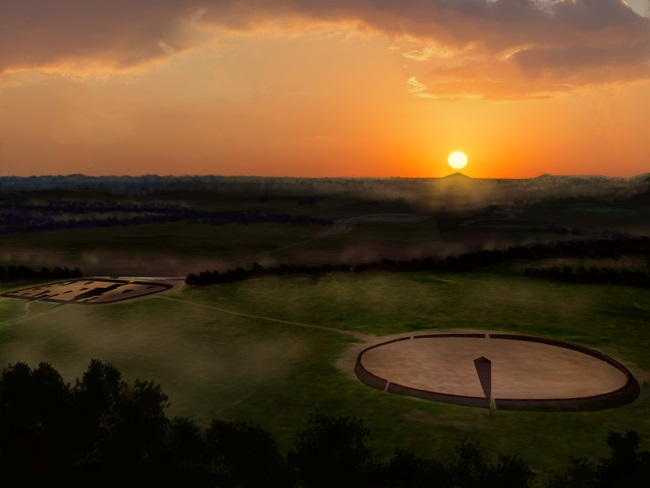
Located in Ross County, Ohio, Shriver Circle is one of the many ceremonial earthworks constructed by the Hopewell culture between approximately 100 BCE and 500 CE. Although it is less well known than the nearby Newark or Hopewell Mound Group, Shriver Circle demonstrates the remarkable engineering, surveying, and ceremonial traditions that characterized Hopewell society. Rather than serving as a permanent settlement or military fortification, the enclosure functioned primarily as a sacred gathering place where religious ceremonies, seasonal celebrations, social meetings, and long-distance exchanges took place. The site's carefully planned circular design reflects the Hopewell belief that geometry and landscape held deep spiritual meaning.
Construction and Engineering
Shriver Circle was built as a nearly perfect circular enclosure consisting of a broad earthen embankment surrounded by an exterior ditch. The circular wall measured several hundred feet across and required the excavation and movement of thousands of cubic meters of soil. Hopewell workers accomplished this enormous task using simple stone hoes, antler picks, wooden digging sticks, and woven baskets, demonstrating an impressive level of labor organization despite the absence of metal tools or draft animals.
The builders carefully selected level ground before marking the circle with extraordinary geometric precision. Archaeologists believe that ropes, wooden stakes, and repeated measurements were used to maintain the enclosure's nearly perfect symmetry. The embankment was constructed by layering compacted soil, while the surrounding ditch provided both construction material and additional visual definition. Multiple entranceways interrupted the circular wall, creating formal access points that may have aligned with important landscape features or astronomical events.
Ceremonial and Social Functions
Unlike later Native American towns, Shriver Circle contains little evidence of permanent domestic occupation. Instead, archaeologists believe it functioned as a ceremonial center where dispersed Hopewell communities periodically gathered for religious rituals, feasting, trade, and political alliances. Large open spaces within the enclosure could accommodate hundreds of participants during seasonal festivals.
Artifacts discovered in the surrounding region—including finely crafted stone pipes, ceremonial blades, copper ornaments, mica sheets from the Appalachian Mountains, marine shells from the Gulf Coast, and obsidian imported from Yellowstone—demonstrate that Hopewell communities participated in one of prehistoric North America's largest long-distance exchange networks. These valuable goods were likely displayed, exchanged, or ritually deposited during important ceremonies held at sites such as Shriver Circle.
Archaeological Importance
Shriver Circle contributes to a broader understanding of Hopewell ceremonial landscapes throughout Ohio. Rather than constructing isolated monuments, Hopewell engineers created interconnected ritual centers that combined earthworks, burial mounds, plazas, and processional routes into carefully planned sacred environments. The site's geometric precision also illustrates the sophisticated mathematical knowledge possessed by Hopewell surveyors, who consistently produced remarkably accurate circular enclosures without written measurements or advanced instruments.
Conclusion
Although less famous than Ohio's larger Hopewell monuments, Shriver Circle stands as an impressive example of prehistoric engineering, communal organization, and ceremonial architecture. Its carefully constructed circular enclosure reflects the Hopewell people's advanced surveying abilities, extensive trade connections, and deep spiritual relationship with geometry and the surrounding landscape.