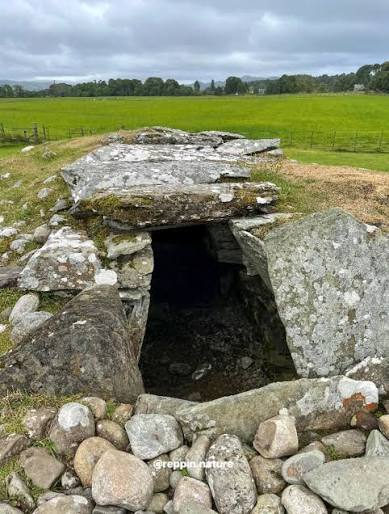
Nether Largie forms one of the most important components of the prehistoric ceremonial landscape of Kilmartin Glen.
Rather than representing a single monument, the Nether Largie complex consists of several burial cairns positioned along the valley floor. Together they demonstrate how prehistoric communities repeatedly returned to the same landscape for funerary and ritual purposes.
The Linear Cemetery
The cairns of Kilmartin Glen form a remarkable north-south alignment.
The monuments are visually connected with one another and with other ritual features of the valley.
This arrangement suggests that location itself was an important part of prehistoric ceremonial activity.
Nether Largie South
Nether Largie South is particularly significant because it originated as a Clyde-type chambered cairn.
The monument was constructed more than 5,000 years ago.
Its central chamber was divided into compartments and probably accommodated multiple burials over an extended period.
Communal Burial
Unlike a modern individual tomb, Neolithic chambered cairns could function as communal burial monuments.
Bodies were placed inside over time.
As additional burials occurred, earlier remains could be rearranged.
Archaeological evidence from comparable monuments suggests that bones could be organized into groups, such as skulls and long bones.
Transformation During the Bronze Age
Nether Largie South was later modified.
The earlier chambered cairn was expanded into a large round cairn.
Two additional cists were inserted into the monument.
This demonstrates that the site remained meaningful long after its original construction.
Nether Largie Mid
Nether Largie Mid belongs to the later Bronze Age phase of the cemetery.
Two burial cists were discovered during excavation.
One contained unusual carved motifs, including cup-and-ring markings and representations of axe-heads.
These carvings are significant because axe imagery is relatively rare in Scotland.
Nether Largie North
Nether Largie North also contains remarkable carvings.
Its central cist capstone features approximately forty cup-and-ring marks as well as two pecked axe-head representations.
The possibility that the capstone itself had an earlier history of use is particularly intriguing.
The Meaning of the Alignment
Why were these cairns placed in a line?
No definitive answer exists.
Possible interpretations include:
ceremonial movement;
ancestral commemoration;
territorial marking;
astronomical observation;
or the deliberate creation of a sacred landscape.
The strongest archaeological conclusion is that the monuments were not randomly distributed.
Landscape and Memory
Prehistoric societies did not necessarily separate the past from the present as sharply as modern societies often do.
An ancient burial monument could remain an active symbol for generations.
New communities could build beside older monuments, creating a layered landscape in which different periods remained physically connected.
Conclusion
Nether Largie: Argyll's Clyde Tomb Alignment provides extraordinary evidence for long-term prehistoric engagement with death, ancestry, and landscape.
The monuments reveal not only how people buried their dead but also how communities organized sacred places across generations.
Their alignment within Kilmartin Glen makes them an essential part of Scotland's prehistoric ceremonial geograph