Introduction
Kuaua Pueblo, located near the Rio Grande north of Albuquerque, is particularly famous for its remarkable kiva murals.
The site provides evidence for Pueblo architecture, ceremonial life, artistic traditions, agriculture, and the cultural transformations that occurred during the period of Spanish colonization.
The Pueblo
Kuaua was a substantial Pueblo settlement.
Its architecture included residential rooms, communal spaces, plazas, and kivas.
The community depended heavily on agriculture.
Corn, beans, squash, and other crops formed the foundation of subsistence.
Kivas
Kivas were important ceremonial structures within Pueblo communities.
They could be partly underground and often contained specialized architectural features.
Their location within settlements indicates that ritual activity was integrated into community life.
The Murals
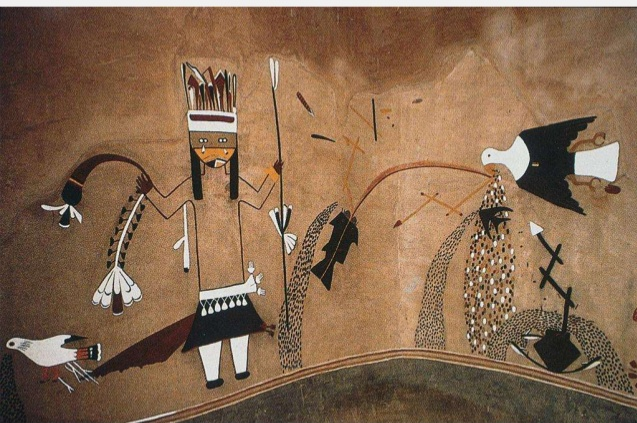
Kuaua's murals are among its most important archaeological discoveries.
Painted designs covered interior walls of kivas.
The images provide rare evidence for Pueblo visual culture.
Because pigments can survive in protected underground structures, kiva murals can preserve artistic information that would otherwise disappear.
What Did the Murals Mean?
Interpretation requires caution.
Some imagery appears to involve supernatural beings, ceremonial figures, masks, animals, and geometric patterns.
However, researchers cannot assume that every image has one fixed meaning.
Pueblo religious traditions are complex, and many ceremonial practices were not recorded by early European observers.
Art as Historical Evidence
The murals are valuable because they demonstrate that Pueblo societies had sophisticated artistic traditions.
Painting was not merely decorative.
Images could participate in ceremonial and social systems.
The creation of murals required pigments, tools, artistic skill, and coordinated labor.
Spanish Contact
Kuaua also preserves evidence of the transition brought by Spanish colonization.
The arrival of Spanish settlers and missionaries introduced new political, religious, and economic systems.
Pueblo communities responded in different ways.
Some incorporated new materials and practices.
Others resisted colonial authority.
The result was a complicated process of cultural interaction.
Preservation
Murals are exceptionally fragile.
Light, humidity, temperature changes, physical contact, and exposure can damage pigments.
Archaeological conservation therefore requires carefully controlled environments.
Why Kuaua Matters
Kuaua's murals provide a rare visual window into Pueblo ceremonial life.
They allow researchers to study imagery that complements archaeological evidence from architecture and artifacts.
Together, these sources provide a more complete picture of prehistoric and early historic Pueblo society.
Conclusion
Kuaua Pueblo is one of the most valuable archaeological sites in New Mexico for understanding Pueblo art and ceremonial traditions.
Its kiva murals demonstrate the sophistication of Indigenous artistic expression and provide evidence of a rich symbolic world that existed long before and during the earliest period of European colonization.
The site reminds us that archaeological ruins are not simply remnants of buildings.
They preserve ideas, beliefs, artistic traditions, and memories embedded within physical landscapes.