Introduction
Staraya Ladoga, known historically as Ladoga, occupies a crucial position in the early history of eastern Europe and the Viking Age.
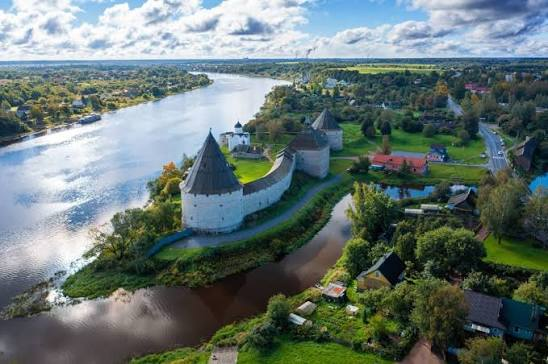
Located near the Volkhov River and Lake Ladoga, the settlement developed at the intersection of Scandinavian, Finnic, Slavic, and eastern trading networks.
Its archaeological remains provide important evidence for the formation of early urban and commercial communities in the lands that later became associated with Rus'.
A Strategic Waterway
Ladoga's importance was primarily geographical.
The settlement stood near the route connecting the Baltic Sea with the river systems of eastern Europe.
From the Baltic, ships could travel through Lake Ladoga and along the Volkhov toward Lake Ilmen and Novgorod.
Other river routes eventually connected the region toward the Dnieper and the Black Sea.
Scandinavian Connections
Archaeological discoveries demonstrate strong Scandinavian connections.
Objects associated with Scandinavian material culture have been recovered alongside local artifacts.
This evidence suggests that Scandinavians were active participants in the settlement's life.
However, Ladoga should not be understood as simply a Scandinavian colony.
Its population and culture were probably highly mixed.
A Multicultural Community
Ladoga brought together people from different cultural backgrounds.
Scandinavian merchants and warriors interacted with local Finnic and Slavic populations.
Such interaction produced cultural exchange.
Languages, technologies, artistic styles, and economic practices could spread through these contacts.
Trade
Ladoga became an important trading center.
Goods passing through the region could include:
furs;
amber;
metal;
beads;
weapons;
textiles;
food products;
imported luxury goods.
The settlement therefore participated in long-distance economic systems.
Craft Production
Archaeological evidence indicates local manufacturing.
Metalworking, woodworking, bone and antler working, pottery production, and other crafts supported the community.
Craft specialization is one of the characteristics that distinguishes major trading settlements from small rural villages.
Viking Age Networks
Ladoga formed part of the larger Viking-Age network extending across northern Europe.
Scandinavian ships connected settlements around the Baltic with river routes leading deep into eastern Europe.
This network ultimately contributed to the development of political structures associated with early Rus'.
The Rurikid Tradition
Medieval traditions connect Ladoga with the early history of the Rurikid dynasty.
Although later written accounts must be treated critically, archaeological evidence confirms that Ladoga was already an important settlement during the period associated with the emergence of early Rus'.
Fortifications
Ladoga was fortified at different stages of its history.
Defensive structures protected valuable economic and political assets.
The presence of fortifications demonstrates the instability of the region and the importance of controlling trade routes.
Archaeological Significance
Ladoga is exceptionally important because archaeological research can trace changes over several centuries.
Excavations have revealed buildings, workshops, imported goods, weapons, jewelry, coins, and other artifacts.
These materials demonstrate the settlement's participation in extensive networks of exchange.
Conclusion
Ladoga provides one of the clearest archaeological windows into the emergence of the Viking-Age world in eastern Europe.
Its location connected the Baltic with the great river routes leading into the interior.
Its multicultural population, craft production, trade, and political connections demonstrate that the origins of Rus' were shaped by interaction between many different communities.
Ladoga was therefore not simply a Viking settlement.
It was a meeting point between Scandinavia, the Baltic, and eastern Europe—and one of the places where the foundations of a new political world were taking shape.