Introduction
Novgorod Detinets is the historic fortified center of Veliky Novgorod and one of the most important archaeological and architectural complexes in medieval Russia.
Situated beside the Volkhov River, the fortress developed at the heart of a city that became one of the most powerful commercial and political centers of medieval eastern Europe.
Although the title identifies the site with a ninth-century origin, the surviving fortress is the product of many centuries of rebuilding and expansion.
Novgorod's Strategic Location
The Volkhov River connected Lake Ilmen with Lake Ladoga and the Baltic Sea.
This waterway formed part of an extensive network connecting northern Europe with the lands of Rus'.
Novgorod's location allowed merchants and travelers to move between Scandinavia, the Baltic, and the interior.
The Birth of a Major City
Novgorod grew into a major urban center during the early medieval period.
Its economy depended heavily on trade.
Merchants exchanged:
furs;
wax;
honey;
timber;
metals;
textiles;
luxury goods.
The city became an important meeting point between different cultural and economic worlds.
The Detinets
The Detinets functioned as the city's fortified political and religious center.
The walls enclosed important buildings and provided protection during warfare.
The fortress's position beside the river gave it additional strategic value.
The Cathedral of Saint Sophia
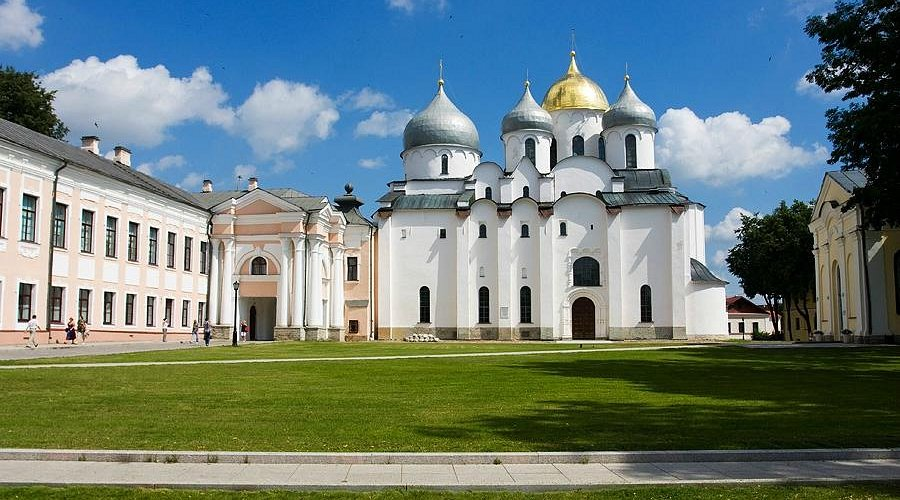
One of the most important buildings within the Detinets is the Cathedral of Saint Sophia.
Constructed in the eleventh century, it became a major symbol of Novgorod.
The cathedral demonstrates the city's wealth and the importance of Christianity in its political culture.
Novgorod's Political Tradition
Novgorod developed a distinctive form of political organization.
The city was associated with the veche, a public assembly that played an important role in political decision-making.
Political authority was therefore distributed differently from the more centralized monarchies that later emerged elsewhere in Russia.
The Detinets stood at the center of this political landscape.
Trade and the Baltic World
Novgorod was deeply connected with northern European commerce.
Its merchants interacted with Scandinavian and German traders.
The city's economic influence extended across enormous distances.
Archaeological finds demonstrate connections reaching far beyond the immediate region.
Birch-Bark Documents
Perhaps the most remarkable evidence from Novgorod comes from birch-bark documents.
These writings preserved everyday communications, financial records, requests, complaints, and other messages.
They reveal that literacy was not restricted exclusively to religious elites.
The documents provide an unusually intimate view of medieval urban society.
Archaeological Importance
Novgorod's archaeological layers are exceptionally valuable.
Waterlogged soil can preserve organic materials that would normally disappear.
Researchers have recovered:
wooden structures;
tools;
leather;
seeds;
food remains;
household objects;
writing materials.
This makes Novgorod one of the world's most important medieval archaeological cities.
Conclusion
Novgorod Detinets represents the political and religious heart of one of medieval Europe's most influential cities.
Its walls protected institutions that controlled a vast commercial network.
The combination of fortress, cathedral, political assembly, and urban economy demonstrates the complexity of medieval Novgorod.
The archaeological evidence from the city makes its history especially valuable because it allows historians to move beyond the lives of rulers and examine the experiences of ordinary residents.
Novgorod was not simply a medieval Russian city.
It was a major bridge between the Baltic world and eastern Europe.