Introduction
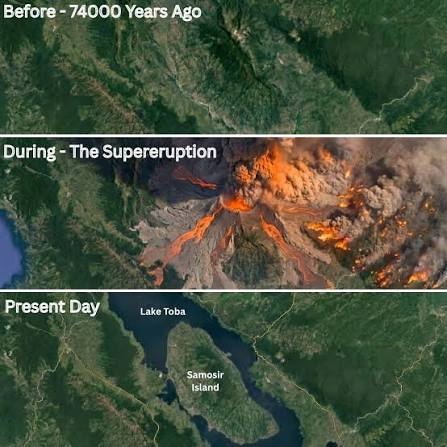
The Late Pleistocene epoch was irrevocably altered by the cataclysmic eruption of the Toba supervolcano in northern Sumatra approximately 74,000 years ago. Registering as a Magnitude 8 event on the Volcanic Explosivity Index (VEI), the Youngest Toba Tuff (YTT) eruption stands as the largest explosive volcanic event on Earth over the last two million years. This disaster ejected an estimated 2,800 cubic kilometers of volcanic material into the atmosphere, blanketed millions of square kilometers in ash, and triggered a profound macro-regional environmental disruption that forced early human populations across Wallacea and the wider Indian Ocean basin to adapt to sudden, severe ecological stress.
Stratigraphy, Climate Dynamics, and the Genetic Bottleneck Debate
The physical evidence of the Toba event is preserved within a massive global stratigraphic marker layer. The eruption column punched deep into the stratosphere, spewing billions of tons of sulfur dioxide ($SO_2$) that reacted with water vapor to create a persistent, highly reflective global sulfate aerosol veil.
This atmospheric shield caused a drastic reduction in solar radiation reaching the Earth's surface, precipitating what modelers identify as a "volcanic winter," which lowered global temperatures by several degrees Celsius for nearly a decade and devastated terrestrial vegetation across Southeast Asia.
For decades, evolutionary biologists leveraged the Toba Catastrophe Theory to explain a pronounced genetic bottleneck in Homo sapiens lineages, suggesting the volcanic winter decimated human populations down to a few thousand breeding pairs.
However, recent high-resolution archaeological excavations in South Asia and South Africa have revealed continuous stone tool records directly spanning above and below the YTT ash layers. This indicates that while the ecological shock was severe, isolated populations possessed the behavioral flexibility and resource-gathering strategies necessary to weather the volcanic winter without experiencing total demographic collapse.
Conclusion
The Youngest Toba Tuff eruption remains a foundational benchmark for studying Late Pleistocene climate instability and hominin resilience. The massive blanket of volcanic ash buried landscapes under meters of debris, reshaping river systems and choking coastal ecosystems across Sundaland and Wallacea. Yet, the survival of human lineages across this deep-time boundary underscores the remarkable evolutionary adaptability of early hominins, demonstrating that raw environmental trauma often acts as a critical evolutionary driver for behavioral innovation