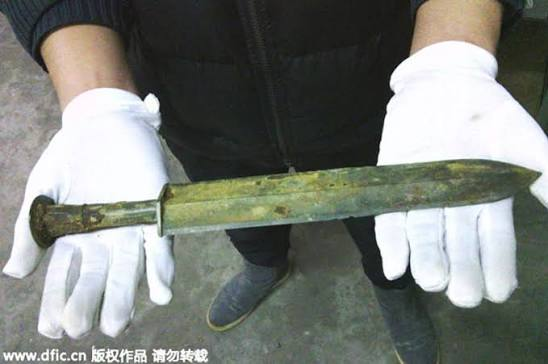
Lijiashan is an important archaeological site associated with the ancient Dian cultural world of Yunnan. The site became especially notable for its discoveries of bronze weapons and other objects that demonstrate the advanced metallurgical traditions of southwestern China.
The description of Lijiashan as a “bronze sword cache” reflects the importance of weapons among its archaeological finds, although such discoveries must be understood within their full burial and cultural context.
Weapons were not simply tools of war. In ancient societies, they could also function as symbols of authority, prestige, and identity.
Bronze Weapons in Ancient Yunnan
Bronze technology allowed artisans to produce durable weapons with carefully controlled shapes.
A bronze sword required:
access to copper and other metals,
knowledge of alloy composition,
the creation of a mold,
controlled casting,
and finishing work.
The production process required considerable skill.
A poorly made weapon could break or bend during use.
Swords and Social Status
In many ancient societies, weapons were associated with elite identity.
A finely produced sword could communicate:
military authority,
wealth,
craftsmanship,
and social status.
When swords were placed in burials, they may have represented the identity or status of the deceased.
However, the presence of a weapon does not automatically prove that the individual was a professional warrior.
Weapons could have ceremonial or symbolic roles.
The Dian Military World
The archaeological evidence from the Dian region includes weapons and artistic scenes associated with conflict.
These indicate that warfare and political competition were important parts of society.
Control over territory and resources could produce conflict between communities.
The possession of weapons was therefore closely connected with political power.
Metallurgical Knowledge
Bronze production required careful management of materials.
Copper alone can be relatively soft for certain applications.
Adding tin or other metals can change the properties of the final alloy.
Ancient metalworkers developed practical knowledge through generations of experimentation.
They learned how different mixtures affected:
hardness,
durability,
casting behavior,
and appearance.
Weapon Workshops
The production of large numbers of weapons suggests organized craft activity.
Specialized artisans may have worked in workshops supported by political elites.
The organization of production could involve:
miners or suppliers,
transporters,
furnace operators,
mold makers,
and finishing specialists.
This demonstrates that weapon production was connected with wider economic systems.
Weapons Beyond Warfare
A bronze sword could remain important even when it was no longer used in battle.
Weapons could be inherited, exchanged, offered in rituals, or buried with important individuals.
The symbolic life of an object could therefore continue long after its practical use ended.
Lijiashan and Archaeological Context
The interpretation of a weapon cache depends heavily on archaeological context.
Researchers examine:
where the weapons were found,
whether they were associated with burials,
their arrangement,
nearby artifacts,
and the chronological layer.
A group of weapons buried deliberately may have a different meaning from weapons abandoned after conflict.
Dian Artistic Traditions
The broader material culture associated with the Dian Kingdom demonstrates that warfare existed alongside highly developed artistic traditions.
Bronze objects could depict both practical and ceremonial scenes.
This combination reveals that metallurgy was used for:
weapons,
ritual objects,
musical instruments,
ornaments,
and artistic sculpture.
Why Lijiashan Is Important
Lijiashan contributes to the understanding of ancient Yunnan's technological and political development.
Its bronze artifacts demonstrate the importance of metallurgy in:
military organization,
elite identity,
craft specialization,
and regional exchange.
Conclusion
The bronze weapons associated with Lijiashan reveal the technological sophistication of the ancient societies of Yunnan.
Swords were practical instruments, but they could also represent power, prestige, and social identity.
By studying these objects within their archaeological context, researchers can reconstruct aspects of the political and economic systems that supported the ancient Dian world.