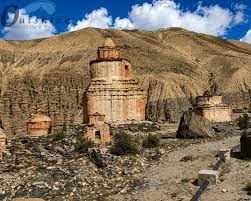
Lo Manthang is one of the most extraordinary historic settlements in the Himalayas. Located in Upper Mustang, northern Nepal, it served as the capital of the former Kingdom of Lo and remains one of the best-preserved walled settlements of the Tibetan cultural world.
Although it is sometimes romantically described as a “hidden kingdom,” Lo Manthang was never historically isolated in the absolute sense. Its location along important mountain routes gave it strategic and economic importance. The city developed within a wider network connecting the Tibetan Plateau, Nepal, and South Asia.
Constructed during the fifteenth century at an elevation of approximately 3,800 meters, Lo Manthang became the political, religious, and cultural center of the Kingdom of Lo. Its earthen walls, palace, monasteries, compact houses, religious monuments, and surrounding agricultural landscape preserve an exceptional example of a Himalayan urban settlement.
The Founding of the Kingdom of Lo
The Kingdom of Lo emerged during the fifteenth century under its founder, Ame Pal.
The creation of a political center in Upper Mustang reflected the strategic importance of the region.
Control over Mustang meant influence over mountain routes connecting Tibet and Nepal.
The kingdom developed its own political identity while maintaining strong cultural relationships with the Tibetan world.
Lo Manthang became the royal capital and the symbolic center of the kingdom.
A Walled City in the Himalayas
One of the most distinctive features of Lo Manthang is its defensive wall.
The settlement is surrounded by a substantial earthen enclosure approximately six meters high, reinforced with towers at strategic points.
Within the walls, houses and religious buildings form a compact urban landscape.
The wall served several possible purposes.
It could provide:
defense;
protection from conflict;
control over movement;
symbolic separation between the capital and surrounding settlements;
and protection in the harsh mountain environment.
The existence of a fortified capital demonstrates the political organization and resources of the Kingdom of Lo.
Building with Earth
Lo Manthang's architecture reflects the materials available in its high-altitude environment.
Many structures were constructed using earth-based techniques.
Building with earth required extensive knowledge.
Workers had to understand:
the properties of local soils;
methods of compaction;
wall thickness;
protection against water damage;
and maintenance.
Earthen architecture can survive for centuries in dry climates, but it requires continual care.
Rain, snow, wind, earthquakes, and modern development can all threaten historic structures.
The Royal Palace
The royal palace of Lo Manthang served as a symbol of political authority.
A palace was not simply a residence.
It could also function as a center for:
administration;
ceremonies;
meetings;
storage;
and royal representation.
Its location within the walled settlement reinforced the relationship between political power and urban space.
Buddhist Monasteries
Religion formed a central part of life in Lo Manthang.
The city contains important Buddhist monasteries, including Jampa Lhakhang and Thubchen Lhakhang, associated with the early history of the settlement.
These monasteries preserve important artistic and religious traditions.
They contain:
religious paintings;
sculptures;
ritual spaces;
and architectural features connected with Tibetan Buddhist practice.
The religious institutions of Lo Manthang were closely connected with the cultural traditions of Tibet, particularly the Sakya tradition of Tibetan Buddhism.
The Importance of Wall Paintings
Himalayan monasteries often preserve elaborate murals.
These paintings could depict:
Buddhas;
bodhisattvas;
protective deities;
religious teachers;
cosmological scenes;
and complex narrative traditions.
The creation of a mural required specialized knowledge of pigments, preparation of wall surfaces, composition, and religious iconography.
Because paintings are vulnerable to moisture, smoke, structural damage, and human activity, their preservation requires careful conservation.
Lo Manthang and the Salt Routes
The historical importance of Lo Manthang was closely related to Mustang's position along routes connecting Tibet and Nepal.
Trade across the Himalayas involved the exchange of complementary resources.
Goods moving through the region included:
salt;
grain;
wool;
livestock products;
textiles;
and other commodities.
The kingdom benefited from its location near these routes.
Trade brought not only wealth but also information, artistic influences, religious ideas, and connections with distant communities.
Agriculture in a High-Altitude Kingdom
Despite its dramatic desert-like landscape, Upper Mustang supported agricultural communities.
Fields were cultivated where water could be controlled through irrigation.
Agriculture required careful management because the growing season was limited.
Communities needed to coordinate:
irrigation;
planting;
harvesting;
food storage;
and the use of scarce land.
Barley and other hardy crops could be particularly important in such environments.
A Living Tibetan Cultural Landscape
Lo Manthang is not merely an archaeological ruin.
It remains part of a living cultural landscape.
The people of the region maintain traditions shaped by centuries of interaction with the Tibetan world.
Religious festivals, rituals, architecture, language, and social practices continue to give the settlement cultural significance.
This creates a special challenge for preservation.
Conservation must protect historic structures while respecting the fact that communities continue to live and worship within them.
Isolation and Preservation
Upper Mustang remained highly restricted to outside visitors until 1992.
This relative isolation contributed to the preservation of many traditional cultural features.
However, preservation does not mean that the region remained unchanged.
Modern roads, tourism, construction, migration, and economic change continue to influence the area.
The challenge is to manage these changes without destroying the cultural heritage that makes Lo Manthang unique.
Why Lo Manthang Matters
Lo Manthang is important because it preserves an unusually complete example of a historic Himalayan capital.
Its significance includes:
fortified urban planning;
earthen architecture;
royal political history;
Tibetan Buddhist monuments;
trade-route connections;
and living cultural traditions.
The settlement provides an exceptional opportunity to study how political authority, religion, architecture, and trade were connected in the Himalayan world.
Conclusion
Lo Manthang was the capital of a mountain kingdom, but it was also a crossroads.
Its walls protected a compact city of houses, monasteries, and royal institutions, while the trade routes surrounding it connected Upper Mustang with Tibet and South Asia.
Today, Lo Manthang remains one of the most remarkable historic settlements in the Himalayas. Its survival allows modern visitors and researchers to encounter a living cultural landscape shaped by the political ambitions, religious traditions, environmental adaptations, and trade networks of centuries