Tsarang, also spelled Charang, is one of the major historic settlements of Upper Mustang and an important center of Tibetan Buddhist culture. Located along the route between southern Mustang and Lo Manthang, the settlement developed as part of the political and religious landscape of the former Kingdom of Lo.
The title “Tsarang Monastery” can refer broadly to the religious heritage of the settlement, which includes historically important monastic architecture and painted interiors. Medieval Himalayan wall paintings are particularly valuable because they preserve complex visual traditions associated with Buddhism, royal patronage, regional artistic exchange, and religious practice.
The study of Tsarang's religious heritage also helps explain how the Kingdom of Lo maintained cultural connections with Tibet while developing its own political identity within the Himalayan landscape.
Tsarang in the Kingdom of Lo
Tsarang occupied an important position within Upper Mustang.
The settlement lay along routes connecting different villages and eventually the royal capital at Lo Manthang.
As the Kingdom of Lo developed during the fifteenth century, religious institutions became closely connected with political authority.
Monasteries were not merely places for private worship.
They could function as centers of:
education;
manuscript preservation;
artistic production;
ritual activity;
and community organization.
The Role of Monasteries
A Buddhist monastery required a complex network of people and resources.
Monks and religious specialists needed support from local communities and political patrons.
The construction and maintenance of a monastery involved:
architects;
builders;
carpenters;
painters;
sculptors;
donors;
and religious authorities.
This made monasteries important institutions within the social and economic life of the region.
The Art of Himalayan Wall Painting
Wall paintings were among the most visually powerful forms of religious expression.
Artists could cover temple interiors with complex scenes representing Buddhist cosmology.
Common subjects included:
Buddhas;
bodhisattvas;
lineage teachers;
protective deities;
mandalas;
religious narratives;
and symbolic landscapes.
These images were not simply decorative.
They formed part of the religious environment in which rituals and meditation took place.
Preparing a Painted Wall
The creation of a mural involved several stages.
First, the wall surface had to be prepared.
Layers of plaster or fine finishing materials could create a suitable painting surface.
Artists then planned the composition.
Major figures and geometric structures needed to be positioned according to established religious conventions.
Pigments were applied using mineral and organic materials available through local or long-distance supply networks.
Religious Iconography
Buddhist images followed systems of symbolism.
The position of a figure, the objects held in its hands, the color of its body, and its relationship to surrounding figures could all carry meaning.
A religious artist therefore needed more than technical skill.
The artist also needed knowledge of iconographic traditions.
In some cases, painters worked according to detailed visual models transmitted across generations.
Connections with Tibetan Art
Upper Mustang belonged to a wider cultural world shaped by the Tibetan Plateau.
Artistic traditions could travel through:
monasteries;
pilgrimage;
trade;
royal patronage;
and the movement of artists.
The wall paintings of Mustang therefore form part of a broader Himalayan artistic history.
At the same time, local artists could adapt imported traditions to local materials and regional preferences.
The Importance of Preservation
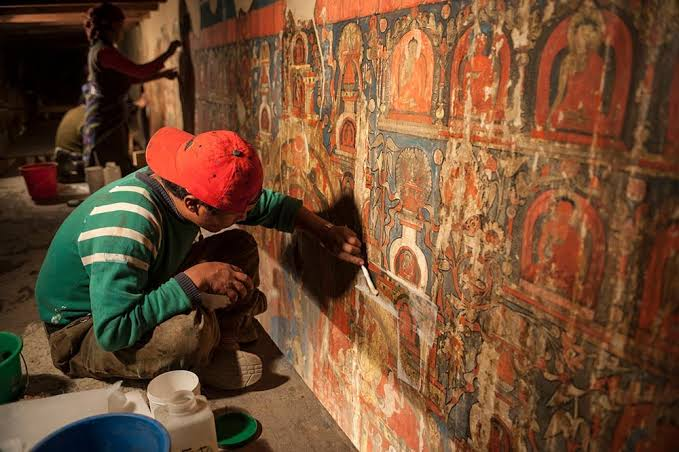
Ancient wall paintings are extremely fragile.
They can be damaged by:
water infiltration;
earthquakes;
smoke;
insects;
temperature changes;
structural collapse;
and human contact.
Conservation is therefore a complicated process.
Restorers must stabilize damaged areas without erasing evidence of the original artwork.
Modern conservation also involves documentation so that future researchers can study the paintings even if parts of the original surface deteriorate.
Monasteries as Historical Archives
Monasteries can preserve more than paintings.
They may contain:
manuscripts;
religious sculptures;
ritual objects;
historical records;
and donated objects.
Together, these materials provide evidence for political and religious relationships across the Himalayan world.
A monastery can therefore function as an archive of centuries of cultural history.
Tsarang and the Trade Routes
The cultural development of Tsarang was influenced by Upper Mustang's position along mountain routes.
Trade allowed communities to obtain materials that were not locally available.
These could include:
pigments;
paper;
metals;
textiles;
and luxury objects.
The movement of merchants and pilgrims also encouraged the circulation of artistic and religious ideas.
Why Tsarang's Wall Paintings Matter
Medieval wall paintings provide direct evidence of how people visualized the religious universe.
They reveal:
artistic techniques;
theological ideas;
regional styles;
systems of patronage;
and cultural interaction.
Because Mustang's environment is relatively dry, some historic structures and paintings have survived that might have deteriorated more quickly elsewhere.
Conclusion
The religious heritage of Tsarang preserves an important chapter in the artistic history of Upper Mustang.
Its monastic traditions and painted interiors demonstrate the close relationship between Buddhism, political authority, artistic production, and community life.
The murals are not simply beautiful historical objects. They are visual records of a religious world shaped by centuries of interaction between the Kingdom of Lo, Tibet, and the wider Himalayan region.