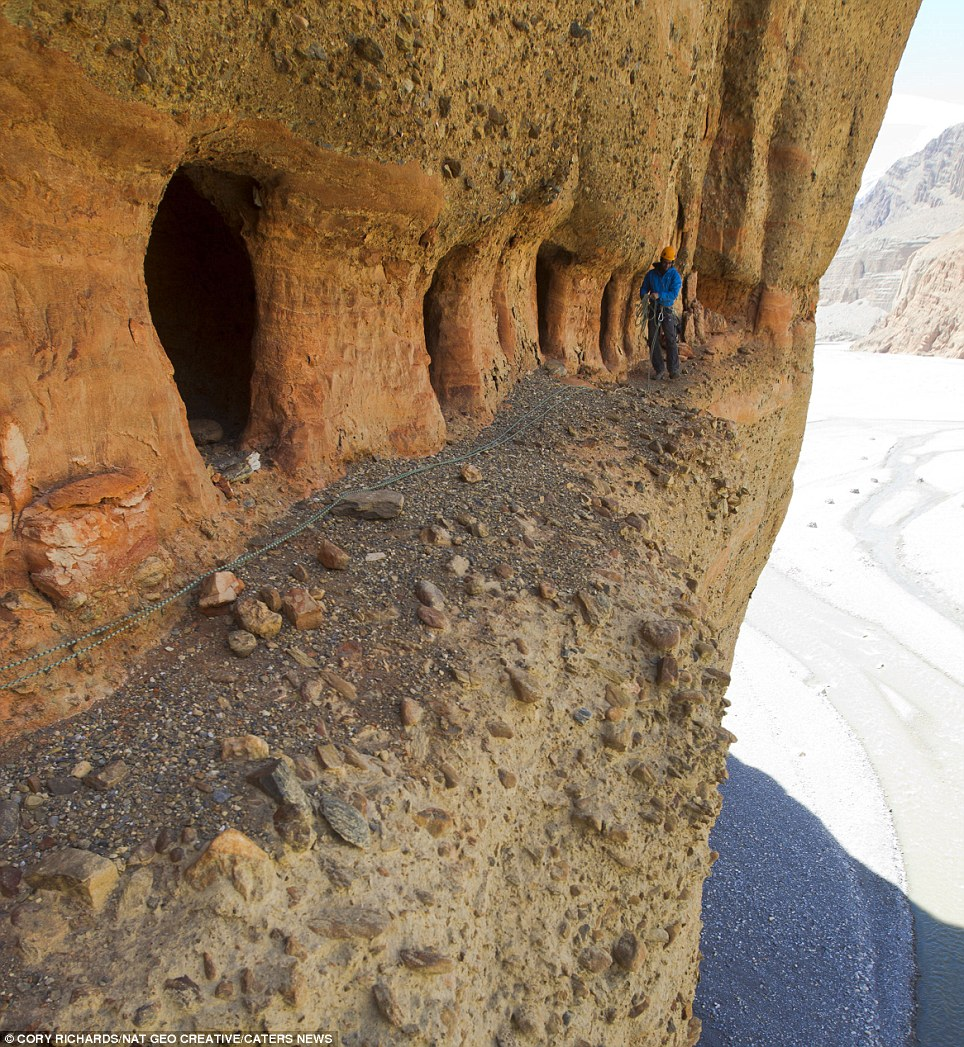
Samdzong, located in the remote highlands of Upper Mustang in Nepal, is one of the most remarkable archaeological landscapes in the Himalayas. The site is associated with ancient funerary caves and tombs positioned dramatically within the cliffs of the Kali Gandaki region. Archaeological discoveries there have revealed human remains, elaborate burial goods, gold masks, weapons, textiles, and other objects that provide rare evidence for life and death in the high Himalayas.
The title “Mustang's 3,000-Year Salt Traders” captures the broader historical importance of Mustang as a region connected to ancient trade routes. However, the archaeological evidence from Samdzong itself should be treated carefully. The excavated shaft tombs at Samdzong are primarily dated to the first millennium CE, especially between approximately the fifth and seventh centuries, while Mustang as a wider archaeological landscape contains evidence of much older human occupation and burial traditions. The Kali Gandaki corridor was also historically an important route linking the Tibetan Plateau with regions farther south, and salt was among the commodities that moved through these mountain networks.
Samdzong is therefore important not simply because of one spectacular archaeological discovery, but because it stands at the intersection of several major historical themes: high-altitude settlement, mortuary traditions, long-distance exchange, and the movement of people and materials through one of the world's most challenging landscapes.
The Landscape of Upper Mustang
Upper Mustang lies within the rain shadow of the Himalayas, creating a cold and relatively dry environment that differs dramatically from the greener regions of Nepal farther south.
The Kali Gandaki River runs through this landscape, forming a natural corridor between the Tibetan Plateau and the lower Himalayan regions.
For thousands of years, this corridor offered one of the most important routes through the mountains.
People moving through the region could transport goods such as:
salt;
grain;
wool;
animal products;
textiles;
metals;
spices;
and other valuable commodities.
The importance of the region as a communication route helps explain why human communities could survive and develop in such an apparently difficult environment. Mustang was not isolated from the wider world. Instead, its mountain valleys connected different cultural and economic zones.
The Discovery of the Samdzong Tombs
The archaeological significance of Samdzong became dramatically apparent after a seismic event damaged part of the cliff and exposed previously hidden tomb chambers.
Archaeological investigations revealed a complex of shaft tombs cut into the cliff environment.
The tombs were situated at an altitude of roughly 4,000 meters, making them among the most remarkable high-altitude mortuary sites studied in the Himalayas.
The discovery demonstrated that communities living in Upper Mustang possessed complex traditions concerning death and burial. These were not simple, isolated graves. Some chambers contained multiple individuals and a diverse collection of objects. Archaeological research indicates that the Samdzong tomb complex was used over several centuries, with most interments concentrated broadly within the middle of the first millennium CE.
A Community Burial Landscape
The Samdzong tombs appear to have served as collective mortuary spaces.
Rather than containing only a single elite individual, some chambers contained the remains of numerous people.
The archaeological evidence includes individuals of different ages and both sexes, indicating that the burial system served a broader community.
The dead were accompanied by objects that included both practical and prestigious materials.
These discoveries provide important information about:
population structure;
mortuary customs;
social relationships;
trade connections;
and technological practices.
The use of collective burial spaces also demonstrates that death was not merely an individual event. Burial may have reinforced relationships between families, communities, ancestors, and the wider social world.
Gold Masks and Elite Burial Objects
Among the most remarkable discoveries from Samdzong were metal artifacts, including gold and silver masks, copper vessels, iron daggers, brass ornaments, and other objects.
These discoveries demonstrate that even remote Himalayan communities participated in wider networks through which materials, technologies, and artistic styles circulated.
The presence of gold masks is particularly significant.
Gold is a prestige material that requires access to valuable resources and skilled craftspeople. The masks found at Samdzong also show stylistic relationships with objects from other parts of the Himalayan and Inner Asian world.
This suggests that the people of Upper Mustang were connected to broader cultural networks rather than living in complete isolation.
Metal Technology in the High Himalayas
The Samdzong artifacts demonstrate considerable technological diversity.
Archaeologists recovered objects made from:
gold;
silver;
copper-based alloys;
iron;
and other materials.
The production and acquisition of these objects required complex systems.
Metalworking involved:
obtaining raw materials;
processing ores or acquiring finished metals;
producing tools and molds;
heating and shaping the materials;
and distributing the finished objects.
Not every object necessarily had to be manufactured locally. Some could have arrived through exchange.
This distinction is important because trade routes could move finished goods as well as raw materials.
Mustang and the Ancient Salt Trade
Salt was one of the most valuable commodities in many premodern mountain economies.
It was essential for human and animal health and could also be used in food preservation.
In the Himalayan world, areas of the Tibetan Plateau possessed access to salt resources, while communities farther south had agricultural products that could be exchanged.
This created economic relationships in which caravans moved across mountain passes carrying different goods.
Mustang became historically important because the Kali Gandaki corridor connected the Tibetan world with Nepal and regions farther south.
The Kora La pass and other routes enabled the movement of people and goods across the Himalayas. Over long periods, Mustang became associated with trade in salt, grain, wool, dried foods, and other products.
Life at High Altitude
Living at approximately 4,000 meters above sea level required extensive adaptation.
Communities had to manage:
low oxygen levels;
cold temperatures;
limited agricultural land;
difficult transportation;
and seasonal changes.
Archaeological evidence from the wider Mustang region indicates that communities combined different strategies for survival.
These could include:
agriculture in suitable areas;
animal husbandry;
seasonal movement;
trade;
and the careful management of limited resources.
Research on Himalayan burial sites has also shown that communities in the region cultivated crops such as barley and buckwheat while maintaining livestock adapted to high-altitude conditions.
The Importance of Trade Networks
The objects found at Samdzong reveal that high-altitude communities could participate in surprisingly extensive exchange networks.
A mountain settlement did not need to produce every material it used.
Instead, communities could exchange local resources and agricultural products for goods obtained from distant regions.
Trade could move:
metals;
ornaments;
glass;
textiles;
salt;
livestock products;
and ceremonial objects.
These networks connected Mustang with the Tibetan Plateau, South Asia, and other parts of Inner Asia.
Archaeology and the Problem of Preservation
Samdzong also demonstrates the vulnerability of archaeological sites.
The cliff environment that protected the tombs for centuries could also become dangerous.
Earthquakes and natural erosion can damage burial chambers and disturb the original arrangement of objects and human remains.
Once archaeological context is disturbed, interpretation becomes more difficult.
Researchers must carefully reconstruct:
where objects originally came from;
whether they were placed intentionally;
how chambers were organized;
and how later events altered the evidence.
Why Samdzong Matters
Samdzong provides rare evidence for the prehistoric and early historical communities of the Himalayas.
The site demonstrates that mountain populations possessed:
complex burial traditions;
access to prestige materials;
connections to long-distance trade;
sophisticated metal objects;
and social systems capable of maintaining collective mortuary spaces.
The discovery challenges the idea that high mountain communities were isolated or culturally simple.
Conclusion
Samdzong is a remarkable archaeological window into the ancient human world of Upper Mustang.
Its tombs, human remains, gold masks, metal objects, and other artifacts reveal communities connected to wider systems of trade and cultural exchange.
Although the site's famous tomb complex should not be simplified into a literal 3,000-year-old salt-trading settlement, Mustang itself had a much deeper prehistoric history and became an important corridor for movement between Tibet and South Asia.
Samdzong reminds us that even in the extreme landscapes of the Himalayas, human communities built networks, maintained traditions, buried their dead with elaborate objects, and participated in a world far larger than their mountain valleys.