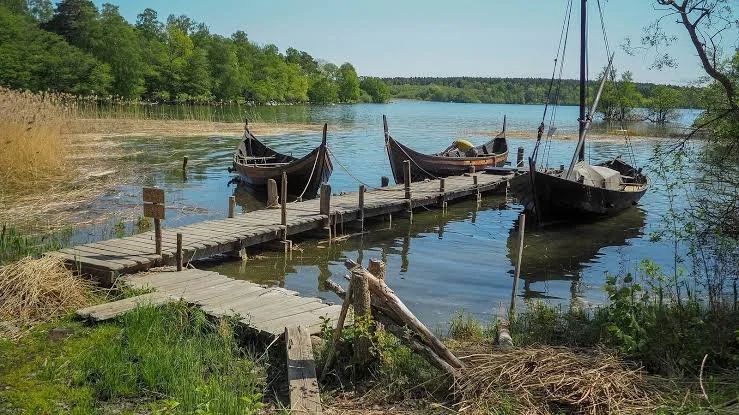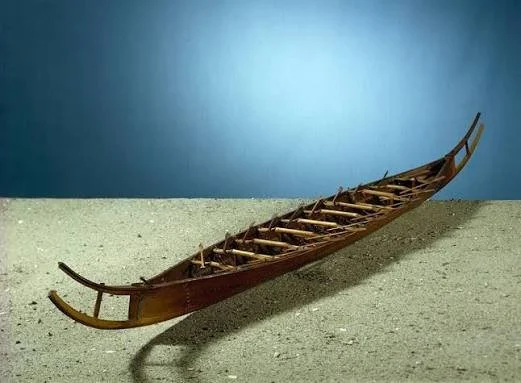
The Lærdal region of Norway belongs to a broader Scandinavian landscape in which maritime imagery and Bronze Age communication routes played an important role. References to Bronze Age boats in this context illustrate one of the defining features of prehistoric Scandinavian culture: the importance of waterways in connecting communities separated by mountains and difficult terrain.
Water as a Highway
Modern maps can make mountainous Norway appear fragmented. For prehistoric communities, however, the sea and waterways could provide efficient transportation.
A boat allowed people to move along fjords and coastlines while avoiding difficult overland routes.
This made maritime technology central to economic life.
Bronze Age Boat Technology
Bronze Age Scandinavian boats were generally constructed from wood using techniques that differed from later clinker-built Viking ships.
Archaeological evidence indicates that prehistoric boatbuilders possessed sophisticated knowledge of timber selection and hull construction.
The surviving evidence is limited because wood normally decomposes. Rock carvings therefore provide an additional source of information.
Boat Images as Historical Evidence
A carved ship cannot reveal every technical detail of the original vessel, but it can demonstrate that particular hull forms and maritime concepts existed.
The images may show the general shape of the vessel, raised ends, crew arrangements, or equipment.
When combined with archaeological boat finds, these representations help reconstruct prehistoric maritime technology.
Maritime Exchange
Boats allowed Bronze Age communities to participate in long-distance networks.
Northern Europe was connected through the exchange of metals, amber, stone, ceramics, and other materials.
Norwegian coastal communities were therefore not isolated. They belonged to networks extending across Scandinavia and beyond.
Ritual Journeys
The ship's symbolic importance is particularly intriguing.
In later Scandinavian traditions, ships were associated with death, journeys, and supernatural movement. Bronze Age burials occasionally incorporated boat imagery or actual boats.
This suggests that maritime technology could have acquired religious significance.
However, direct continuity between Bronze Age symbolism and later Viking beliefs cannot simply be assumed. Archaeologists must instead recognize recurring themes while respecting chronological differences.
Lærdal in Context
The importance of Bronze Age boat traditions in Lærdal lies in the way they illuminate the relationship between geography, technology, economy, and belief.
The mountains did not isolate prehistoric communities completely. Waterways created corridors through the landscape.
Boats transformed geography into a network of connections, enabling people, materials, ideas, and cultural practices to move across considerable distances.