The Majiayao culture is one of the most important Neolithic archaeological traditions of northwestern China. Flourishing primarily in the upper Yellow River region, especially in parts of present-day Gansu and Qinghai, the culture is famous for its beautifully painted pottery.
Majiayao ceramics are remarkable not only because of their artistic quality but because they provide evidence for the social, technological, and cultural development of Neolithic communities in northwestern China.
The painted vessels demonstrate that prehistoric art was not limited to monumental structures or elite societies. Everyday objects could also become highly sophisticated expressions of cultural identity.
The Majiayao Culture
The Majiayao culture developed during the later Neolithic period and represented a major regional tradition in the upper Yellow River region.
Its communities practiced agriculture and produced a distinctive range of ceramic vessels.
The culture is often divided into different phases based on changes in pottery style.
These include traditions such as:
Majiayao,
Banshan,
and Machang.
The changing styles allow archaeologists to study cultural development over time.
Why Pottery Was Important
Pottery transformed daily life.
Ceramic vessels could be used for:
cooking,
storing food,
carrying liquids,
processing agricultural products,
and serving meals.
Unlike many organic containers, pottery can survive for thousands of years when buried.
As a result, ceramic fragments are among the most common materials found at archaeological sites.
The Painted Designs
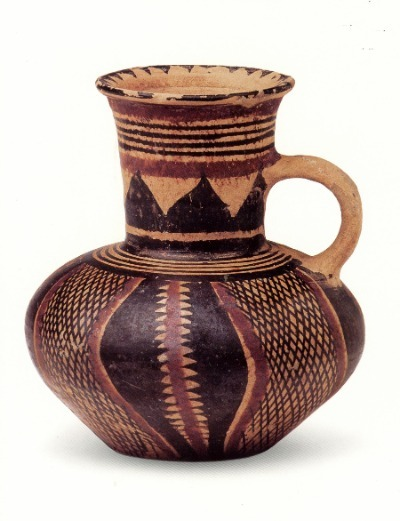
Majiayao pottery is famous for its painted geometric and curvilinear patterns.
Artists often used dark pigments to create:
spirals,
lines,
circles,
waves,
triangles,
and other abstract forms.
The patterns could cover large portions of the vessel.
The resulting designs demonstrate careful planning and a sophisticated sense of composition.
How the Pottery Was Made
Creating a painted ceramic vessel involved several stages.
1. Collecting and Preparing Clay
Potters first needed suitable clay.
The material could be cleaned and mixed with temper such as sand or crushed material to improve its working properties.
2. Shaping the Vessel
The vessel could be formed through hand-building techniques such as:
coiling,
pinching,
or shaping prepared clay.
The exact method depended on local traditions.
3. Drying
The newly formed vessel needed to dry before firing.
If heated too quickly while still wet, trapped moisture could cause cracking or breakage.
4. Applying Decoration
Pigments were applied to create the characteristic painted designs.
The artist needed to control the thickness and placement of the paint.
5. Firing
The vessel was heated in a firing environment.
Controlling temperature and oxygen affected the final appearance and durability of the pottery.
Pottery as Cultural Identity
Pottery styles can help archaeologists identify cultural traditions.
A community may share particular preferences for:
vessel shapes,
decorative patterns,
manufacturing techniques,
and firing methods.
However, pottery should not automatically be treated as proof of ethnicity.
Styles can spread through trade, imitation, marriage, and cultural interaction.
Nevertheless, shared pottery traditions can provide important evidence for social connections.
Agriculture and Majiayao Society
Majiayao communities lived during a period when agriculture was becoming increasingly important.
Farming provided more reliable access to certain foods and allowed communities to establish longer-term settlements.
Agricultural production also supported population growth and increased social complexity.
However, farming communities remained dependent on environmental conditions.
Drought, floods, and changes in climate could affect food production.
Settlement and Community Life
Majiayao sites provide evidence for communities organized around households and shared cultural traditions.
Daily life would have involved:
food preparation,
farming,
tool production,
pottery making,
child care,
construction,
and social activities.
The decorated pottery that survives today represents only one part of a much larger material world that included wood, textiles, baskets, and other organic materials that often did not survive.
The Banshan and Machang Phases
Later developments of the Majiayao tradition produced increasingly elaborate ceramic decoration.
The Banshan phase is particularly associated with complex and carefully arranged designs.
The Machang phase developed different stylistic traditions, demonstrating that artistic preferences changed over time.
These changes may reflect:
cultural innovation,
population interaction,
shifting social identities,
or changes in regional communication.
Art Before Writing
The Majiayao culture existed long before the widespread use of writing in the region.
The painted pottery therefore represents a form of visual expression from a society that did not leave historical texts explaining its artistic choices.
This creates an important challenge.
Modern observers can describe the patterns, but the original meanings may remain unknown.
A spiral or geometric design may have been:
purely decorative,
symbolic,
connected with social identity,
or associated with beliefs that have been lost.
Why Majiayao Pottery Matters
Majiayao pottery is important because it demonstrates the artistic sophistication of Neolithic societies.
These communities were not culturally simple or technologically primitive.
They possessed knowledge of:
ceramics,
agriculture,
design,
material selection,
and high-temperature firing.
The pottery also provides one of the best archaeological records for studying cultural development in northwestern China.
Majiayao and the Broader History of China
The Majiayao culture formed part of a long prehistoric process that eventually contributed to the emergence of more complex societies across China.
Different regions developed distinctive traditions.
The history of ancient China was therefore not created by a single isolated civilization.
It emerged through the interaction of numerous regional communities with their own technologies, artistic traditions, and economic systems.
Conclusion
The painted pottery of the Majiayao culture is one of the great artistic achievements of Neolithic China.
Its spirals, curves, geometric patterns, and carefully constructed forms demonstrate that prehistoric communities possessed sophisticated artistic traditions long before the development of writing and imperial states.
More than simple household containers, these vessels preserve evidence of technological knowledge, cultural identity, and creative expression.
Today, Majiayao pottery remains an essential archaeological record of the communities that lived along the upper Yellow River thousands of years ago—and a reminder that some of humanity's earliest artistic traditions were created not in palaces or monuments, but in the everyday objects used by ordinary people.