The Qijia culture occupies an important place in the archaeological history of northwestern China because it emerged during a period of major technological and social change. Flourishing broadly during the late third and early second millennium BCE in regions of present-day Gansu and Qinghai, the Qijia culture belonged to the transitional world between the late Neolithic and the Early Bronze Age. Its settlements, cemeteries, pottery, stone tools, animal remains, and early metal objects provide valuable evidence for understanding how communities in northwestern China adapted to new technologies and participated in expanding networks of cultural exchange.
The importance of the Qijia culture lies partly in its geographical position. Northwestern China formed a vast contact zone linking the Yellow River region with Inner Asia, the Tibetan Plateau, and areas farther west. Ideas, materials, domesticated animals, and technologies could move across these landscapes over long periods. The Qijia culture therefore cannot be understood as an isolated society. It developed within a broader prehistoric world in which farming communities, pastoral populations, and increasingly specialized craftspeople interacted with one another.
Although it is often described as an “Early Bronze” culture, the Qijia people did not suddenly abandon older technologies. Stone, bone, pottery, and organic materials continued to play essential roles in daily life. Bronze and copper objects represented an important technological development, but they existed alongside older traditions. This combination makes Qijia particularly valuable for studying how technological change actually occurred: gradually, unevenly, and within societies that continued to depend on familiar materials and practices.
The Geographic Setting of the Qijia Culture
The archaeological sites associated with the Qijia culture are concentrated primarily in the upper Yellow River region and surrounding areas of modern Gansu and Qinghai. This landscape includes river valleys, loess plateaus, mountain corridors, and environments leading toward the Tibetan Plateau.
The availability of rivers and fertile valleys made agriculture possible, while surrounding grasslands and upland environments supported animal husbandry. Communities could therefore combine different economic strategies rather than relying entirely on a single source of food.
The region's location was equally important from a cultural perspective. Northwestern China stood along routes through which people and materials could travel between East Asia and Inner Asia. Archaeological evidence from this wider region has contributed to discussions about the movement of:
metallurgical knowledge;
domesticated animals;
cereal crops;
technological practices;
artistic styles;
and ideas concerning social organization.
The Qijia culture developed within this dynamic frontier zone.
Qijia Settlements and Community Life
Archaeological sites associated with the Qijia culture include settlements containing evidence of houses, storage areas, hearths, tools, pottery, and other remains of everyday life.
Many prehistoric houses in northwestern China were partly constructed below ground level or incorporated sunken floors. Such structures could provide insulation and protection from changing weather conditions. Walls and roofs may have incorporated timber, earth, reeds, or other organic materials that rarely survive archaeologically.
Archaeologists often reconstruct houses through indirect evidence such as:
postholes;
compacted floors;
hearth remains;
wall trenches;
concentrations of artifacts;
and changes in soil color.
These traces allow researchers to understand how domestic spaces were organized even when the original wooden structures have disappeared.
Agriculture and Animal Husbandry
The Qijia economy appears to have depended on a combination of farming and animal husbandry.
Earlier agricultural traditions in northern China had long relied heavily on millet cultivation. Millet was particularly well suited to many dryland environments and could be cultivated without the intensive irrigation systems associated with later agricultural societies.
Animal husbandry also played an important role. Archaeological studies of animal remains indicate the significance of domesticated livestock, while hunting may have continued to supplement food supplies.
The combination of agriculture and herding provided communities with a flexible economic system. Farmers could cultivate crops in suitable areas while livestock could exploit grasslands and environments less appropriate for intensive agriculture.
The Introduction of Metal Technology
One of the most important features associated with the Qijia culture is the presence of early metal objects.
Copper and bronze artifacts demonstrate that communities in northwestern China were increasingly participating in the development of metallurgy. However, metallurgy was not a simple replacement for stone technology.
Stone tools remained useful and widely employed.
The development of metalworking involved several complicated stages:
obtaining metal-bearing ores;
extracting usable metals through heating and processing;
preparing molds or shaping tools;
controlling furnace temperatures;
casting or working the finished material;
sharpening and finishing the object.
Each stage required knowledge, labor, fuel, and access to resources.
The appearance of metal objects therefore reflects not only technological innovation but also expanding systems of exchange and specialization.
Qijia Pottery
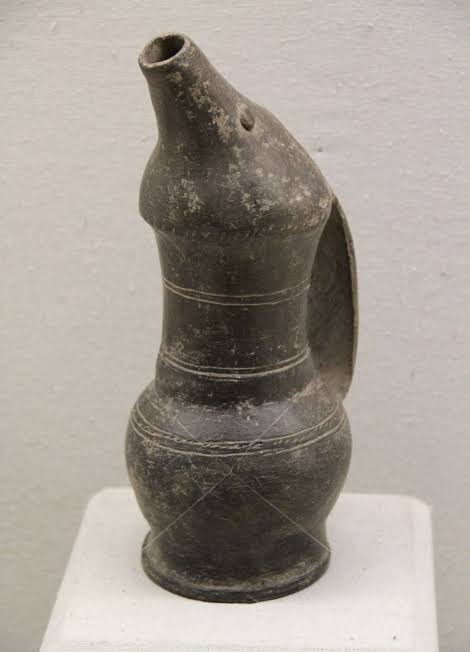
Ceramics remain among the most useful sources of information for archaeologists studying the Qijia culture.
Qijia pottery includes a variety of vessel forms created for practical activities such as:
cooking;
food storage;
serving;
and processing agricultural products.
Changes in vessel shape, decoration, manufacturing technique, and distribution help archaeologists distinguish cultural traditions and establish relative chronologies.
Pottery also reveals the practical realities of prehistoric life. A cooking vessel had to withstand repeated heating, while a storage jar needed sufficient capacity and structural stability.
The production of ceramics required detailed knowledge of:
clay selection;
tempering materials;
shaping techniques;
drying;
and firing conditions.
Burial Practices and Social Differences
Qijia cemeteries provide evidence about prehistoric attitudes toward death and social identity.
Burials may differ in terms of:
grave construction;
body position;
associated objects;
and the amount of labor invested in the burial.
Such differences can sometimes suggest distinctions in age, gender, family status, wealth, or social position.
However, archaeologists must be careful not to interpret every rich burial as evidence of a permanent ruling class. Burial practices are shaped by religious beliefs and cultural traditions as well as social hierarchy.
Nevertheless, the distribution of prestige goods and specialized objects can provide clues about the development of inequality.
Connections with Inner Asia
The Qijia culture is especially important to discussions concerning interaction between ancient China and regions farther west.
Northwestern China was not separated from Inner Asia by an impenetrable boundary. Mountain corridors, river valleys, and grassland routes allowed movement over long periods.
Archaeologists have investigated whether developments in:
metallurgy;
animal husbandry;
crop cultivation;
and material culture
reflect local innovation, outside influence, or a combination of both.
The evidence increasingly demonstrates that prehistoric societies were capable of long-distance interaction long before the historical Silk Road.
The Qijia Culture and the Beginning of the Bronze Age
The term “Bronze Age” can sometimes create the misleading impression that an entire society immediately became dominated by metal.
The Qijia culture demonstrates a more realistic process.
Metal objects appeared within communities that still relied heavily on:
stone tools;
ceramic technology;
farming;
animal husbandry;
and traditional forms of settlement.
Technological change was therefore cumulative.
New materials were incorporated into existing social systems rather than instantly replacing them.
Why the Qijia Culture Matters
The Qijia culture provides evidence for one of the most important transitions in prehistoric East Asia.
It allows archaeologists to investigate:
the development of early metallurgy;
changing agricultural systems;
animal husbandry;
social organization;
settlement patterns;
and long-distance cultural interaction.
The culture also demonstrates that northwestern China played an active role in prehistoric technological exchange.
Conclusion
The Qijia culture represents a fascinating chapter in the transition from the Neolithic world to the Early Bronze Age in northwestern China.
Its communities cultivated crops, raised animals, produced pottery, maintained established stone technologies, and increasingly experimented with or adopted metalworking. Situated between the agricultural heartlands of northern China, the Tibetan Plateau, and Inner Asia, the Qijia world became part of a much larger network of prehistoric interaction.
Rather than representing a sudden technological revolution, Qijia archaeology reveals the gradual transformation of human societies as new materials, skills, and economic relationships were incorporated into everyday life.